:format(webp))

One of the most common questions from new traders is:
"How much money do I need to start trading gold?"
There are actually two different ways to answer this question.
How much money do you need to open a trade?
How much capital do you need to manage trading risk?
These are not the same number.
Because XAUUSD can be traded using leverage, the margin required to open a position may appear relatively small.
But the more important question is:
If the gold price moves against your position, how much can your trading account afford to lose?
Quick Answer: How Much Capital Do You Need to Trade Gold?
There is no single amount of money that is suitable for every trader.
The capital you need depends on factors such as:
Your lot size
Your Stop Loss distance
How much money you are willing to risk per trade
The minimum position size available
The volatility of XAUUSD
Based on the example framework used in the source content, a trading account of approximately $500–$1,000 may provide more flexibility for managing risk and adjusting lot size and Stop Loss levels than a very small account.
However:
This is not a guaranteed profit threshold.
The purpose of having more trading capital is not necessarily to trade larger positions.
It can provide:
More room to manage risk.
Margin Is Not the Same as Risk
This is one of the most important concepts for beginners to understand.
What Is Margin?
Margin is a portion of your funds required by a trading provider to open and maintain a position.
However:
Margin does not tell you the maximum amount you could lose on a trade.
Using the example framework from the source content:
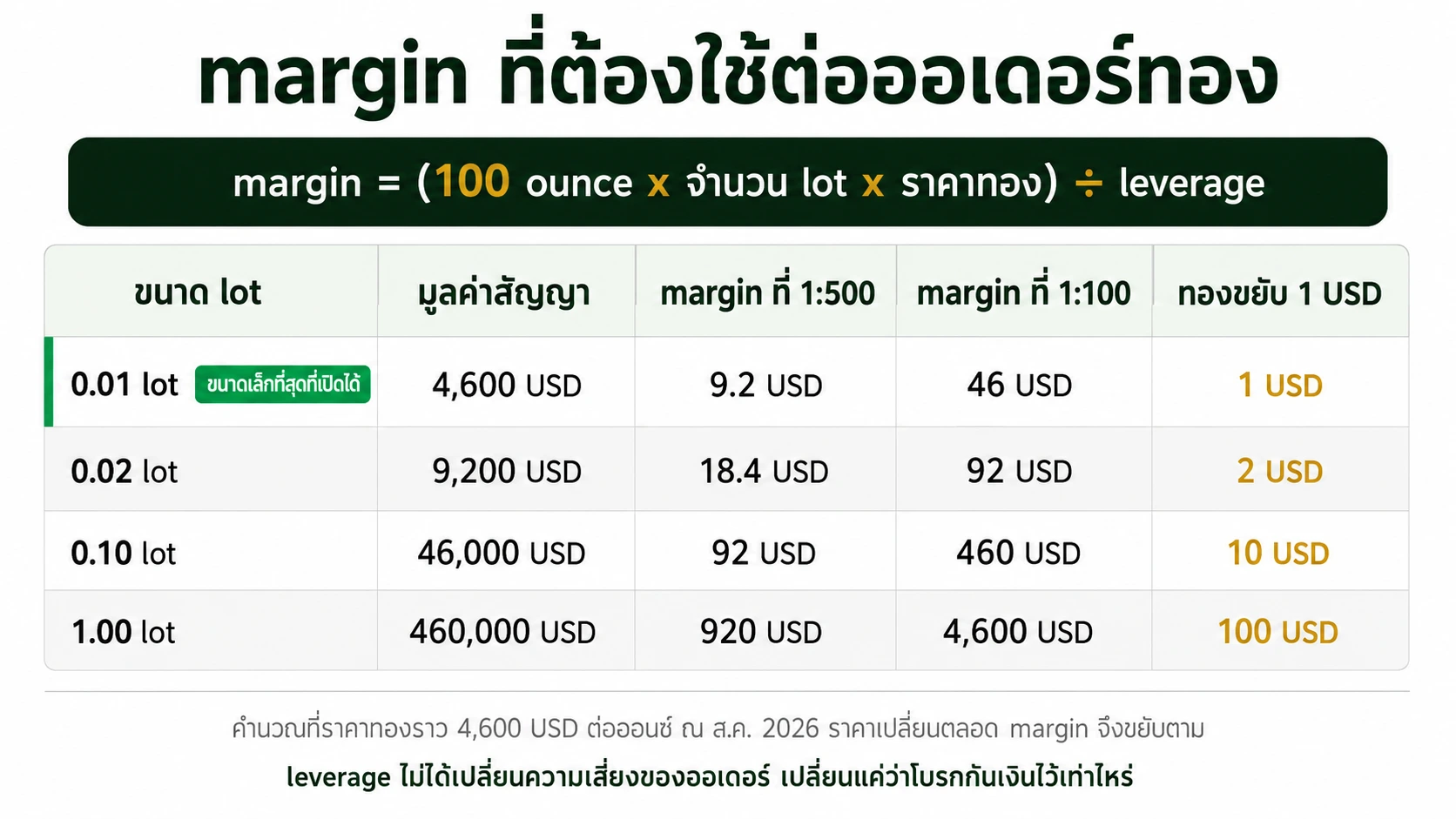
Margin = (100 ounces × Lot Size × Gold Price) ÷ Leverage
Let's assume:
Gold price: approximately $4,600
Position size: 0.01 lot
Leverage: 1:500
The calculation would be:
Margin = (100 × 0.01 × 4,600) ÷ 500
≈ $9.20
This might make it appear that:
"I only need around $10 to trade gold."
But now consider the actual price risk.
If you open 0.01 lot and the gold price moves $30 against your position, the approximate impact could be:
-$30
So:
Having $10 of margin available to open a trade does not mean that $10 is enough capital to manage the market's price movement.
Higher Leverage Does Not Mean Lower Risk
Leverage can reduce the amount of margin required to open a position.
However, it does not automatically reduce the financial impact of price movement on the lot size you trade.
For example, if you trade 0.10 lot of XAUUSD, the impact of gold price movement must still be considered based on the position size and contract specifications.
It helps to separate these two concepts.
Margin
The funds required to open and maintain a position.
Risk
The amount of money you could lose if the market moves against your position.
Higher leverage may make it easier to open a position, but it does not automatically make that position safer.
How Risky Is 0.01 Lot When Trading Gold?
Using the standard contract example in this guide:
1 standard lot = 100 ounces
The approximate impact of gold price movement would be:
Lot Size | Approximate Impact of a $1 Move | Approximate Impact of a $10 Move |
|---|---|---|
0.01 lot | ±$1 | ±$10 |
0.05 lot | ±$5 | ±$50 |
0.10 lot | ±$10 | ±$100 |
1.00 lot | ±$100 | ±$1,000 |
For example:
If you have a $100 trading account and open 0.01 lot, a $30 move against your position could result in an approximate:
$30 loss
That represents approximately:
30% of a $100 account
This is why the important question is not simply:
"Can I trade 0.01 lot?"
It is:
"Does 0.01 lot fit my account size and Stop Loss?"
The Better Way to Calculate How Much Capital You Need
Instead of starting with:
"I have this amount of money. What lot size can I trade?"
consider this order:
Stop Loss → Money You Are Willing to Lose → Lot Size → Required Capital
This is the basic logic behind risk management.
Step 1: Decide Where Your Stop Loss Should Be
Before entering a trade, ask:
If my analysis is wrong, where will I exit?
For example:
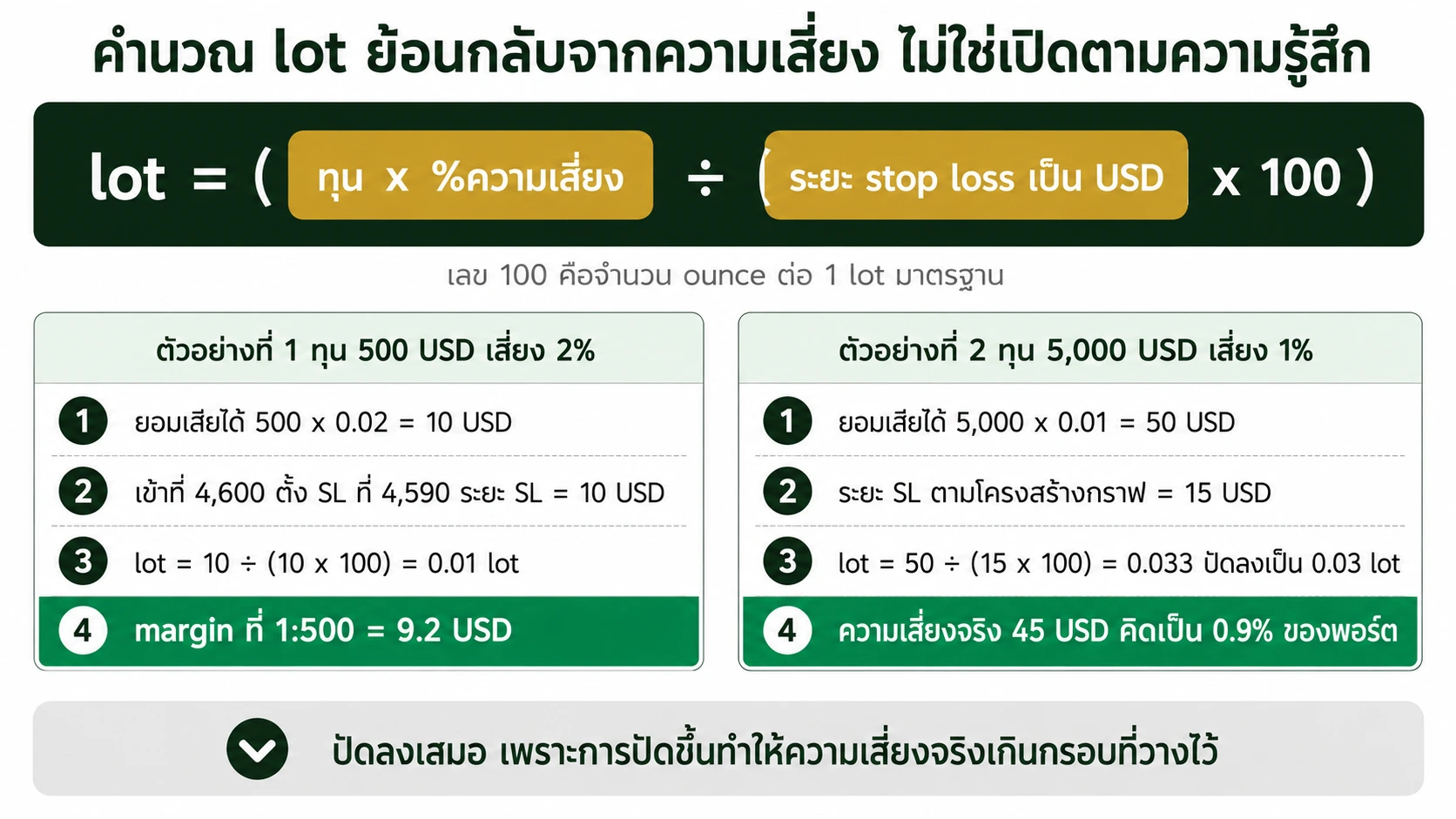
Buy entry: $4,600
Stop Loss: $4,590
The Stop Loss distance is:
$10
Step 2: Decide How Much You Are Willing to Risk
The source content uses approximately:
1–2% of your account per trade
as an example risk framework.
For example:
Trading account:
$500
Risk per trade at 2%:
$10
This means that if your trade reaches the Stop Loss, you are planning to limit the approximate loss to:
$10
Step 3: Calculate the Position Size
Let's use the following example:
Account size: $500
Maximum risk: $10
Stop Loss distance: $10
Using the example where:
0.01 lot has an approximate $1 impact for every $1 movement in gold
If gold reaches a Stop Loss that is $10 away, the approximate loss would be:
$10
This matches the planned 2% risk in this example.
The concept behind the formula is:
Lot Size = Amount You Are Willing to Lose ÷ (Stop Loss Distance × 100)
The 100 in this example comes from the standard contract size of 100 ounces per 1 lot used in this guide.
Always check the actual contract specifications provided by your trading provider.
How Much Capital Do You Need at Different Account Sizes?
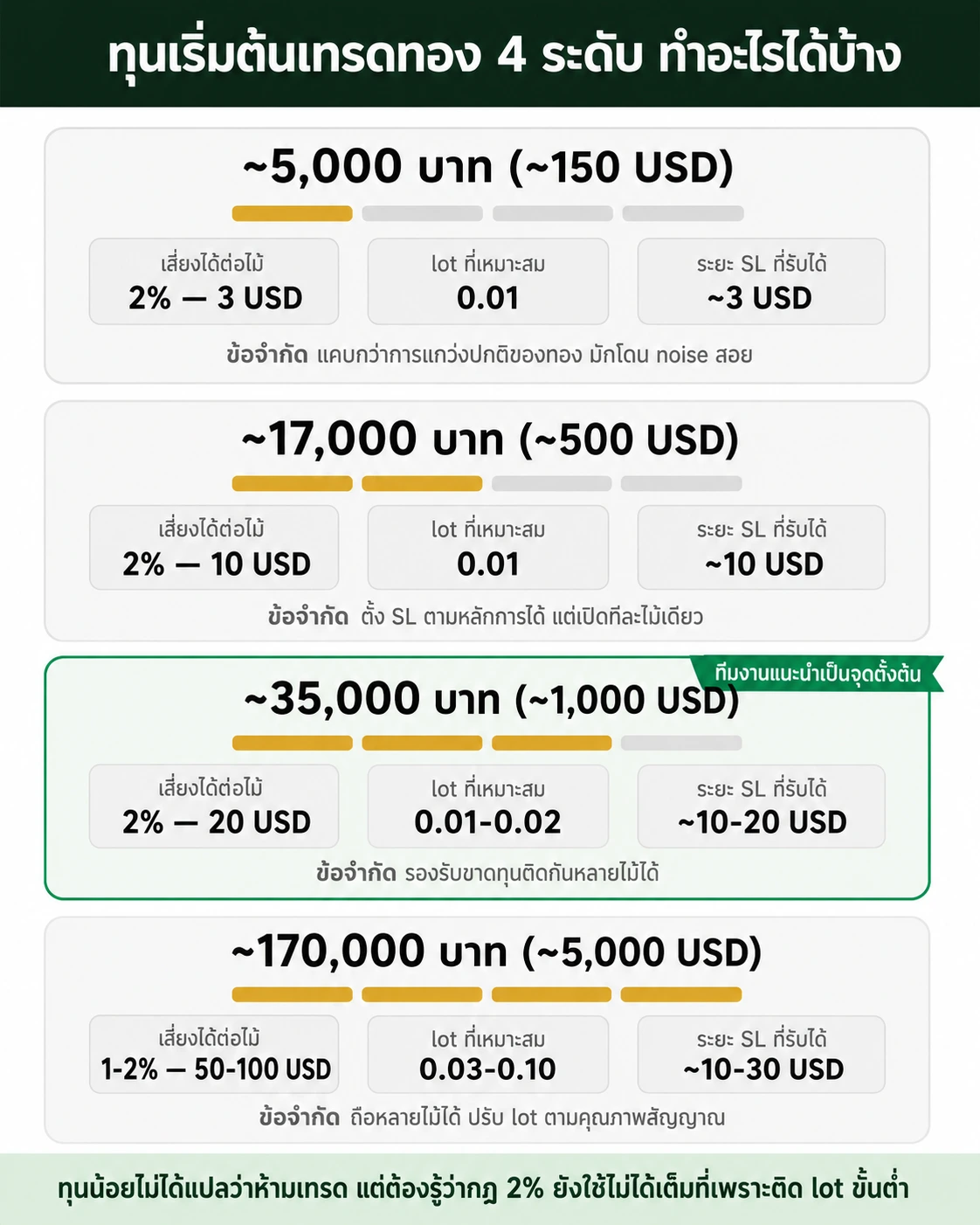
Based on the example framework from the source content:
Approximate Capital | 2% Risk | Main Consideration |
|---|---|---|
~$150 | $3 | Minimum lot size may make actual risk relatively high |
~$500 | $10 | May provide more room to use 0.01 lot with a practical Stop Loss |
~$1,000 | $20 | More flexibility when adjusting Stop Loss and position size |
~$5,000 | $100 | Greater flexibility across different trading scenarios |
This table does not mean that any of these account sizes will generate profits.
Instead, it illustrates an important idea:
More capital can provide more flexibility for risk management.
This can be particularly relevant when the minimum position size cannot be reduced further.
Can You Trade Gold With $150?
Technically, you may be able to open a trade depending on the account conditions.
But if you use a 2% risk framework:
$150 × 2% = $3
The challenge is that a minimum position size such as 0.01 lot may make it difficult to place your Stop Loss at a technically appropriate level while keeping your risk near $3.
For example:
Position size: 0.01 lot
Stop Loss distance: $10
The approximate risk could be:
$10
For a $150 account, that represents approximately:
6.67%
This means a very small account may provide less flexibility when trying to balance:
Position size
Stop Loss distance
Risk per trade
Can You Trade Gold With $500?
Using the example framework in this article:
A $500 account with a 2% risk limit would allow approximately:
$10 of planned risk per trade
In some situations, this may provide more flexibility when using a 0.01 lot minimum position size compared with a smaller account.
For example:
Planned risk: $10
Stop Loss distance: $10
Position size: 0.01 lot
However:
Having $500 does not automatically make trading safe.
Your actual risk still depends on your:
Lot size
Stop Loss
Market conditions
Trading process
Can You Trade Gold With $1,000?
Using a 2% example:
$1,000 × 2% = $20
A larger account may provide more flexibility to:
Adjust Stop Loss levels
Adjust position size
Handle market volatility without taking an excessively large percentage risk on each trade
Again:
More capital does not mean you should automatically trade larger lot sizes.
The goal is to maintain an appropriate relationship between account size and risk.
Can You Start Gold Trading With $100?
In some account conditions, you may technically be able to open a 0.01 lot position.
However, if gold moves:
$10 against your position
the approximate impact could be:
10% of a $100 account
This is why beginners should not focus only on whether they have enough margin to open a position.
Instead, consider:
Where is your Stop Loss?
How much will you lose if it is reached?
What percentage of your account does that represent?
What About Starting Gold Trading With a Small Amount of Money?
A small trading account may be used for purposes such as:
Practising with a limited amount of real money
Learning to follow a trading plan
Developing emotional discipline
Understanding how orders work in a live environment
However, a small account should not automatically be treated as a way to generate significant income quickly.
When capital is limited, traders may face pressure to:
Increase lot size
Take excessive risks
Try to recover losses quickly
Overtrade
These behaviours can make risk management more difficult.
Don't Forget Other Trading Costs
When calculating your trading capital, do not look only at potential profits and losses from price movement.
There may also be other costs.
Spread
The spread is a trading cost associated with opening a position.
It can vary depending on:
Account type
Trading provider
Market liquidity
Trading conditions
Swap or Overnight Financing
This may apply when positions are held overnight.
The cost can depend on:
The instrument
Position direction
The provider's conditions
Commission
Some account types may charge additional commissions.
This is why you should not compare trading accounts based on spread alone.
Currency Conversion and Deposit or Withdrawal Costs
These may depend on:
Payment method
Account currency
Trading provider
Check these conditions before using an account.
Trading Tools or System Costs
If you use:
Indicators
Trading tools
Automated systems
Subscription services
consider keeping this budget separate from the capital you are prepared to risk in the market.
Not every dollar in your trading budget should automatically be treated as available to absorb market losses.
What Money Should You Not Use for Trading?
The source content clearly highlights that money with essential obligations should not be treated as trading capital.
Examples include money intended for:
Education expenses
Car payments
Mortgage payments
Loan repayments
Emergency savings
The reason is not only financial.
It can also affect your decision-making.
If you feel:
"I have to make a profit before this bill is due."
you may begin trading under pressure rather than following your trading plan.
This can contribute to behaviours such as:
Increasing lot size
Refusing to close losing positions
Revenge trading
Opening too many trades
Trading capital should be money you can afford to expose to trading risk.
Do You Need More Capital to Trade Gold With an EA?
The answer depends on the strategy and settings of the automated system.
You should not automatically apply capital examples for manual trading to an EA or automated trading system.
Some systems may:
Open multiple positions
Increase the number of open trades
Use different lot sizes
Require additional margin as positions accumulate
Before using an automated system, consider:
The maximum number of positions it may open
The lot sizes involved
Total margin requirements
Potential drawdown
How the system adds or reduces positions
Automation does not remove the need for risk calculations.
Before using an EA, you should understand:
How much drawdown could occur if market conditions do not develop as expected?
FAQ: How Much Money Do You Need to Trade Gold?
Can I trade gold with $100?
You may technically be able to open a position depending on your account conditions.
However, the more important question is whether the minimum lot size allows you to keep your risk per trade within your planned limit.
Can I trade gold with $1,000?
A $1,000 account may provide more flexibility than a smaller account when adjusting position size and Stop Loss levels.
However, the appropriate lot size should still be calculated based on your risk plan.
Is $500 enough to start trading gold?
Using the example risk framework in this article, a $500 account may provide more room for risk management than a very small account.
However, whether it is sufficient depends on:
Minimum lot size
Stop Loss distance
Your risk limit
Trading conditions
How much should I risk per gold trade?
There is no single percentage that is suitable for every trader.
The source content uses approximately:
1–2% per trade
as an example framework.
The appropriate level depends on factors such as:
Your trading system
Account size
Trading frequency
Personal risk tolerance
Does higher leverage make gold trading safer?
No.
Higher leverage may reduce the margin required to open a position.
However:
It does not automatically reduce the potential profit or loss created by your position size.
Higher leverage should not automatically be considered a risk-reduction tool.
Should I increase my lot size when my account gets bigger?
Not automatically.
Position size should still be based on:
The amount you are willing to risk
Stop Loss distance
Contract specifications
Do not increase your lot size simply because:
"My account is larger now."
Final Thoughts: Don't Calculate Capital From Margin Alone
When asking:
"How much money do I need to trade gold?"
do not start with:
Margin
Start with:
Stop Loss → Money You Are Willing to Lose → Lot Size → Required Capital
The goal is not simply:
"Do I have enough money to open a trade?"
The more important question is:
"If the market moves against me, does my account give me enough room to follow my risk management plan?"
Before trading gold, make sure you understand:
The difference between margin and risk
How lot size affects your account
Why Stop Loss should be considered before position size
How to calculate risk per trade
Why essential living expenses should not be used as trading capital
Other costs associated with trading
Continue Learning
1. How to Trade Gold for Beginners
Learn the basics of XAUUSD, chart analysis, lot size, Stop Loss, and risk management.
2. Gold vs Forex Trading: Which Is Better for Beginners?
Compare XAUUSD and Forex currency pairs by volatility, lot size, market behaviour, and risk.
3. What Is the Best Time to Trade Gold?
Learn about trading sessions and periods when XAUUSD market activity may change.
4. How to Choose a Gold Trading Course
Compare different learning options before paying for a trading course.
If you would like to learn more about Indy Trader Academy's courses or tools, contact the team through LINE OA @indytrader.
Risk Warning: Forex and CFD trading, including XAUUSD, involves a high level of risk and you may lose all of your invested capital. Leverage can increase both potential profits and losses. Use only money you can afford to expose to trading risk. This content is provided for educational purposes only and should not be considered investment advice.
