:format(webp))

If you're searching for how to trade gold for beginners, one of the first things to understand is that gold trading does not start with trying to predict:
"Will gold go up or down today?"
A better place to start is by understanding:
What is XAUUSD?
How does lot size affect your trading account?
Where should you place a Stop Loss?
How much can you afford to lose if the trade goes against you?
For beginners, learning gold trading in the right order can help build a stronger foundation before risking real money.
Quick Answer: How Should Beginners Start Trading Gold?
A simple learning path is:
Understand XAUUSD → Practice on Demo → Learn to read charts → Set a Stop Loss → Calculate your lot size → Start small with real money → Keep a trading journal
The goal is not to make money as quickly as possible.
The goal is to first understand how risk works and learn how to follow a consistent trading process.
What Is XAUUSD?
XAUUSD is the trading symbol used to represent the price of gold against the US dollar.
XAU = Gold
USD = United States Dollar
In simple terms, XAU/USD shows how much one unit of gold is worth in US dollars.
When trading XAUUSD through a Forex or CFD provider, you are generally trading a financial instrument linked to the movement of the gold price rather than buying physical gold bars.
Traders can generally:
Buy when they expect the gold price to rise
Sell when they expect the gold price to fall
One important feature of CFD trading is the possible use of leverage.
Leverage can reduce the amount of margin required to open a position, but it does not reduce the market risk of that position.
Low margin does not mean low risk.
Leverage can increase both potential profits and potential losses.
7 Steps to Start Trading Gold for Beginners
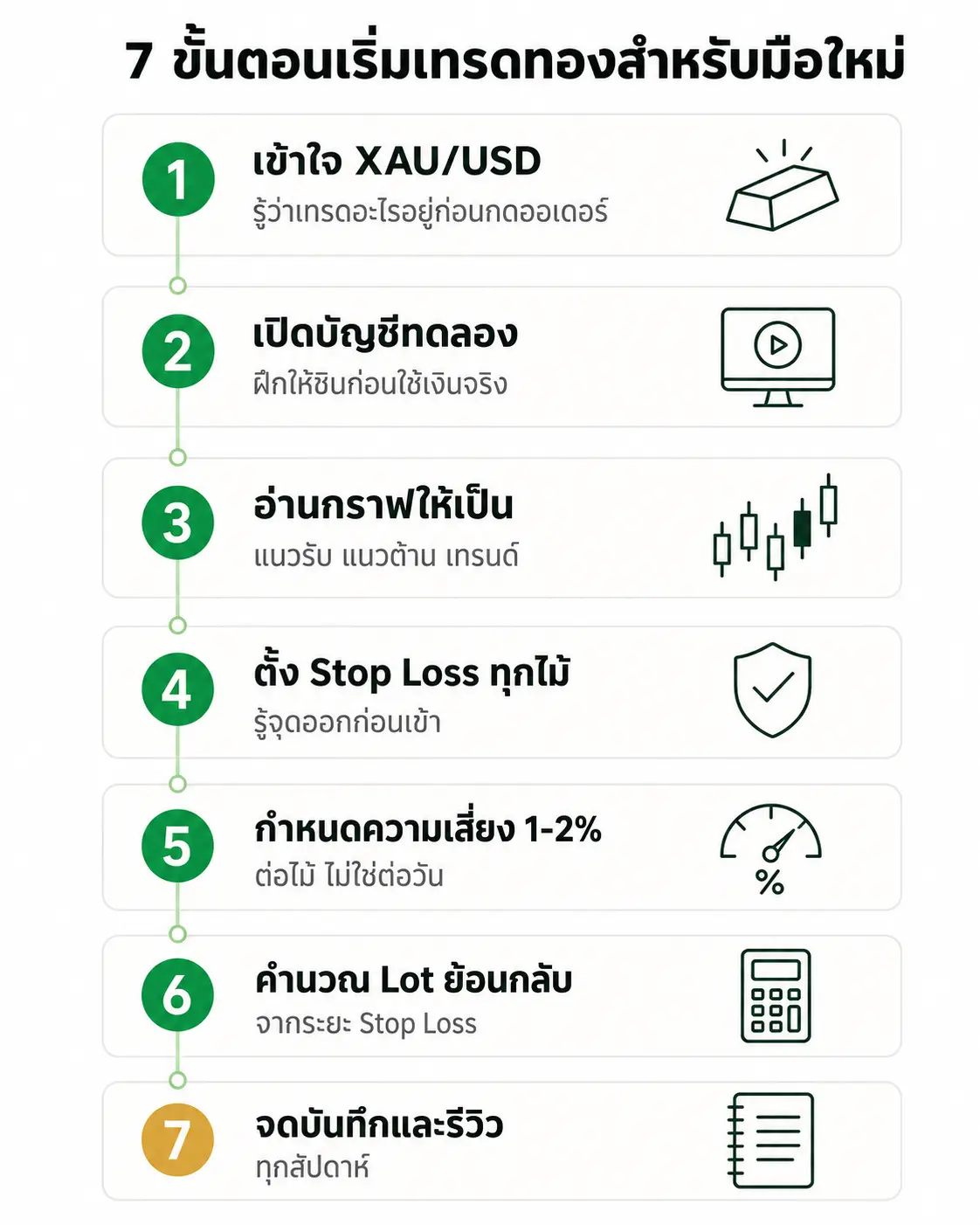 1. Understand Gold Lot Size Before Opening a Trade
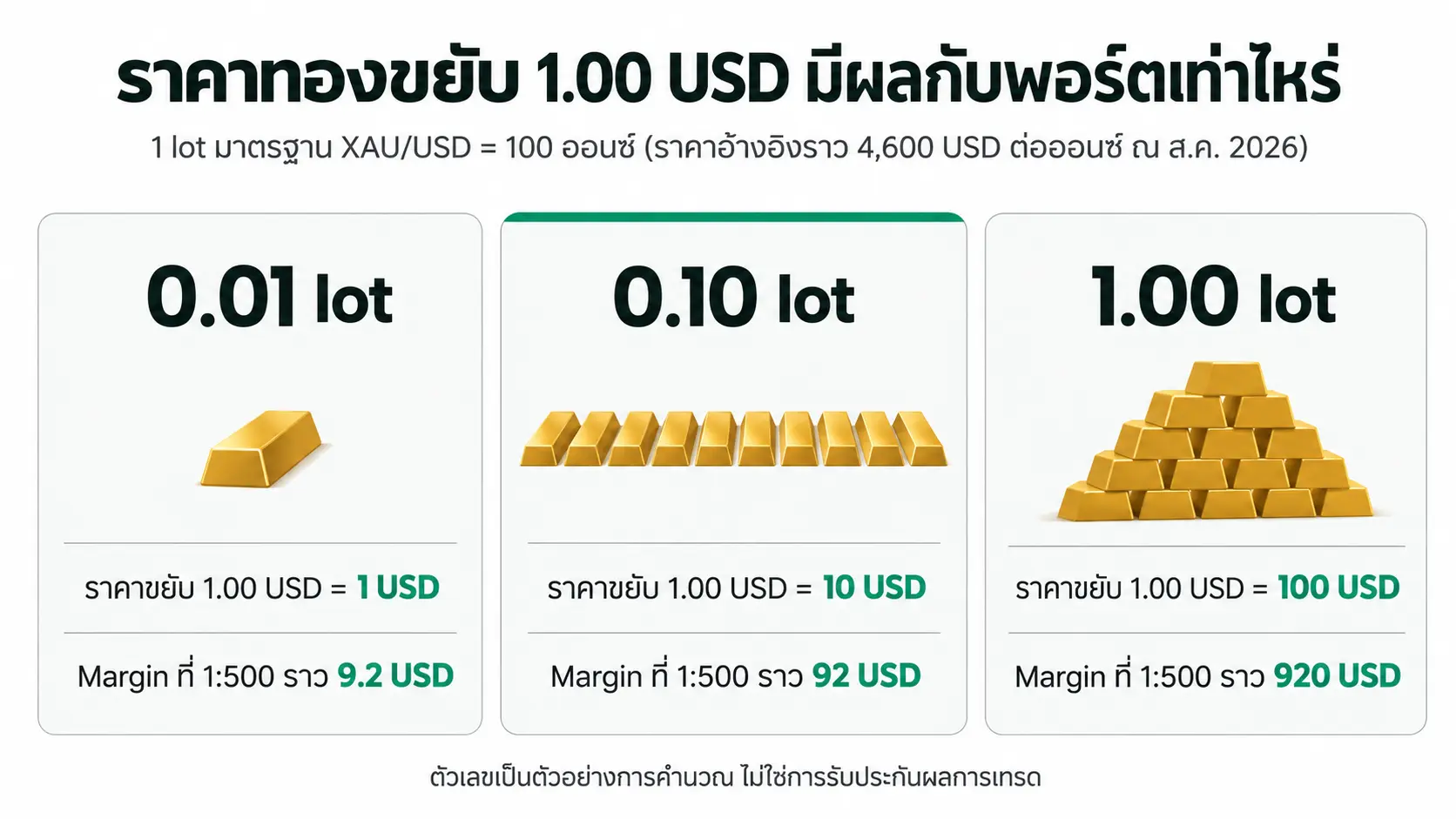 Before trading XAUUSD, beginners should understand how lot size affects the value of a price movement.
Using the standard contract size in the examples in this guide:
1 standard lot of gold = 100 ounces
This means approximately:
Lot Size | If Gold Moves $1 |
|---|---|
0.01 Lot | ±$1 |
0.10 Lot | ±$10 |
1.00 Lot | ±$100 |
For example, if you open a 0.10 lot position and gold moves $20 against you, the approximate impact could be:
$200
This is why beginners should not choose a lot size simply because:
"The number looks small."
A small lot size can still create a significant level of risk depending on:
The distance to your Stop Loss
Your account balance
The volatility of gold
The contract specifications of your trading provider
The same lot size does not always mean the same level of risk.
Always check the contract specifications provided by your broker or trading platform.
2. Choose a Broker and Trading Platform Carefully
When choosing a trading provider, do not focus only on the maximum leverage offered.
Before opening an account, check important factors such as:
Regulation and licensing
Deposit and withdrawal conditions
XAUUSD spreads
Commission fees
Swap or overnight financing
Minimum lot size
Margin requirements
Available trading platforms, such as MT4 or MT5
These costs and conditions can affect your actual trading experience, especially if you trade frequently or hold positions overnight.
3. Practice With a Demo Account First
A demo account allows beginners to practice the trading process using virtual funds.
You can practice:
Opening a trade → Setting Stop Loss → Setting Take Profit → Choosing lot size → Closing the trade → Recording the result
One useful approach is to set your demo account balance close to the amount of real capital you eventually plan to use.
For example:
If you plan to start live trading with $1,000, but practice on a demo account with $100,000, you may become comfortable using position sizes that are unrealistic for your real account.
The purpose of a demo account is not simply to produce the highest possible profit.
Its purpose is to practice:
Following your trading plan consistently.
4. Learn to Read the Chart Using Trend and Support & Resistance
Beginners do not need to add a large number of indicators from the first day.
Start with three basic concepts.
Trend
Ask yourself:
Is the market moving up, down, or sideways?
Understanding the broader market direction can help you avoid focusing only on small price movements.
Support and Resistance
Look for areas where the price has previously shown significant reactions.
Support and resistance can help provide context when planning potential entries and exits.
Timeframes
One approach is to:
Start with a larger timeframe, such as H4 or H1 → Then look for potential setups on smaller timeframes, such as M15 or M5
Using multiple timeframes may help you avoid situations where you see a Buy signal on a smaller chart while the larger timeframe is approaching an important resistance level.
5. Set Your Stop Loss and Risk Before Opening a Trade
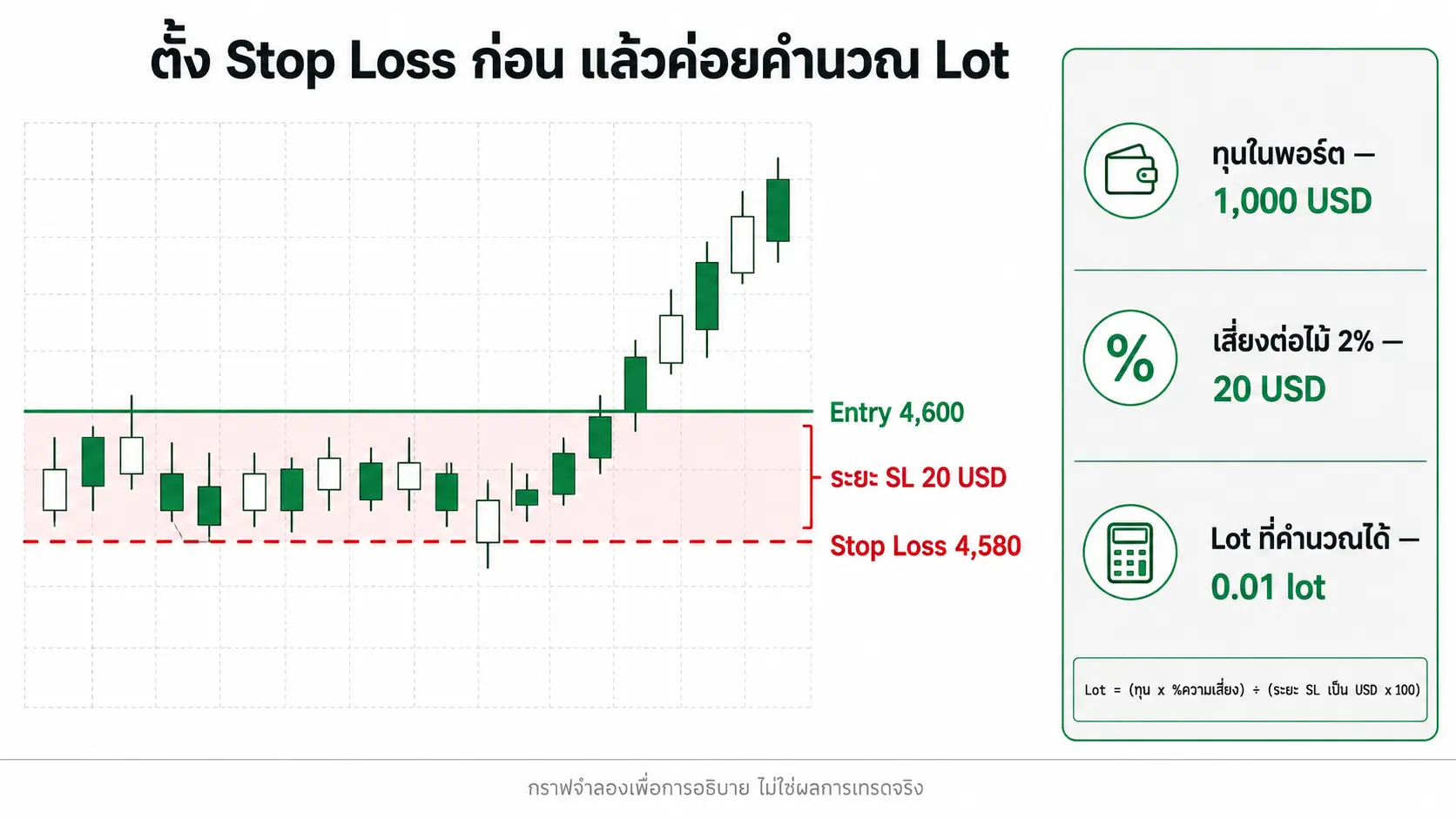 Before opening any trade, you should know three things.
Entry
At what price will you enter?
Stop Loss
Where will you exit if your trading idea is invalidated?
Risk
How much money will you lose if your Stop Loss is reached?
One common example used by traders is to limit the risk per trade to a small percentage of the account, such as 1–2%.
However, the appropriate level of risk depends on your trading strategy, capital, and personal risk tolerance.
The important principle is:
Do not choose your lot size first and then search for a place to put your Stop Loss.
A more structured process is:
Analyze the price structure → Determine the Stop Loss → Decide how much money you are willing to risk → Calculate the lot size
6. Calculate Your Lot Size Based on Risk
Let's look at a simple example.
Assume:
Trading account: $1,000
Maximum risk: 2%
Amount willing to lose: $20
Buy entry: $4,600
Stop Loss: $4,580
Stop distance: $20
Using the contract example in this article, where 1 standard lot represents 100 ounces:
At 0.01 lot, a $1 movement in gold has an approximate impact of $1.
Therefore, if gold moves $20 against the position and reaches the Stop Loss, the approximate loss would be:
$20
The logical process is:
Entry → Stop Loss → Amount willing to lose → Lot size
Not:
I want to trade 0.10 lots → Now I need to find somewhere to place my Stop Loss
This approach helps connect your position size to the level of risk you have already decided to accept.
Read next: How Much Money Do You Need to Start Trading Gold?
7. Start Small With Real Money and Keep a Trading Journal
One of the biggest differences between demo trading and live trading is emotion.
When real money is involved, you may:
Feel afraid when your account goes into drawdown
Close profitable trades too early
Move your Stop Loss
Increase your lot size after a losing trade
Try to recover losses immediately
This is why beginners should not judge their early progress only by asking:
"How much profit did I make this month?"
A more useful question is:
"Did I follow my trading plan?"
What Should You Record in a Trading Journal?
At a minimum, record:
Date and time
Entry price
Stop Loss
Take Profit
Lot size
Reason for entering
Trade result
Mistakes made during the trade
After collecting data from multiple trades, you may start to identify patterns in your decision-making and execution.
What Is the Best Time to Trade Gold?
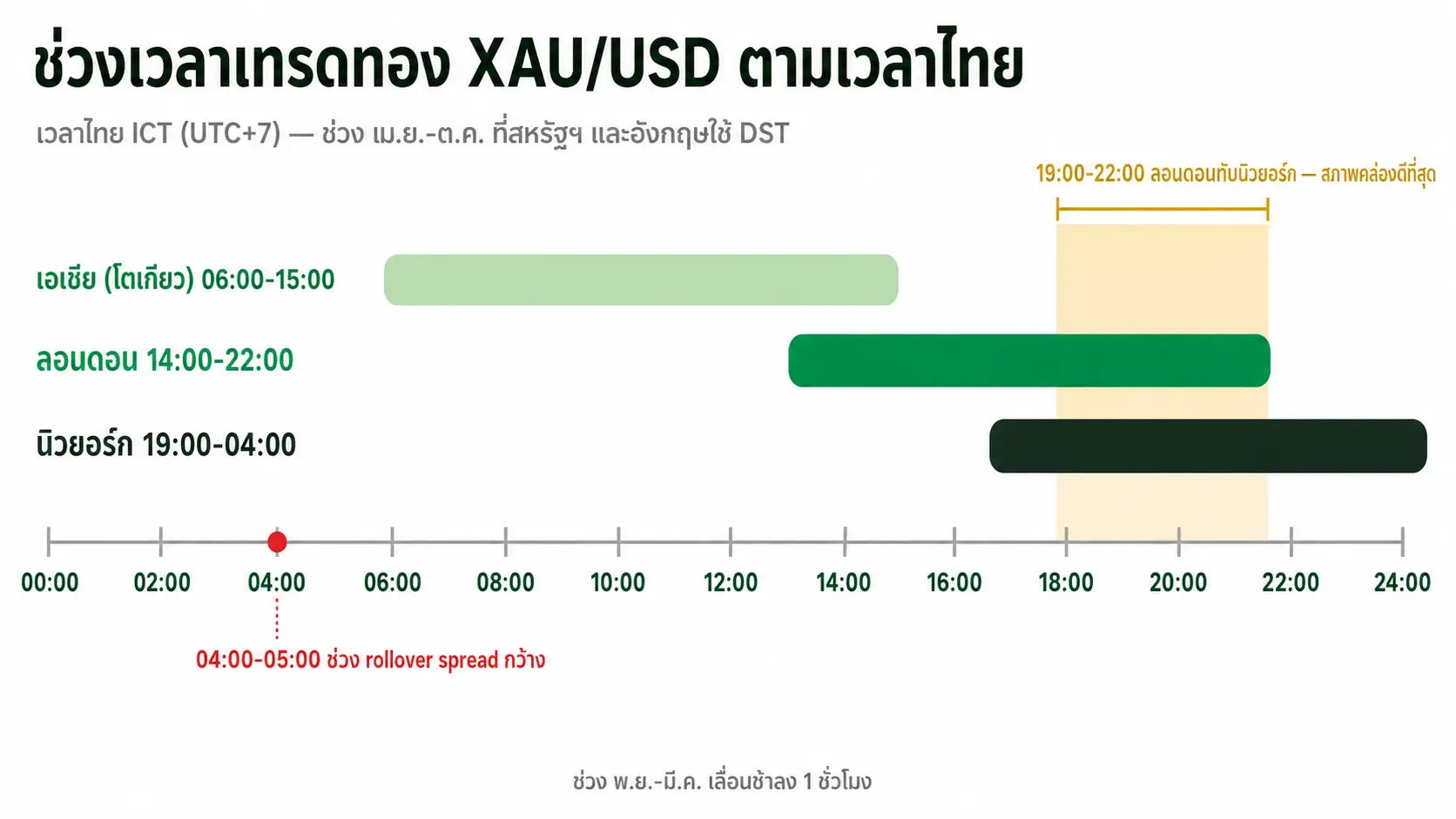 Gold can be traded for much of the business week, but market conditions are not the same throughout the day.
One period many gold traders watch is the London–New York overlap, when two major trading sessions are active at the same time.
According to the timing framework used in the original content:
Period | Thailand Time |
|---|---|
Daylight Saving Time | Approximately 19:00–22:00 |
Standard Time | Approximately 20:00–23:00 |
The original content also identifies the approximate 04:00–05:00 Thailand time rollover period as a time when spreads may widen.
However, there is no single trading session that guarantees profitability.
The better question is:
Does your trading strategy match the market conditions during that session?
Read next: What Is the Best Time to Trade XAUUSD?
What News Can Affect the Gold Price?
Gold prices can be influenced by several factors, including:
US interest rate expectations
The US dollar
Inflation
Geopolitical developments
Central bank gold purchases
Some major economic events that gold traders often monitor include:
CPI
US inflation data.
NFP
US Non-Farm Payroll employment data.
FOMC
Federal Reserve interest rate decisions and policy communication.
During major news releases, markets can experience:
Rapid price movements
Wider spreads
Slippage
For beginners, choosing not to open a new trade immediately before or during a major news release can be one way to manage risk.
5 Common Mistakes Beginner Gold Traders Make
1. Trading a Lot Size That Is Too Large
A low margin requirement does not mean a position has low risk.
Always consider how much you could lose if the price reaches your Stop Loss.
2. Trading Without a Stop Loss
Without a predefined point where you accept that your trading idea may be wrong, the market can determine the size of the loss for you.
A Stop Loss does not eliminate risk, but it can help define the potential loss according to your trading plan.
3. Chasing the Price During High-Impact News
The feeling of:
"I don't want to miss the move."
often appears when the market is already moving quickly.
During these periods, volatility can increase and trading conditions may change.
Having a plan before the news is often more useful than trying to enter every fast-moving market.
4. Revenge Trading
Increasing your lot size immediately after a loss in an attempt to recover money can shift your decision-making away from your trading system and toward emotion.
After a series of losses, consider reviewing:
Did you follow your trading plan?
Have market conditions changed?
Is your risk per trade appropriate?
5. Changing Your Trading System Too Frequently
If you test a strategy for only a few trades and immediately move to a new method, you may not have enough data to evaluate the original strategy.
Try to distinguish between:
A problem with the trading strategy
A problem with how the strategy was executed
A sample size that is too small
Should Beginners Trade Gold or Forex?
There is no single market that is best for everyone.
Gold, represented by XAUUSD, can experience relatively large price movements during certain market conditions. This means traders need to pay close attention to:
Lot size
Stop Loss distance
Volatility
Risk management
Major Forex currency pairs have different market characteristics and may respond to different economic factors.
Before choosing, consider three things.
1. Your Trading Capital
Can the minimum position size allow you to keep your risk within the level you have planned?
2. Your Available Time
Does your schedule match the periods when your chosen market is most active?
3. Your Tolerance for Volatility
If rapid changes in your account balance cause you to make emotional decisions, a market with different volatility characteristics may be easier to use while developing trading discipline.
Read next: Gold vs Forex Trading: What's the Difference?
Do You Need Trading Tools to Analyze Gold?
Trading tools can help reduce repetitive work and organize information on a chart.
However, tools should not replace your understanding of:
Lot size
Margin
Stop Loss
Drawdown
Risk management
For example, IST (Indy System Trade PRO) from Indy Trader is described as an analysis tool that combines features such as Trend Lines, Support and Resistance, and multi-timeframe dashboards.
However, the trader still needs to make decisions according to their own trading plan.
Automated trading systems can execute trades based on predefined conditions, but users should still understand:
What lot size the system uses
How much margin may be required
How many orders the system can open
What level of drawdown may occur
Whether the risk settings are appropriate for their capital
A tool can help reduce workload, but it should not replace an understanding of risk.
Beginner Checklist Before Trading Gold With Real Money
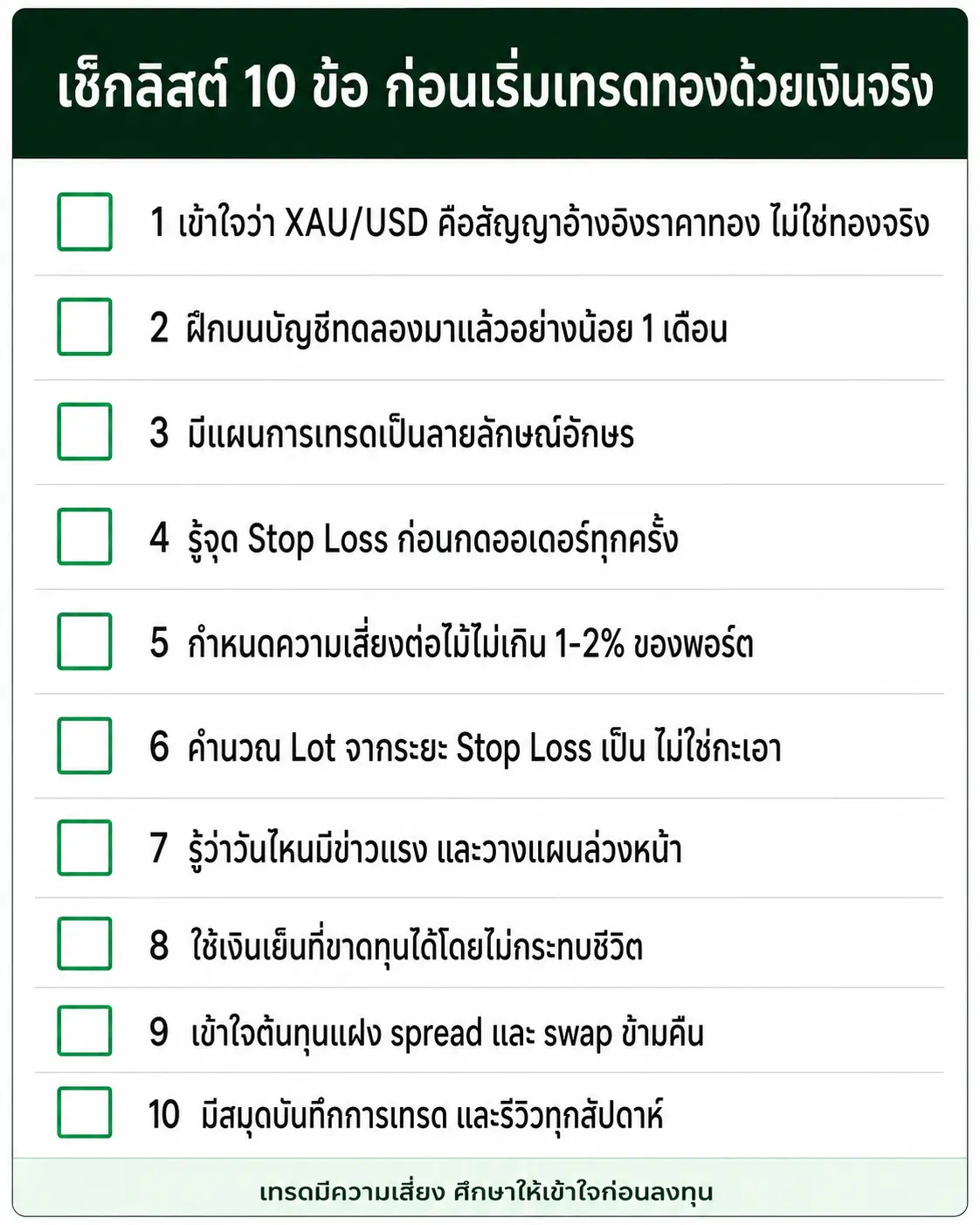 Before using real money, ask yourself whether you can confidently check the following boxes:
I understand what XAUUSD is
I understand how lot size affects my account
I understand trading costs such as spreads and fees
I use a Stop Loss for every trade
I define my risk before opening a trade
I calculate my lot size based on my Stop Loss
I check major economic news
I keep a trading journal
If there are questions you cannot answer yet, it may be better to learn more before increasing your trading risk.
FAQ: How to Trade Gold for Beginners
How much is 0.01 lot in gold trading?
Using the standard contract example in this guide, where 1 lot = 100 ounces, a 0.01 lot position represents approximately 1 ounce.
Therefore, if the gold price moves by $1, the approximate impact would be $1.
However, always check the contract specifications of your broker or trading provider.
Should beginners use MT4 or MT5?
Both MT4 and MT5 can be used for trading.
For beginners, understanding the basics is often more important than choosing between platforms, including:
How to open an order
How to set a Stop Loss
How to set a Take Profit
How lot size works
Do you need a lot of money to start trading gold?
It is important to separate two questions:
How much money do you need to open a trade?
and
How much capital do you need to manage risk?
Leverage may reduce the margin required to open a position, but it does not reduce the volatility of the gold market.
A more structured way to think about capital is:
Stop Loss → Amount willing to lose → Lot size → Required trading capital
Can I trade gold using an automated trading system without learning how to trade?
Automated systems can execute trades according to predefined rules.
However, users should still understand:
Capital requirements
Lot size
Margin
Drawdown
The risks associated with the system's settings
Automation does not remove trading risk.
Start With Risk Management, Not the Search for Quick Profits
Many beginners start with the question:
"Will gold go up or down today?"
But an equally important question is:
"If I am wrong, how much could I lose?"
Once you understand:
XAUUSD
Lot size
Stop Loss
Risk management
you will have a stronger foundation for learning trading strategies, chart analysis, and trading tools.
Recommended Next Steps
To continue learning, consider reading these topics in order:
1. How Much Money Do You Need to Trade Gold?
Understand capital, lot size, margin, and risk.
2. Gold vs Forex Trading: What's the Difference?
Compare the characteristics of gold and currency pairs.
3. What Is the Best Time to Trade XAUUSD?
Learn about trading sessions and market behaviour.
4. How to Choose a Gold Trading Course
Understand what to consider before choosing a trading course.
If you're unsure where to begin, you can explore the educational approach and trading resources available through Indy Trader Academy to find a learning path that fits your time and goals.
If you would like to learn more about Indy Trader Academy's courses or tools, contact the team through LINE OA @indytrader.
Risk Warning: Forex and CFD trading, including XAUUSD, involves a high level of risk. Leverage can increase both profits and losses. Past performance does not guarantee future results. This content is provided for educational purposes only and should not be considered investment advice.
