
Short answer: In general, gold and the US dollar tend to move in opposite directions, because gold is priced in dollars, a stronger dollar makes gold more expensive for holders of other currencies, and the dollar tends to strengthen alongside higher US interest rates, which make holding gold (which pays no interest) less attractive. But this isn't a fixed rule. In a crisis, or when central banks are buying heavily, gold and the dollar can rise together. Thai gold prices also depend on the baht: a weaker baht can push Thai gold prices up even when world gold doesn't move.
"Strong dollar, weak gold" is the phrase you hear most in gold analysis, and it's a good place to start. But traders who apply it rigidly regularly meet days when the dollar strengthens and gold soars anyway. This article explains where the relationship comes from, what matters more than the dollar, and how to use it when trading XAUUSD.
3 reasons gold and the dollar usually move apart
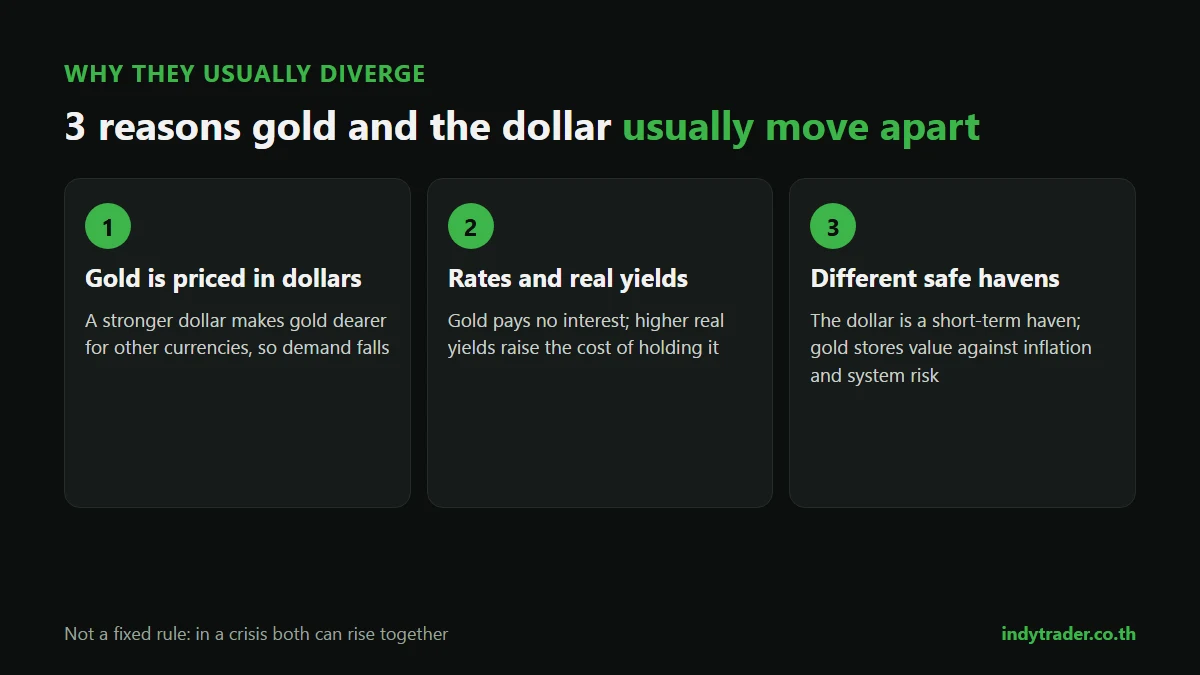
1. Gold is priced in dollars
The world gold price is quoted in dollars per ounce. When the dollar strengthens, people holding euros, yen or baht need more of their own currency to buy the same amount of gold, so demand falls and the dollar price of gold comes under pressure. When the dollar weakens, gold becomes cheaper for everyone else.
2. Interest rates and real yields
Gold pays no interest or dividends. When US interest rates rise, bonds and dollar deposits pay more, so the opportunity cost of holding gold rises. The number gold analysts watch most is the real yield: bond yields after inflation. When real yields rise, gold tends to come under pressure; when they fall, gold tends to find support.
The dollar often strengthens in the same periods that US rates rise, so part of the "strong dollar, weak gold" relationship comes from interest rates driving both at once.
3. Both are safe havens, of different kinds
Both the dollar and gold are places investors hide, but in different roles. The dollar is the most liquid short-term haven; gold is a store of value when people worry about inflation, currencies or the financial system. Money flows between the two depending on what kind of worry dominates.
The US Dollar Index (DXY)
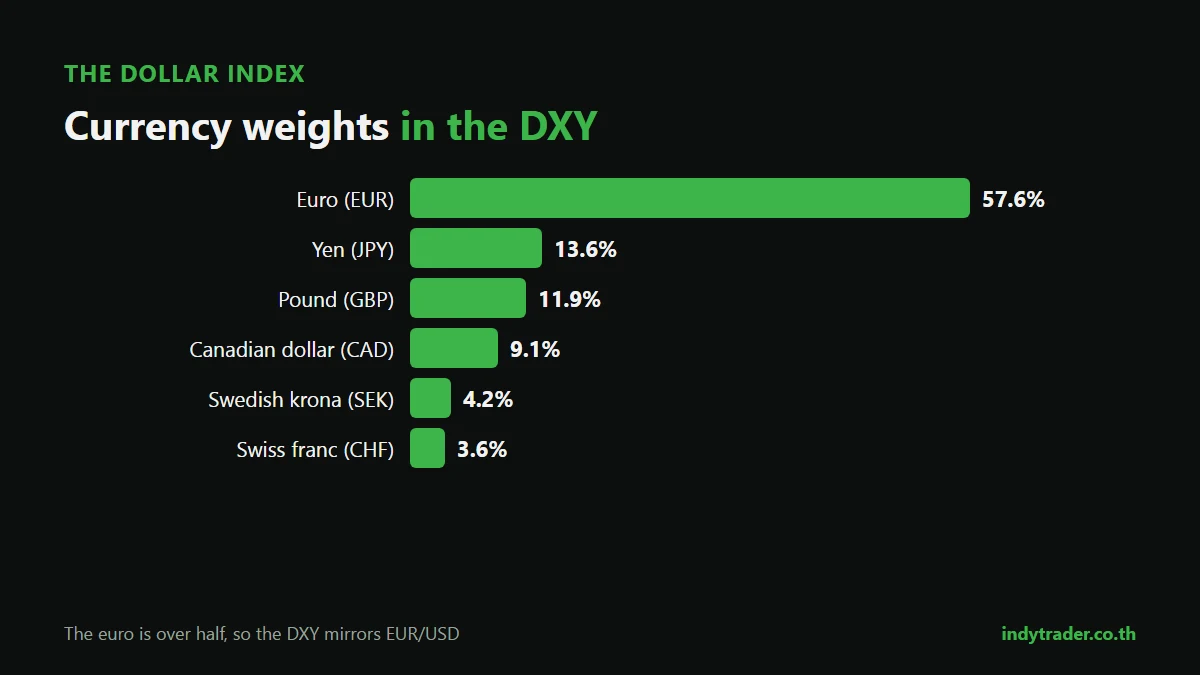
Gold traders often watch the US Dollar Index (DXY), which measures the dollar against six major currencies.
Currency | Weight in the index |
|---|---|
Euro (EUR) | 57.6% |
Japanese yen (JPY) | 13.6% |
British pound (GBP) | 11.9% |
Canadian dollar (CAD) | 9.1% |
Swedish krona (SEK) | 4.2% |
Swiss franc (CHF) | 3.6% |
Because the euro makes up more than half, the DXY moves almost exactly opposite to EUR/USD. If your platform doesn't offer the DXY, use EUR/USD as an inverted proxy: EUR/USD rising means a weaker dollar.
When "strong dollar, weak gold" doesn't hold
Situation | What often happens | Why |
|---|---|---|
A financial or geopolitical crisis | Gold and the dollar rise together | Money flows into both havens |
Heavy central bank buying | Gold rises even as the dollar strengthens | Central bank demand doesn't depend on the short-term dollar |
High inflation with rates rising more slowly | Gold rises | Real yields are negative or falling |
News affecting gold directly | Gold moves on its own | E.g. Asian demand or supply news |
Central bank buying is the clearest example. The World Gold Council reports that central banks' net gold purchases topped 1,000 tonnes for the third year in a row in 2024 (1,045 tonnes), far above the average of about 473 tonnes a year in 2010–2021. Buying on that scale has made the link between gold and the dollar looser than in the past.
The takeaway for traders: use the dollar as one of several factors, not the only one that decides.
US news that moves both gold and the dollar
News | Frequency | If better than expected (generally) |
|---|---|---|
Non-Farm Payrolls | Monthly, usually the first Friday | Dollar stronger, gold under pressure |
Consumer Price Index (CPI) | Monthly | If inflation beats forecasts, markets expect high rates for longer; gold often dips short term |
Federal Reserve meetings (FOMC) | 8 times a year | Hawkish: dollar up, gold down. Dovish: gold up |
GDP and retail sales | Quarterly / monthly | A strong economy, a stronger dollar |
Around these releases gold can swing tens of dollars in minutes and spreads widen. If you trade news, cut your size or wait for price to settle (see news times and sessions in The best time to trade gold).
Why Thai gold prices also depend on the baht
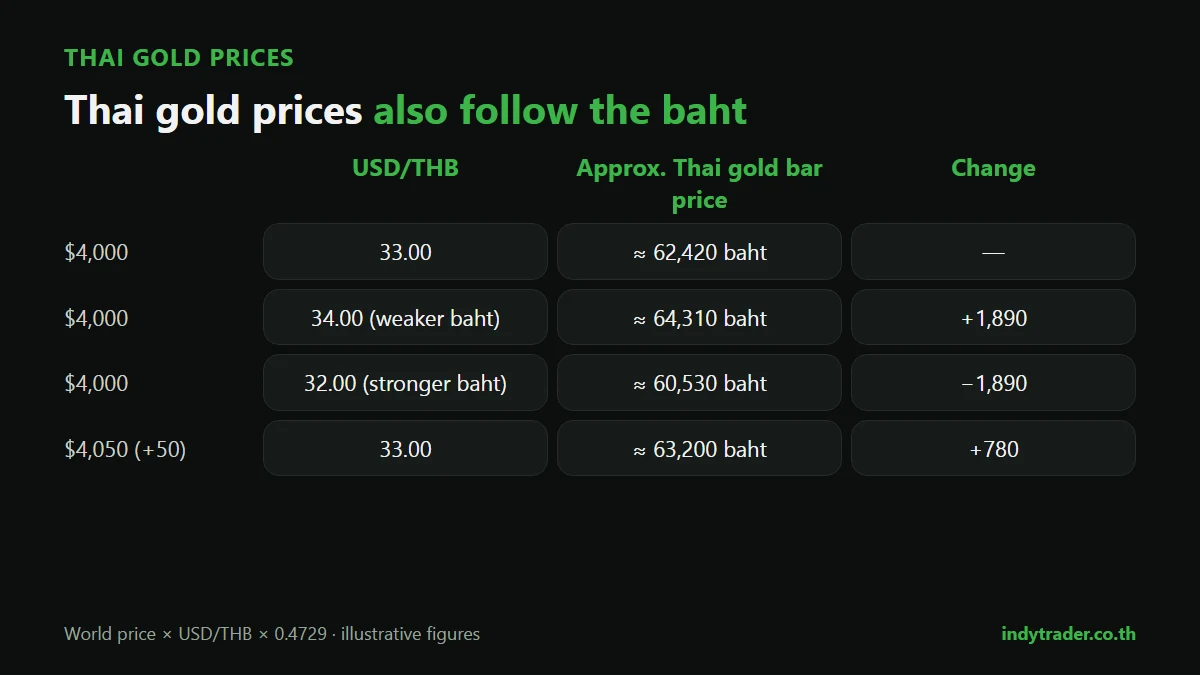
The price of 96.5% gold bars announced by the Thai Gold Traders Association is calculated from the world gold price and the baht. The approximate formula commonly used is:
Thai gold bar price (baht per baht-weight) ≈ world gold price ($/oz) × USD/THB × 0.4729
The 0.4729 comes from the weight of 1 baht of gold (15.244 g) × 96.5% purity ÷ 1 troy ounce (31.1035 g). Prices actually quoted by gold shops add buy/sell spreads, and a workmanship fee for jewellery.
World gold price | USD/THB | Approximate Thai gold bar price |
|---|---|---|
$4,000 | 33.00 | ≈ 62,420 baht |
$4,000 (world gold unchanged) | 34.00 (weaker baht) | ≈ 64,310 baht (+1,890) |
$4,000 | 32.00 (stronger baht) | ≈ 60,530 baht (−1,890) |
$4,050 (world gold +$50) | 33.00 | ≈ 63,200 baht (+780) |
(Gold prices and exchange rates in this table are illustrative.)
The table shows that a 1-baht move in the exchange rate affects Thai gold prices more than a $50 move in world gold, which is why Thai gold sometimes rises on days world gold falls. When you trade XAUUSD, profits and losses are in dollars, so the baht only matters when you convert deposits and withdrawals (see the difference between Thai gold and XAUUSD in What is XAUUSD).
Using the relationship to trade XAUUSD
Keep a dollar chart next to your gold chart. Use the DXY or EUR/USD on the same timeframe. Gold rising with a weakening dollar is usually a stronger trend than gold rising against a strengthening dollar
Watch rates and real yields for the big picture. Periods when markets expect US rate cuts have often supported gold in the medium term
Check the US news calendar every morning, and know what's due and when
Use the relationship to confirm, not to trigger. Entries and stop-losses still come from the gold chart itself, such as support, resistance and candlesticks (see How to read a gold chart)
Be careful when the relationship looks unusual. If gold and the dollar both rise sharply, the market is usually worried and volatility may be higher than normal, so cut your size
An example analysis
Say that on a Thursday the dollar index has weakened for three days after US inflation came in below forecasts. On H4, gold has made a new high and pulled back to previous support. A trader using this relationship sees the big picture favouring buys, so waits for a bullish reversal signal at support, but reduces size or stays out before Friday's jobs figures, which could change the dollar's direction instantly.
Summary
Gold and the dollar usually move apart because gold is priced in dollars and the two respond to US interest rates in opposite ways. But the relationship can change in a crisis or when central banks buy heavily, and Thai gold prices also depend heavily on the baht. Use the dollar to confirm the big picture, then plan entries and exits from the gold chart and control risk on every trade (see Risk management and Gold trading strategies).
Learn to analyse gold systematically
The Road to Trader course for beginners, taught by founder Coach Beer, covers forex basics, trading mindset, key terms such as pips, lots, leverage and margin, the MT4 platform and the Indy System Trade method, with access to the Indy Trader community. Read more in How to analyse gold prices and Gold vs forex trading.
Frequently asked questions
Does a strong dollar mean gold goes down?
Usually, because gold is priced in dollars and the dollar tends to strengthen with higher US rates. But not always: in a crisis or during heavy central bank buying, gold and the dollar can rise together.
Why does Thai gold rise when world gold falls?
Because Thai gold prices depend on both the world gold price and the baht. If the baht weakens enough, Thai gold prices rise even as world gold falls.
What is the DXY?
The DXY is an index measuring the US dollar against six major currencies, with the euro the largest weight at about 57.6%. Gold traders use it to see whether the dollar is broadly strong or weak.
How do US interest rates affect gold?
Gold pays no interest. When rates or real yields rise, holding gold costs more in missed returns, so gold tends to come under pressure. When markets expect rate cuts, gold tends to find support.
How do I calculate the Thai gold price from the world price?
Use the approximation: world gold price × USD/THB × 0.4729, which gives the approximate price of a 96.5% gold bar per baht-weight. Shop prices add buy/sell spreads on top.
Sources
By the Indy Trader team. Indy Trader is a forex and gold trading academy founded in 2012 by Coach Beer (Tithivat Huayhongtong).
Risk warning: Gold trading carries a high level of risk and you may lose some or all of your capital. Prices and exchange rates in this article are illustrative only and are not investment advice.
