
Short answer: An EA is an automated trading program you install and run yourself on MT4/MT5, following rules someone wrote. Copy trading copies trades from a source account or strategy into your account, so you don't maintain any software. Systems sold as "AI trading" may use models that learn from data, or may be rule-based systems carrying the AI name. None of the three is always best; what decides is a verifiable track record, risk you can accept, and a transparent provider. Indy Trader's AI Auto Trade is a gold copy trading service built on clearly defined strategies.
People who want a system to trade for them usually meet these three terms at once and struggle to tell them apart. Some buy an EA and find they have to leave a computer running all day. Some join copy trading without realising their results won't match the source. Others choose a system because of the word "AI" in its name without knowing how it works inside.
This article compares the three on what actually affects your money: who decides when to enter and exit, what you need to install, where the risks lie, and which suits your situation.
How the three kinds of automated trading differ
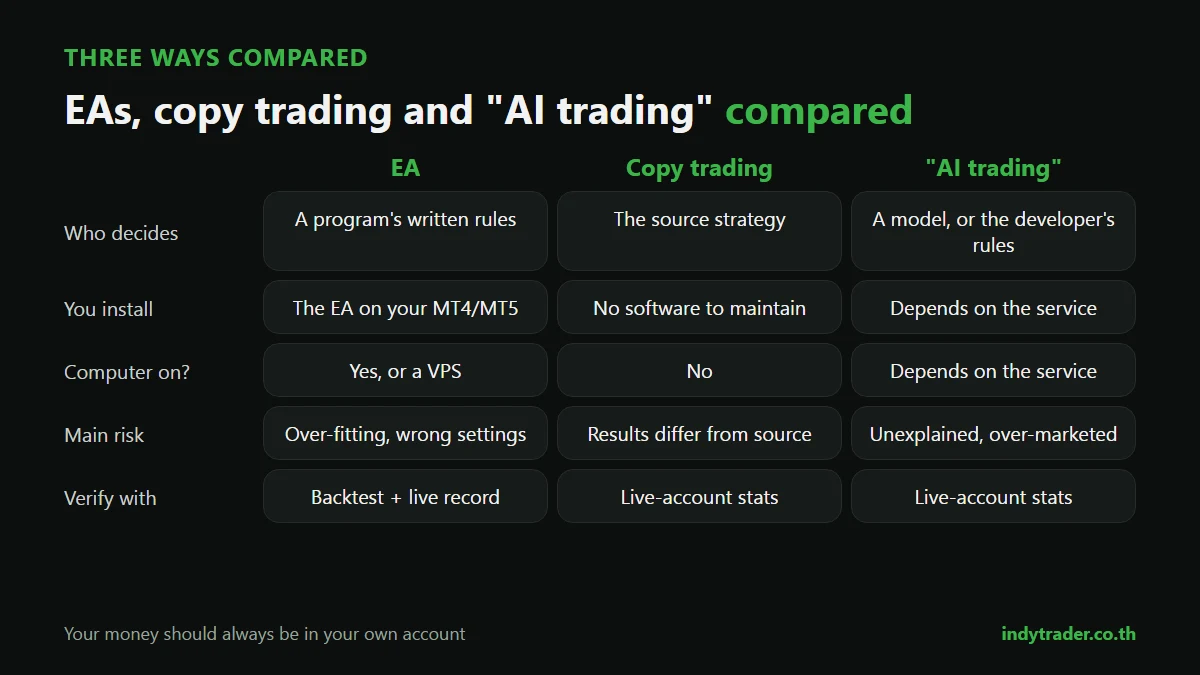
EA (Expert Advisor) | Copy trading | Systems sold as "AI trading" | |
|---|---|---|---|
Who decides entries and exits | A program following rules someone wrote | The source strategy or trader | A model that learns from data, or rules set by the developer |
What you install | The EA on your own MT4/MT5 | Link your account to the service; no software to maintain | Depends on the service; often delivered as an EA or copy trading |
Must a computer stay on? | Yes, MT4/MT5 running constantly, or a VPS | No | Depends on the service |
Where your money sits | Your own account with a provider | Your own account with a provider (with a legitimate service) | Should always be your own account |
How much control you have | Lots of settings, but you must understand the system | You can set size and stop, but entries come from the source | Often little, if the developer can't explain how it works |
Main risks | Overfitting, breaking when markets change, wrong settings | Results differ from the source; the source takes too much risk | Unexplained decisions, exaggerated marketing |
How to verify results | Backtest plus a long live track record | Live-account statistics verified by a third party | Live-account statistics verified by a third party |
Note that "AI trading" isn't really a separate way of delivering a service. Most systems carrying the AI label still reach users as an EA or as copy trading. The real difference is the logic behind the decisions, not the name.
What is an EA?
An EA (Expert Advisor) is a program that runs on MT4 or MT5 and opens and closes trades automatically according to written rules, such as "if the moving averages cross upward, buy, with a stop-loss at the latest low". Its strength is following rules 24 hours a day without emotion. Its limits are that the software must stay running (or you rent a VPS), and EAs with very attractive backtests are often over-fitted to the past.
MT4 and MT5 EAs aren't interchangeable, so check that an EA supports your platform before buying or using it (see What is an EA and MT4 vs MT5).
What is copy trading?
Copy trading copies trades from a source account or strategy into your account automatically. You choose how much to copy and can stop, but you don't decide entries and exits. Its strength is that you don't install or maintain software. What you must know is that your results will not always match the source, because of different capital, lot rounding, costs and when you started copying (see Can copy trading really make money and What is copy trading).
What are systems sold as "AI trading"?
In trading, "AI" is used for two very different groups of systems:
Systems using genuine machine-learning models, which learn relationships from past data and use them to decide. They need large amounts of data and testing, and carry a high risk of over-fitting
Rule-based systems carrying the AI name, which work on predefined conditions. That isn't necessarily worse: rule-based systems that can be explained and tested are often easier to verify than models that can't explain why they trade
So the right question isn't "is it really AI?" but "how does this system decide, how was it tested, and is there a verifiable live track record?" (read more in Can AI really trade forex and What is a forex robot).
The US regulator CFTC warned in 2024 that scammers use "AI" and trading bots to lure investors with impossible returns. The word AI in a product's name is not evidence that it makes money.
Where Indy Trader's AI Auto Trade fits
Indy Trader's AI Auto Trade is a copy trading service for gold. It copies trades from 2 clearly defined strategies, Gold Apex (trend following) and Gold Ranger (trend plus momentum), into the user's own trading account on MT4/MT5. The system is built on statistical logic and algorithms backtested across market conditions, and results, including drawdown, are published on MyFXBook.
In the table above, the service sits in the copy trading column: users don't install or maintain an EA themselves, and the money stays in their own account. The selection principles in this article apply to it as to any system: look at verifiable results, understand the drawdown, and only use money you can afford to lose.
Which suits you?
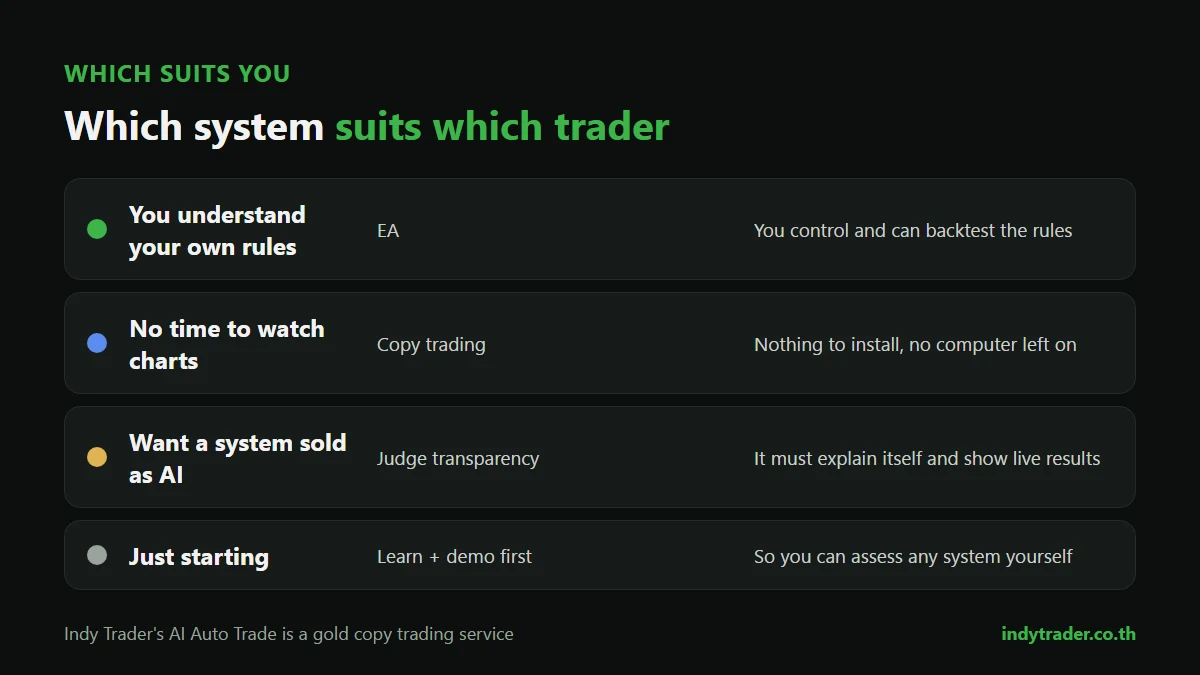
If you | Usually suits | Why |
|---|---|---|
Write or understand your own trading rules and want a system to execute them | EA | You control the rules and can backtest them |
Have no time to watch charts and don't want to maintain software | Copy trading | Nothing to install, no computer left running |
Want a system sold as AI | Judge on transparency, not the name | It must explain how it works and show verifiable live results |
Are just starting and don't yet understand the risks | Learn the basics and practise on demo first | So you can assess any system yourself |
Whichever you choose, understanding basics such as lots, leverage, drawdown and risk management tells you when to stop or reduce size, instead of letting a system run without knowing what's happening.
Risks all three share
Drawdown. Every system has losing streaks. Ask what the largest past drawdown was, and whether you could accept it with your money
Changing markets. A system that worked in one period may stop working when conditions change. Past results don't guarantee the future
Leverage and position size. The same system run with lots too big for the account can do serious damage in days (see Risk management)
Provider risk. Your money should always sit in your own account with a provider you can verify
Scams. Beware of services that guarantee profits, ask you to transfer money to a personal account, or ask for your trading account's master password
8 questions before choosing an automated system
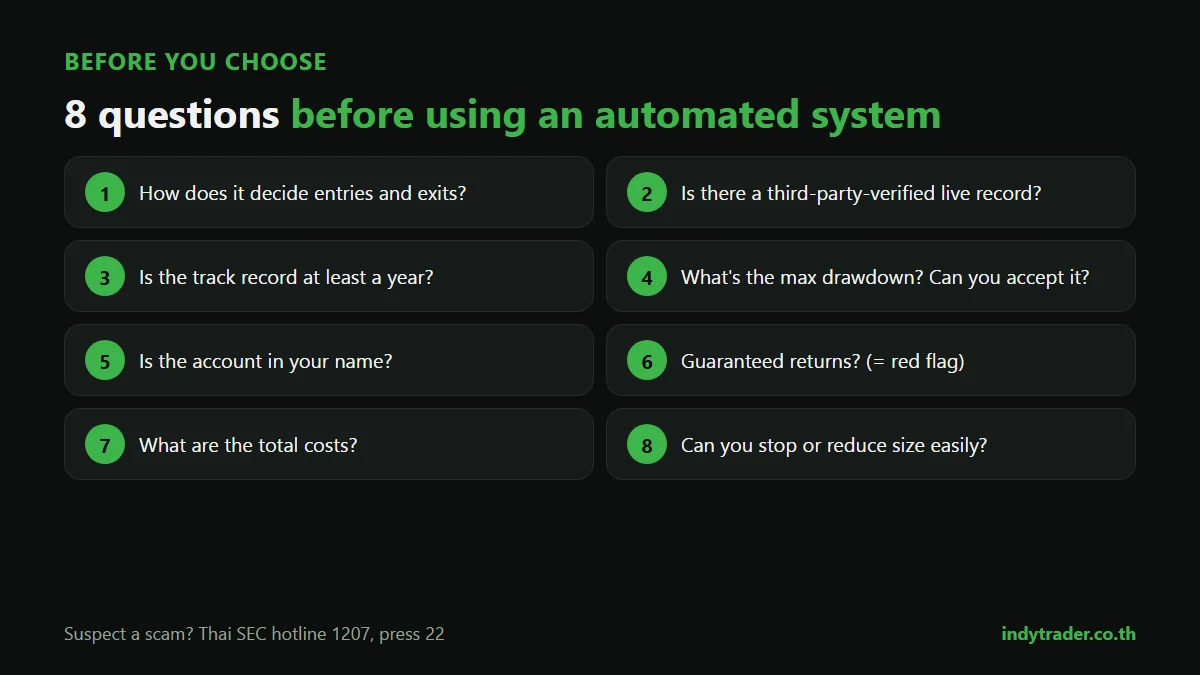
How does the system decide entries and exits? Can the provider explain the principles?
Is there a live-account record verified by a third party, such as MyFXBook linked to a real account, not a self-made table?
Is the track record long enough, at least a year, through uptrends, downtrends and ranges?
What is the maximum drawdown, and could you accept it?
Whose name is the account in? It must be yours, and you must be able to withdraw yourself
Are returns guaranteed? If so, treat it as a red flag
What are the total costs, including service fees, spreads, commissions and a VPS if needed?
Can you stop or reduce size easily, and is someone available to answer questions during a losing streak?
If you suspect a scam, call the Thai SEC hotline 1207, press 22.
Starting with automated trading safely
Test first. For an EA, run it on a demo account for several weeks and check it behaves as the developer says
Start small. Use money you can afford to lose, and increase size only after seeing real results in your own account
Set a loss limit. Decide in advance at what level of account drawdown you'll stop and review
Understand backtesting so you can tell flattering results from credible ones (see What is backtesting)
Summary
An EA is a program you run yourself according to rules; copy trading copies trades from a source without any software to maintain; and "AI trading" may mean a data-trained model or a rule-based system with an AI name. Choose on transparency, a verifiable live track record, a drawdown you can accept and the time you have, not on the label, and always start small.
Understand a system before letting it trade for you
The Road to Trader course for beginners, taught by founder Coach Beer, covers forex basics, trading mindset, key terms such as pips, lots, leverage and margin, the MT4 platform and the Indy System Trade method, with access to the Indy Trader community, so you can assess any automated system yourself.
Frequently asked questions
What is an EA?
An EA, or Expert Advisor, is an automated trading program that runs on MT4 or MT5 and opens and closes trades according to written rules. The software must stay running, or you use a VPS, and MT4 EAs don't work on MT5.
What's the difference between an EA and AI trading?
An EA follows rules a person wrote, while machine-learning AI systems learn relationships from data. In practice, many systems carrying the AI name are also rule-based, and reach users as an EA or as copy trading.
Is copy trading or an EA better?
Neither is always better. An EA suits people who understand and want to control the rules; copy trading suits people without time who don't want to maintain software. Either way, check verifiable live results and drawdown before choosing.
Is Indy Trader's AI Auto Trade an EA or copy trading?
It's a copy trading service for gold, copying trades from the Gold Apex and Gold Ranger strategies into the user's own account on MT4/MT5. Users don't install or maintain an EA, and results can be checked on MyFXBook.
Can an automated trading system guarantee profits?
No. Every system has losing periods, and past results don't guarantee future ones. Any service that guarantees profits is a red flag.
Sources
By the Indy Trader team. Indy Trader is a forex and gold trading academy founded in 2012 by Coach Beer (Tithivat Huayhongtong).
Risk warning: Forex and gold trading carry a high level of risk and you may lose some or all of your capital. Every automated trading system has losing periods. Past performance is not a guide to future results. This article is not investment advice.
