:format(webp))

Many traders are attracted to Grid Trading because it appears simple: place multiple orders at different price levels and let the system manage trades automatically.
However, Grid Trading is not a money-making machine that generates profits automatically.
A Grid Trading system is a method of placing orders at predefined price intervals. The final result depends on several important factors, including Grid spacing, position size, available capital, market conditions, and how the system manages risk when the market moves strongly in one direction.
Before using any Grid Trading system or EA Grid, traders need to understand both the advantages and limitations of this approach.
In this guide, we will explain:
What Grid Trading is
How Grid systems work
Why Grid Trading is commonly used in sideways markets
The risks during strong trends
Important risk management factors
How Indy Super Grid approaches automated Grid Trading
What Is Grid Trading?
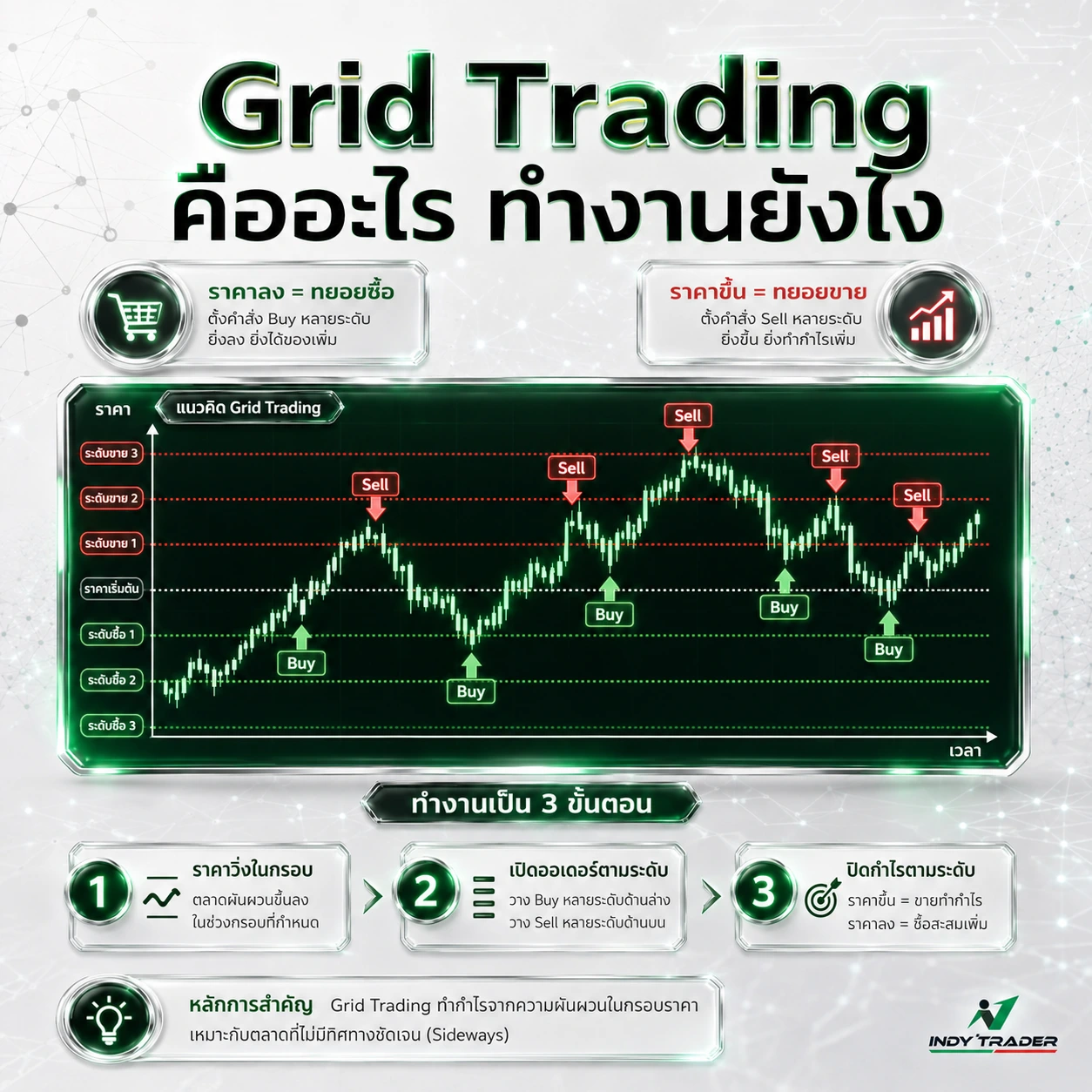 Grid Trading is a trading method that divides the market into multiple price levels, known as "Grid Levels."
Instead of trying to predict whether the market will go up or down, the system places buy and sell orders based on predefined rules.
For example, a trader may create Grid levels every 50 points:
Price Level 1
Price Level 2
Price Level 3
Price Level 4
Price Level 5
When the market moves through these levels, the system executes trades according to its settings.
The main idea behind Grid Trading is to take advantage of price fluctuations.
When the market moves within a range, the system can open and close multiple positions as price moves between Grid levels.
However, when the market moves strongly in one direction, the same mechanism can create higher exposure and increased risk.
This is why understanding Forex risk management is essential before using any Grid system.
How Does a Grid Trading System Work?
A Grid Trading system works by following predefined rules instead of making emotional decisions.
The main components include:
1. Grid Levels
Grid levels define where the system will place orders.
The distance between each level is called Grid Spacing.
A smaller Grid spacing means:
More frequent entries
More trading activity
More potential positions
A larger Grid spacing means:
Fewer entries
More room between trades
Lower trading frequency
Choosing the correct spacing depends on market volatility and the trading strategy.
2. Automated Order Management
Many traders use an EA Grid to automate the process.
An EA Grid can help manage:
Entry execution
Multiple positions
Take Profit levels
Order management rules
However, automation does not remove risk.
An automated system only follows the rules it has been programmed to follow.
If market conditions change significantly, traders still need proper risk management.
When Does Grid Trading Work Best?
One of the most important factors in Grid Trading is understanding market conditions.
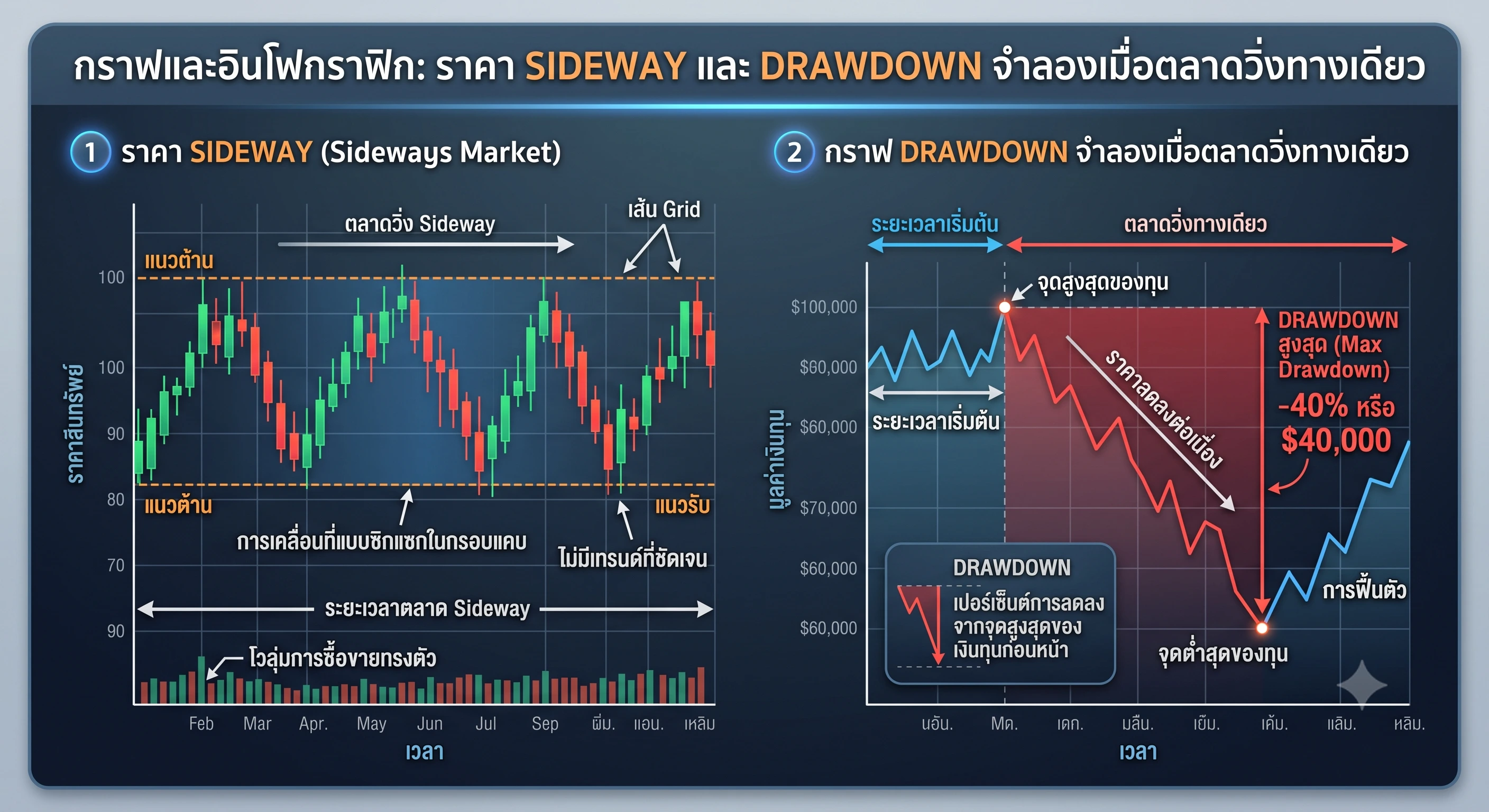
Grid systems generally perform better in Sideways Markets, where price moves within a defined range.
During a sideways market:
Price repeatedly moves between support and resistance areas
Short-term price fluctuations occur frequently
The market does not have a strong directional movement
These conditions allow Grid systems to capture smaller price movements.
For example:
Gold moves between a specific range for several days.
A Grid system may place orders at different levels within that range and attempt to benefit from repeated price movements.
However, no market condition lasts forever.
A sideways market can eventually become a strong trend, creating a different risk environment.
Grid Trading in Sideways Markets
Sideways markets are often considered the preferred environment for Grid Trading because the strategy is designed around price movement within a range.
Common characteristics include:
Price moving horizontally
Frequent small reversals
No strong buying or selling pressure
Clear support and resistance zones
However, traders should remember that identifying market conditions is critical.
A market that appears sideways on one timeframe may already be trending on another timeframe.
This is why professional Grid traders evaluate:
Timeframe
Volatility
Trend strength
Economic events
before activating a system.
The Biggest Risk of Grid Trading: Strong Trends
The biggest challenge for Grid Trading occurs when the market moves strongly in one direction.
For example:
Gold enters a strong bullish trend and continues moving higher without significant pullbacks.
A Grid system designed to place additional positions at different levels may continue accumulating trades.
This can lead to:
Increasing floating losses
Higher margin usage
Larger account exposure
Higher drawdown
The issue is not that Grid Trading does not work.
The issue is that every trading system has market conditions where it performs better and conditions where risk increases.
Successful traders understand when a system is suitable and when additional protection is required.
Key Factors That Determine Grid Trading Performance
A common misunderstanding about Grid Trading is that the more orders a system opens, the more opportunities it creates.
In reality, the performance of a Grid Trading system depends heavily on how the system is designed and how risk is managed.
Several important variables determine how a Grid system behaves:
Grid Spacing
Grid Spacing refers to the distance between each price level where orders are placed.
The spacing directly affects how frequently the system enters trades.
Smaller Grid Spacing
Advantages:
More trading opportunities
More frequent order execution
Can capture smaller price movements
Risks:
More positions may be opened quickly
Higher margin usage
Increased exposure during unfavorable conditions
Larger Grid Spacing
Advantages:
Fewer unnecessary entries
More room for price movement
Lower trading frequency
Risks:
Fewer trading opportunities
May miss smaller market movements
The appropriate Grid Spacing depends on factors such as market volatility, timeframe, trading objectives, and risk tolerance.
Lot Size and Position Sizing
Lot size is one of the most important risk factors in any trading system.
A Grid system with aggressive position sizing may generate larger returns during favorable conditions, but it can also increase losses when the market moves against the system.
Before using any Grid Trading system, traders should consider:
Account size
Maximum acceptable drawdown
Number of possible positions
Margin requirements
Proper position sizing helps ensure the account can withstand normal market fluctuations.
Number of Grid Levels
The number of Grid levels determines how many positions the system can potentially open.
Increasing the number of levels may allow the system to handle wider price movements.
However, more levels can also mean:
More accumulated positions
Higher capital requirements
Increased exposure
A well-designed system should balance opportunity and risk rather than focusing only on the number of trades.
Maximum Exposure
Maximum Exposure refers to the highest level of market exposure a system allows.
Without exposure limits, a Grid system may continue accumulating positions during a strong directional move.
Risk management features such as exposure limits help traders define boundaries before market conditions become unfavorable.
Equity Stop
An Equity Stop is a risk management mechanism that monitors the overall account equity.
If the account reaches a predefined loss level, the system can stop opening additional trades or take action based on the programmed rules.
This helps prevent unlimited exposure during unexpected market conditions.
The Concept Behind Indy Super Grid
 A professional Grid Trading approach is not simply about opening multiple orders.
The important question is:
How does the system manage risk when the market does not behave as expected?
Indy Super Grid focuses on the structured management of Grid positions by combining automated order handling with risk management principles.
The objective is not to create unlimited positions, but to provide a systematic framework where traders can understand:
How orders are managed
What market conditions are suitable
What risk controls are available
When the system should reduce exposure
Grid Trading should always be viewed as a tool that requires proper understanding and management.
It should not be considered a guaranteed profit system.
Exclusive Indy Trader Information Placeholder
Add verified product information:
Designed markets
Recommended timeframe
Backtest examples from different market conditions
Maximum Drawdown information
Conditions for stopping additional orders
Checklist Before Using a Grid Trading System
Before activating any Grid Trading system, traders should review the following checklist:
Market Conditions
✓ Is the current market suitable for Grid Trading?
✓ Is the market moving sideways or showing strong directional movement?
✓ Are there upcoming economic events that may increase volatility?
Risk Management
✓ Is the account size suitable for the strategy?
✓ Is the Lot Size appropriate?
✓ Is Maximum Exposure defined?
✓ Is there an Equity Stop or risk protection mechanism?
System Understanding
✓ Do you understand how orders are opened?
✓ Do you know when the system stops adding positions?
✓ Have you tested the system under different market conditions?
✓ Are you comfortable with potential drawdown?
Understanding the system before using it is one of the most important steps in responsible trading.
Who Should Avoid Grid Trading?
Although Grid Trading can be useful for some traders, it is not suitable for everyone.
Grid Trading may not be appropriate for traders who:
Expect Guaranteed Profits
No trading system can guarantee profits. Every strategy has periods where performance may decrease.
Do Not Understand Risk Management
Using automated systems without understanding exposure, drawdown, and position sizing can create unnecessary risk.
Have Limited Capital
Grid systems require sufficient capital to handle market fluctuations.
Small accounts with aggressive settings may face higher risks.
Cannot Accept Drawdown
Grid Trading can experience temporary losses during strong market movements.
Traders should understand and accept this possibility before using the system.
CEO Beer's Perspective on Grid Trading
According to CEO Beer, founder of Indy Trader Academy, Grid Trading can be an effective strategy when traders fully understand how it works and manage the associated risks responsibly. While a Grid strategy can capitalize on market fluctuations, its success depends on factors such as proper position sizing, grid spacing, and disciplined money management. Without a clear risk management plan, Grid Trading can expose traders to significant drawdowns during strong market trends. For this reason, CEO Beer encourages traders to learn both the strengths and limitations of Grid Trading before applying it in live markets, ensuring the strategy is used appropriately and as part of a well-structured trading plan.

Final Thoughts: Is Grid Trading Right for You?
Grid Trading is a structured approach that uses predefined price levels to manage multiple positions.
It can be effective in suitable market conditions, especially when prices move within a range.
However, the biggest mistake traders make is viewing Grid Trading as an automatic profit solution.
A successful Grid approach requires:
Understanding market conditions
Proper Grid configuration
Effective risk management
Realistic expectations
Before using any automated system, traders should study how it works and evaluate whether it matches their trading goals and risk tolerance.
Related Articles & Indy Super Grid
Continue improving your Forex knowledge with our related educational guides, including What Is a Forex Trading System?, Forex Risk Management, How to Read Forex Charts, and Trading Psychology for Beginners. These resources will help you understand how professional traders build structured decision-making processes before using automated tools. If you are interested in automated Grid Trading, explore Indy Super Grid to learn more about its features, operating principles, and risk management approach before deciding whether it matches your trading style.
Learn More About Indy Super Grid
Interested in understanding how an automated Grid Trading system works?
Explore Indy Super Grid and learn how the system manages Grid levels, order execution, and risk control.
Before using any trading tool, always review the system conditions, understand the risks involved, and ensure it fits your trading plan.
Frequently Asked Questions
What is Grid Trading?
Grid Trading is a strategy that places multiple buy and sell orders at predefined price levels to take advantage of market fluctuations.
Is Grid Trading automatic?
Grid Trading can be automated through tools such as EA Grid, but automation does not eliminate risk. The system still depends on market conditions and risk management settings.
Does Grid Trading work in trending markets?
Grid Trading is generally more suitable for sideways markets. Strong trends can increase exposure and create larger drawdowns if not properly managed.
What risks should I consider before using Grid Trading?
Important risks include large drawdowns, accumulated positions, margin usage, and unexpected market movements.
Is Indy Super Grid guaranteed to make profits?
No trading system can guarantee profits. Indy Super Grid should be evaluated as a trading tool that requires proper understanding, risk management, and suitable usage.
Risk Disclaimer
Forex and CFD trading involve significant risk and may not be suitable for all investors. Automated trading systems can experience losses, and past performance does not guarantee future results.
Before using any trading system, carefully evaluate your financial situation, understand the risks involved, and trade responsibly.
