:format(webp))

Many traders do not lose money because they lack trading knowledge.
They lose because they enter trades too quickly.
A trader may understand technical analysis, know how to read charts, and have a good strategy, but still make mistakes when emotions take control.
The biggest question is not always:
"Where should I enter?"
A better question is:
"Does this trade follow my plan?"
Trading discipline does not come from promising yourself:
"Next time, I will not make the same mistake."
Discipline comes from having the same set of questions that must be answered before opening every position.
A Pre-Trade Checklist helps traders slow down, evaluate market conditions, and make decisions based on rules instead of emotions.
In this article, you will learn the 5 important things to check before entering a Forex trade, including market conditions, entry confirmation, Stop Loss placement, risk percentage, and Risk Reward ratio.
Why Do Traders Need a Pre-Trade Checklist?
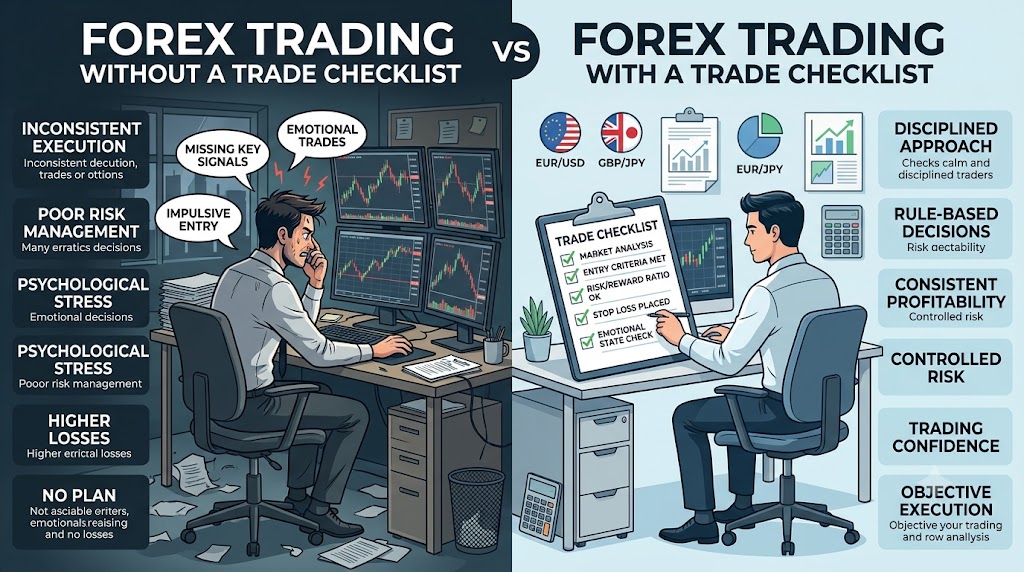 One of the biggest challenges in trading is making decisions under pressure.
The market moves quickly.
A trader sees a strong candle, a sudden price movement, or a social media prediction and feels the need to act immediately.
This often leads to:
Entering without a clear setup
Increasing lot size after losses
Moving Stop Loss because of fear
Taking trades based on FOMO
Ignoring risk limits
A checklist creates a pause between emotion and action.
Instead of asking:
"Should I buy now?"
A disciplined trader asks:
Is the market condition suitable?
Does this setup match my strategy?
Where is my invalidation point?
How much am I risking?
Is the potential reward worth the risk?
This process helps transform trading from reaction into planned decision-making.
1. Is the Market Trending, Sideways, or Moving Abnormally?
Before entering any trade, the first step is understanding the current Market Condition.
The same strategy may perform differently depending on the market environment.
Trend Market
A trend market occurs when price moves consistently in one direction.
Examples:
Higher Highs and Higher Lows in an uptrend
Lower Highs and Lower Lows in a downtrend
Some strategies perform better when there is a clear direction.
Sideway Market
A sideways market occurs when price moves within a range without a strong direction.
Characteristics:
Price moves between support and resistance
False breakouts may occur
Trend-following strategies may become less effective
Abnormal Volatility
Some situations create unusual market movement:
Major economic announcements
Unexpected news
Low liquidity periods
During these conditions, traders should carefully evaluate whether entering a trade matches their plan.

2. Is the Entry Based on a Setup or FOMO?
Many trading mistakes happen because traders enter after seeing price already move.
This is called FOMO (Fear of Missing Out).
A planned entry should come from a defined setup.
A setup answers:
Why am I entering?
What conditions must happen first?
Where is my entry zone?
What confirms this trade?
For example:
A trader may define:
"Only enter when price reaches a support area and shows confirmation."
This is different from:
"Price is moving up quickly, so I should buy before it goes higher."
The first decision follows a trading plan.
The second decision follows emotion.
Before opening an order, ask:
"Would I still take this trade if I had not seen the price move?"
If the answer is no, the trade may be driven by emotion rather than analysis.
3. If the Trade Goes Wrong, Where Will I Exit?
Every trade should have an exit plan before entering.
Many beginners focus only on:
"How much can I make?"
Professional traders also ask:
"How much can I lose?"
A Stop Loss is not a sign that a trade failed.
It is a tool that defines risk before entering the market.
A proper Stop Loss helps traders:
Limit potential losses
Avoid emotional decisions
Protect trading capital
Follow consistent risk rules
The important question is not:
"Can this trade lose?"
Every trade can lose.
The important question is:
"If this trade loses, is the loss acceptable according to my plan?"
4. How Much Risk Am I Taking on This Trade?
One of the most important questions before opening any trade is:
"If this trade reaches my Stop Loss, how much of my account am I willing to lose?"
Many traders focus heavily on finding the perfect entry but ignore the amount of risk they are taking.
A professional trading plan considers risk before entering.
Risk management factors include:
Account size
Position size
Stop Loss distance
Market volatility
Maximum acceptable loss
For example, two traders may take the same trade setup, but the outcome can be completely different because their position sizing and risk management are different.
A trader who risks too much on one position may experience:
Emotional pressure
Difficulty following the plan
Revenge trading after losses
Larger account drawdowns
A trader who controls risk has more flexibility to continue executing their strategy over time.
Understanding Risk Percentage
Risk percentage represents how much of your account you are willing to lose if the trade reaches Stop Loss.
Before entering a position, ask:
Is this risk level acceptable?
Does this trade fit my overall plan?
Can I accept the potential loss without changing my decision?
The goal is not to avoid losses completely.
Losses are part of trading.
The goal is to make sure individual losses do not damage your ability to continue trading.
5. Is the Risk Reward Ratio Worth the Trade?
A good entry does not automatically mean a good trade.
Before opening an order, traders should evaluate the relationship between potential risk and potential reward.
This is known as Risk Reward Ratio (R:R).
Example:
Potential loss: 100 points
Potential profit: 200 points
The Risk Reward Ratio is 1:2.
This means the potential reward is twice the amount being risked.
However, Risk Reward should not be viewed separately from strategy quality.
A high Risk Reward ratio does not guarantee a winning trade.
A complete evaluation should include:
Market condition
Trading setup
Probability of success
Stop Loss location
Take Profit target
The purpose of Risk Reward analysis is to help traders make better decisions before entering, not to predict guaranteed outcomes.
The Importance of Daily Loss Limit
Even traders with a good strategy can make mistakes when emotions take over.
A Daily Loss Limit is a rule that defines when a trader should stop trading for the day.
The purpose is not to prevent losses completely.
The purpose is to prevent emotional decisions after losses.
For example:
After several losing trades, a trader may feel the need to recover losses immediately.
This can lead to:
Increasing lot size
Entering low-quality setups
Ignoring trading rules
Revenge trading
A Daily Loss Limit creates a boundary.
When the limit is reached, the trader stops, reviews, and returns with a clearer mindset.
Trading Journal: Review After Every Trade

A Pre-Trade Checklist does not end when the position is opened.
The review process after closing a trade is equally important.
A Trading Journal helps traders identify patterns in their decisions.
A useful journal can record:
Before Entry
Market condition
Trading setup
Entry reason
Expected outcome
Risk percentage
During Trade
Emotional state
Rule changes
Market behavior
After Exit
Result
Mistakes
Lessons learned
Improvements for future trades
Over time, a Trading Journal creates valuable data about personal trading behavior.
It helps answer questions such as:
Which setups perform best?
When do I make emotional decisions?
Do I follow my own rules?
Which mistakes happen repeatedly?
A Simple Pre-Trade Decision Flow
Before entering a trade, follow this process:
Market Condition
        ↓
Trading Setup
        ↓
Risk Assessment
        ↓
Entry Confirmation
        ↓
Stop Loss & Take Profit
        ↓
Execute Trade
        ↓
Review Result
This simple process helps traders avoid entering positions based on emotions.
A good trade is not only a trade that wins.
A good trade is a trade that follows the plan.
Coach Beer’s Pre-Trade Checklist
A professional checklist should be simple enough to use before every trade.
 The purpose of a checklist is not to create more complexity.
It is to create consistency.
Download Your Forex Pre-Trade Checklist
Want to improve your trading discipline?
Start using a Pre-Trade Checklist before your next position.
A simple checklist can help you:
Reduce emotional trading
Follow your trading plan
Improve risk awareness
Review your decisions more effectively
Download the checklist and test it before your next trade.
CEO Beer Recommends Using a Pre-trade Checklist
One of the key principles that CEO Beer, founder of Indy Trader Academy, consistently teaches is the importance of completing a Pre-trade Checklist before entering any position. Successful trading is not only about identifying good trade opportunities—it is also about following a structured decision-making process. Reviewing factors such as market trend, entry and exit conditions, risk management rules, and the risk-to-reward ratio helps traders minimize emotional decisions and maintain consistency. CEO Beer believes that developing the habit of using a clear pre-trade checklist is one of the simplest yet most effective ways to improve trading discipline and achieve long-term success.
Related Articles & Trading Workshop
Continue developing your trading process with our related educational resources, including What Is a Forex Trading System?, Grid Trading Explained, Forex Risk Management, and Trading Psychology Guide. These articles will help you understand how professional traders build structured decision-making habits before entering the market. For traders who want to develop stronger execution skills, explore Indy Trader workshops designed to improve market analysis, trading discipline, and systematic trading approaches with guidance from experienced coaches.
Frequently Asked Questions (FAQ)
What is a Pre-Trade Checklist?
A Pre-Trade Checklist is a set of questions and rules traders review before entering a trade to ensure the decision follows their trading plan.
Why do traders need a trading checklist?
A checklist helps reduce emotional decisions, prevent impulsive entries, and create consistency in the trading process.
Does a Pre-Trade Checklist guarantee profitable trades?
No. A checklist does not guarantee profits. It helps traders improve discipline, risk awareness, and decision quality.
What should be included in a Forex Pre-Trade Checklist?
A good checklist should include market conditions, trading setup, entry confirmation, Stop Loss, position size, Risk Reward, and emotional readiness.
How does Trading Psychology affect trading decisions?
Trading psychology affects how traders respond to wins, losses, fear, and pressure. A checklist helps create a structured process that reduces emotional reactions.
Risk Disclaimer
Forex and leveraged trading products involve significant risk and may not be suitable for all investors.
Past performance, backtesting results, and historical data do not guarantee future results.
Before trading, investors should study the product details, understand the risks involved, and evaluate whether the strategy matches their financial situation and risk tolerance.
