
Short answer: Forex trading is not banned for individuals, but no Thai regulator licenses retail forex brokers, so you trade through offshore providers and carry the counterparty risk yourself. Since 2024, Thai tax residents also owe tax on foreign trading income when they bring it into the country. A sensible start is: learn the basics, practise on a demo account, then go live with money you can afford to lose, risking no more than 1% of your account per trade. With the smallest 0.01 lot, that means roughly 8,000–10,000 baht for major currency pairs and more for gold.
Forex is the largest market in the world. The Bank for International Settlements' 2025 Triennial Survey put average daily turnover at $9.6 trillion, up 28% from $7.5 trillion in 2022. Its size and 24-hour schedule are what attract beginners. The odds are what should make them careful. When the European Securities and Markets Authority (ESMA) reviewed retail CFD accounts, it found that 74–89% lost money, with average losses per client of €1,600 to €29,000.
It covers what the law and tax rules actually say, how much money you need in baht, when to trade in Thai time, and a step-by-step plan for your first six months.
Is forex trading legal?
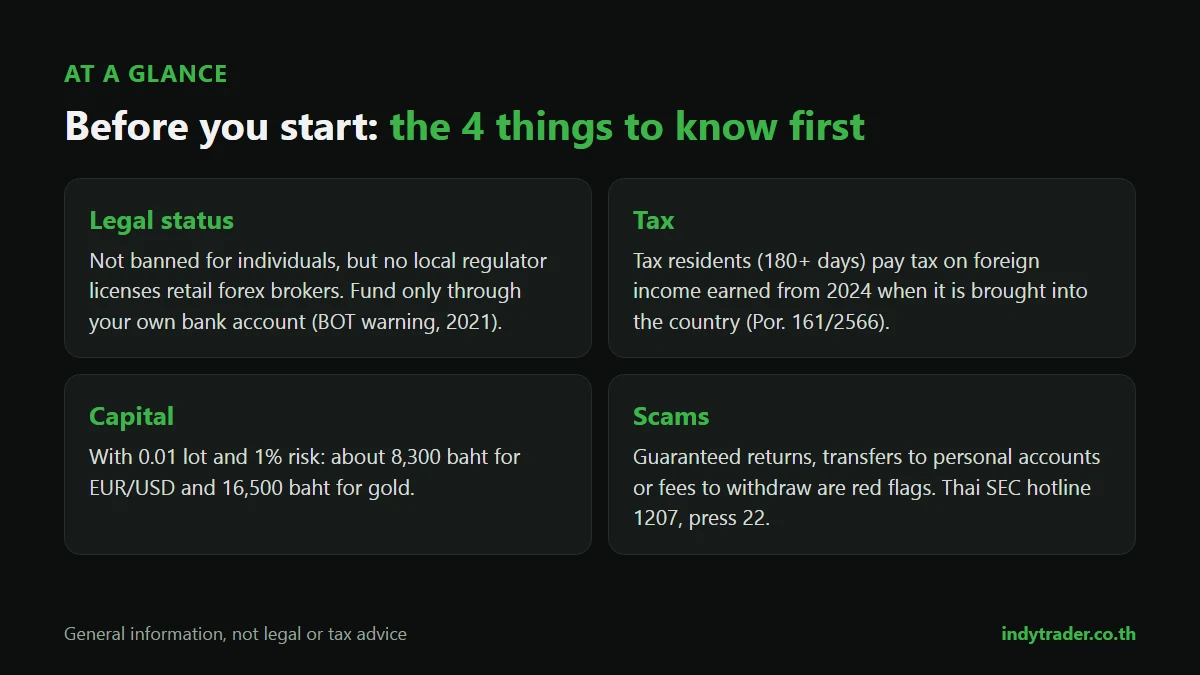
The short version: trading is not prohibited, but it is not regulated for retail clients either.
Question | What the rules say | What it means for you |
|---|---|---|
Does the Thai SEC license forex brokers? | The SEC has said that forex trading is not a securities business under its licensing regime. | There is no Thai-licensed retail forex broker to choose from. |
Who controls foreign exchange? | Foreign exchange services fall under the Exchange Control Act, with licences issued under the Ministry of Finance and supervised by the Bank of Thailand. | Moving money abroad is the regulated part, not the trading itself. |
Has the Bank of Thailand warned about forex? | Yes. In October 2021 the BOT warned that using unlicensed money-transfer services to fund forex trading is an offence. | Fund your account through proper banking channels, never through agents or personal accounts. |
Can I lose money with no local protection? | Yes. Disputes with an offshore provider are handled under that provider's home rules, if at all. | Choose providers regulated by a major overseas regulator and test withdrawals early. |
There are locally regulated leveraged products too: futures on TFEX, including gold and currency contracts, are traded through SEC-licensed brokers. If local regulation matters most to you, compare those before opening an offshore account.
How forex profits are taxed
The Revenue Department's order Por. 161/2566 (15 September 2023) changed the rules for foreign income. From 1 January 2024, Thai tax residents, meaning anyone resident 180 days or more in a tax year, Thais and foreigners alike, must include foreign income in their tax return when it is brought into the country, whichever year that happens.
Trading profits earned on an offshore account and withdrawn to a local bank account fall into this. Keep a record of every deposit and withdrawal, statements from your trading account, and the exchange rates you used. If your profits are material, talk to a tax adviser. Rules for remitting income earned before 2024, and double-tax treaties, can change the answer.
The numbers to know before you start
Pips, lots and what a move costs you
On EUR/USD, one pip is the fourth decimal place (1.0800 to 1.0801). Position size decides what a pip is worth:
Position size | Units of currency | Value of 1 pip on EUR/USD |
|---|---|---|
1 standard lot | 100,000 | About $10 |
0.1 lot (mini) | 10,000 | About $1 |
0.01 lot (micro) | 1,000 | About $0.10 |
Gold (XAUUSD) works differently: 1 lot is 100 ounces, so each $1 move in the gold price changes a 1-lot position by $100 and a 0.01-lot position by $1. More detail: What is a pip and Lot size explained.
How much capital you need, in baht
The 1% rule, risking no more than 1% of your account on any single trade, is what keeps a beginner's account alive through a losing streak. Because the smallest position is 0.01 lot, the 1% rule sets a floor on your capital (assuming $1 = 33 baht):
Market | Typical stop-loss | Risk per trade at 0.01 lot | Minimum account for 1% risk |
|---|---|---|---|
EUR/USD (day trading) | 25 pips | $2.50 (≈ 83 baht) | $250 (≈ 8,300 baht) |
EUR/USD (swing trading) | 60 pips | $6 (≈ 198 baht) | $600 (≈ 19,800 baht) |
Gold (XAUUSD) | $5 price move | $5 (≈ 165 baht) | $500 (≈ 16,500 baht) |
With less money than this you can still practise, but every trade will risk more than 1%. Treat that money as a training cost, not an investment.
Leverage cuts both ways
Leverage lets you control a large position with a small deposit (margin). A 0.01-lot EUR/USD position is worth about $1,080; at 1:100 leverage it needs only about $10.80 of margin. That is why it is easy to open positions far too large for your account. ESMA capped retail leverage at 30:1 for major currency pairs and 20:1 for gold, and offshore providers often offer far more. Using high leverage is optional, so treat it as a ceiling, not a target. Read Leverage and Margin before your first live trade.
When to trade: forex hours in Thai time
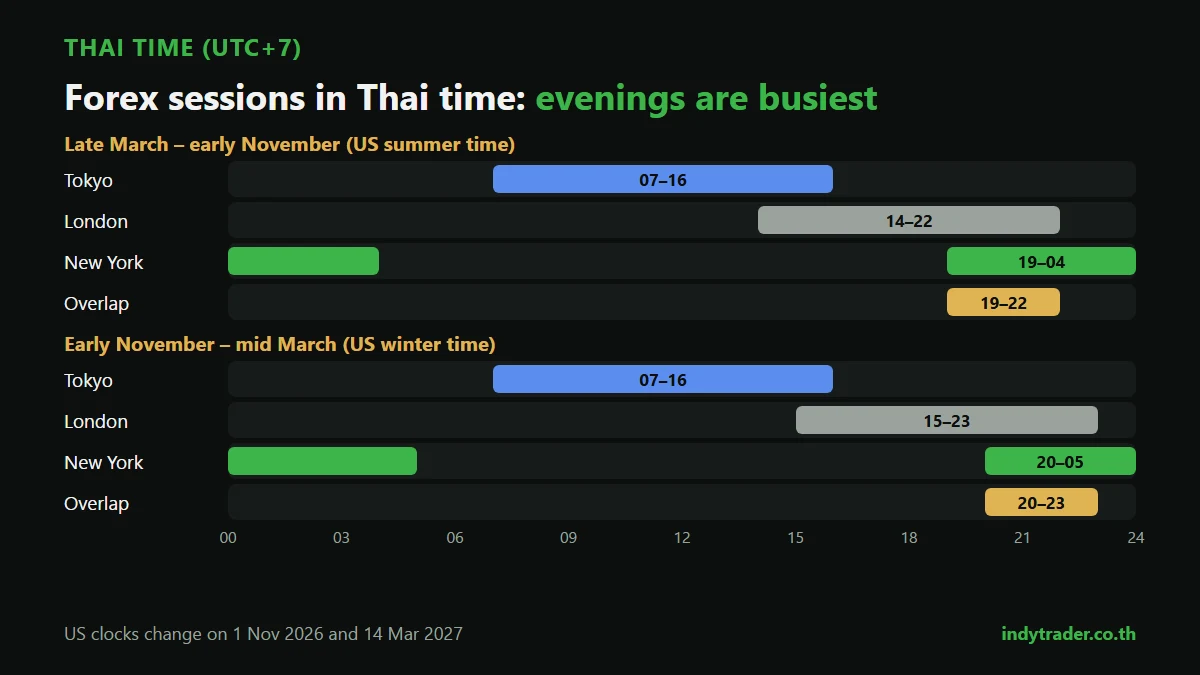
The market runs from Monday morning to Saturday morning Thai time. Volume is highest when the big centres overlap:
Session | Thai time (late Mar to early Nov) | Thai time (early Nov to mid Mar) |
|---|---|---|
Tokyo | 07:00–16:00 | 07:00–16:00 |
London | 14:00–22:00 | 15:00–23:00 |
New York | 19:00–04:00 | 20:00–05:00 |
London–New York overlap (most active) | 19:00–22:00 | 20:00–23:00 |
Thai time does not use daylight saving, so the European and US sessions shift by an hour twice a year. The US moves to winter time on 1 November 2026 and back to summer time on 14 March 2027. The UK changes on slightly different dates. For people with day jobs, the London–New York overlap falls conveniently in the evening Thai time. See the full schedule in Forex market hours.
How to start forex trading: 7 steps
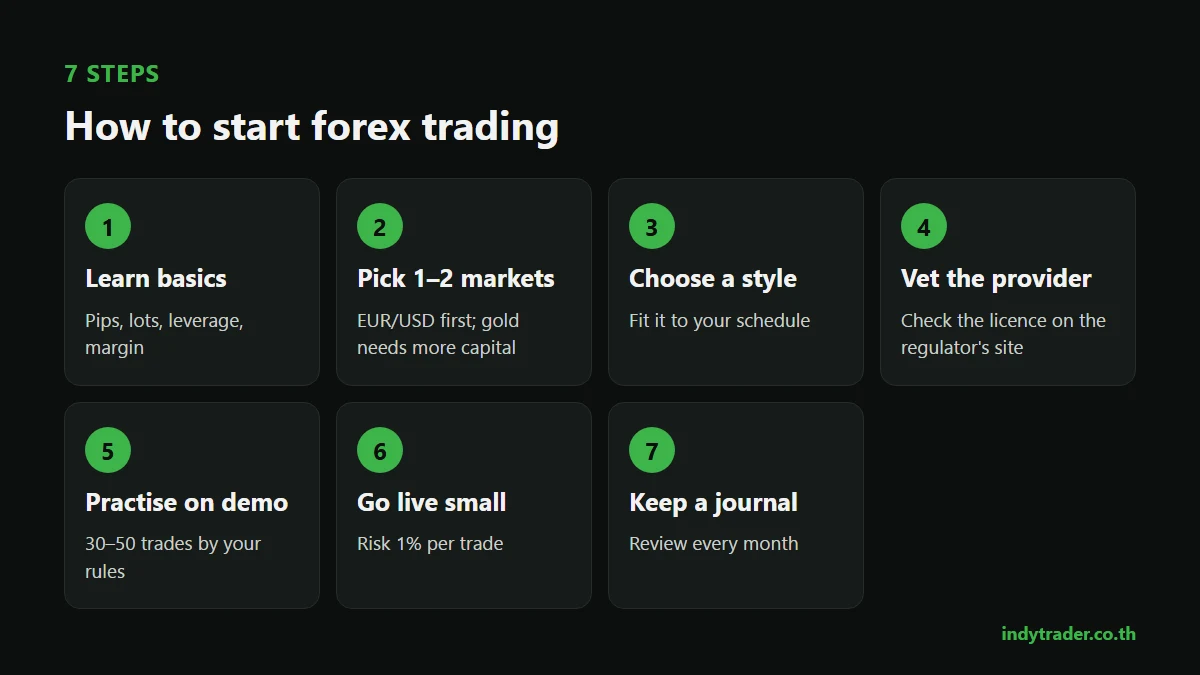
1. Learn the basics before you open an account
Understand what moves currency prices, how a trade makes or loses money, and what pips, lots, leverage, margin and spreads are. Start with What is forex. Two to four weeks of study is enough to begin practising; it is not enough to trade real money.
2. Pick one or two markets
Beginners do better focusing on one or two liquid instruments rather than scanning twenty. EUR/USD is the usual starting point because spreads are tight and moves are steadier. Gold is popular, but it moves several times further per day and needs a larger account. See Best forex pairs for beginners.
3. Choose a trading style that fits your schedule
Style | Holding time | Screen time | Suits |
|---|---|---|---|
Scalping | Seconds to minutes | Several hours of focus | Full-time traders only |
Day trading | Minutes to hours | 1–3 hours in the evening | People with day jobs who trade the London–New York overlap |
Swing trading | Days to weeks | 30–60 minutes a day | People with limited time; needs a larger account for wider stops |
4. Choose a provider carefully
No local licence is available, so do the checking yourself:
Regulation: licensed by a major regulator such as the UK FCA, Australia's ASIC or Cyprus's CySEC, and check the licence number on the regulator's own website, not the broker's.
Client money: segregated client accounts and, ideally, negative balance protection.
Costs: spreads, commission and overnight swap on the instruments you will actually trade.
Funding: deposits and withdrawals through your own bank account in your own name. Never transfer to a personal account or an "agent".
Withdrawals: make a small test withdrawal in your first week. A provider that delays this is a red flag.
5. Practise on a demo account with rules
Open a demo account with the same balance you plan to trade live. Write down your setup, stop-loss rule and position-size rule before you start. Move to live trading only after at least 30–50 demo trades in which you followed your rules, even if some of them lost.
6. Go live small and risk 1% per trade
Start with the smallest position size. Your first goal with real money is to follow the same rules under the pressure of real losses, not to make money. Use a pre-trade checklist on every trade.
7. Keep a journal and review every month
Record each trade: date, instrument, reason for entry, stop-loss, result and whether you followed your plan. After 50–100 trades you will have real data on whether your approach works. Without it, you are guessing. More on protecting your account: Risk management in forex.
A worked example: your first live trade
You have 20,000 baht (about $606) and trade EUR/USD in the evening.
Your rule: risk 1% per trade, so up to $6 (about 200 baht).
Your setup gives a stop-loss 25 pips away.
Position size: $6 ÷ 25 pips = $0.24 per pip, which rounds down to 0.02 lot ($0.20 per pip).
Actual risk: 25 pips × $0.20 = $5, about 165 baht or 0.8% of the account.
Your target is 50 pips away, so a winning trade makes $10 (about 330 baht).
With a 1:2 risk-to-reward ratio, you can be right on only 40% of trades and still come out slightly ahead before costs. That is the real goal of a trading plan: keeping the maths in your favour, not a high win rate.
Common scam warning signs
Forex scams often run through LINE groups, Facebook and dating apps. Walk away if you see any of these:
Guaranteed monthly returns, or "no-loss" trading
Requests to transfer money to a personal bank account
A "fee" or "tax" you must pay before you can withdraw
Pressure to recruit friends or upgrade to a bigger package
A platform you can only reach through a link someone sent you
If you think you have been targeted, the Thai SEC's hotline is 1207, press 22.
Learning on your own vs with an academy
Self-study | Structured course | |
|---|---|---|
Cost | Free to low | Course fee |
Structure | You decide what to learn and in what order | A tested path from basics to a full trading plan |
Feedback | None, unless you find a community | Coaches review your trades and plan |
Risk | Expensive mistakes learned with real money | Mistakes caught earlier, in practice |
Suits | Disciplined learners with time | People who want to shorten the learning curve |
Either path works. What fails is skipping the practice and the risk rules.
Start with a structured plan at Indy Trader
Indy Trader has taught forex and gold trading since 2012. The Road to Trader course for beginners is taught by founder Coach Beer. It covers forex basics, trading mindset, key terms such as pips, lots, leverage and margin, the MT4 platform and the Indy System Trade method, and includes access to the Indy Trader community. See all programmes on our courses page.
Frequently asked questions
Is forex trading legal?
Trading forex is not prohibited for individuals, but the Thai SEC does not license retail forex brokers. Funding an account through unlicensed money-transfer services is an offence, according to the Bank of Thailand. Use your own bank account and a provider licensed by a major overseas regulator.
Do I pay tax on forex profits?
If you are a Thai tax resident (180 days or more in a tax year), foreign income earned from 1 January 2024 is taxable when you bring it into the country, under Revenue Department order Por. 161/2566. This applies to foreign residents as well as Thai nationals.
How much money do I need to start forex trading?
You can open an account with a few hundred dollars, but to keep risk at 1% per trade with a normal stop-loss you need roughly 8,000–10,000 baht for EUR/USD and about 16,500 baht or more for gold.
What is the best time to trade forex in Thai time?
The London–New York overlap, 19:00–22:00 Thai time from late March to early November and 20:00–23:00 from early November to mid-March, has the most volume and tightest spreads for major pairs.
Does this apply to foreign residents?
Yes. The same rules apply: no local retail licence, funding through your own bank account, and the 180-day tax-residency rule for foreign income brought into the country.
How long does it take to become profitable?
There is no fixed timeline, and most retail traders never do, according to ESMA's data. Plan on at least 6–12 months of study, demo practice and small live trading before judging whether your approach works.
Sources
Bank for International Settlements: Triennial Survey 2025 (30 Sep 2025)
ESMA: Product intervention measures on CFDs and binary options (27 Mar 2018)
Bank of Thailand: Warning on unlicensed FOREX service providers (15 Oct 2021)
By the Indy Trader team. Indy Trader is a forex and gold trading academy founded in 2012 by Coach Beer (Tithivat Huayhongtong).
Risk warning: Forex and gold trading carry a high level of risk and you may lose some or all of your capital. Figures in this article are worked examples using an assumed exchange rate, not investment advice or expected returns. This article is general information, not tax or legal advice.
