
Short answer: Copy trading can make money if the trader or system you copy has a real edge and you manage your capital properly. But a follower's results almost never match the source's, because of lot rounding, fees, slippage and when you start copying. What decides your real result is choosing a source from verifiable statistics, using capital that can survive the drawdown, and not switching off out of emotion during a normal losing period.
Copy trading sounds simple: pick a trader or system with good results and let your account copy their trades. But many people who start because of an impressive profit chart find their own account looks very different.
If you're new to the basics, read What is copy trading first. This article picks up from there: why results differ, how to read statistics without being fooled, and how to set your risk rules.
Where copy trading sits with regulators
In 2023 ESMA, the EU's markets regulator, published supervisory guidance on copy trading. It said services that copy trades into a client's account automatically will often count as portfolio management, and services where the client must confirm first may count as investment advice, both licensed activities in Europe. ESMA also expects providers to market accurately and disclose all costs.
The takeaway: copy trading isn't "just a feature". You're handing investment decisions to someone else, so check the provider as carefully as you would a fund manager.
5 reasons your results don't match the source
1. Lot rounding on small accounts
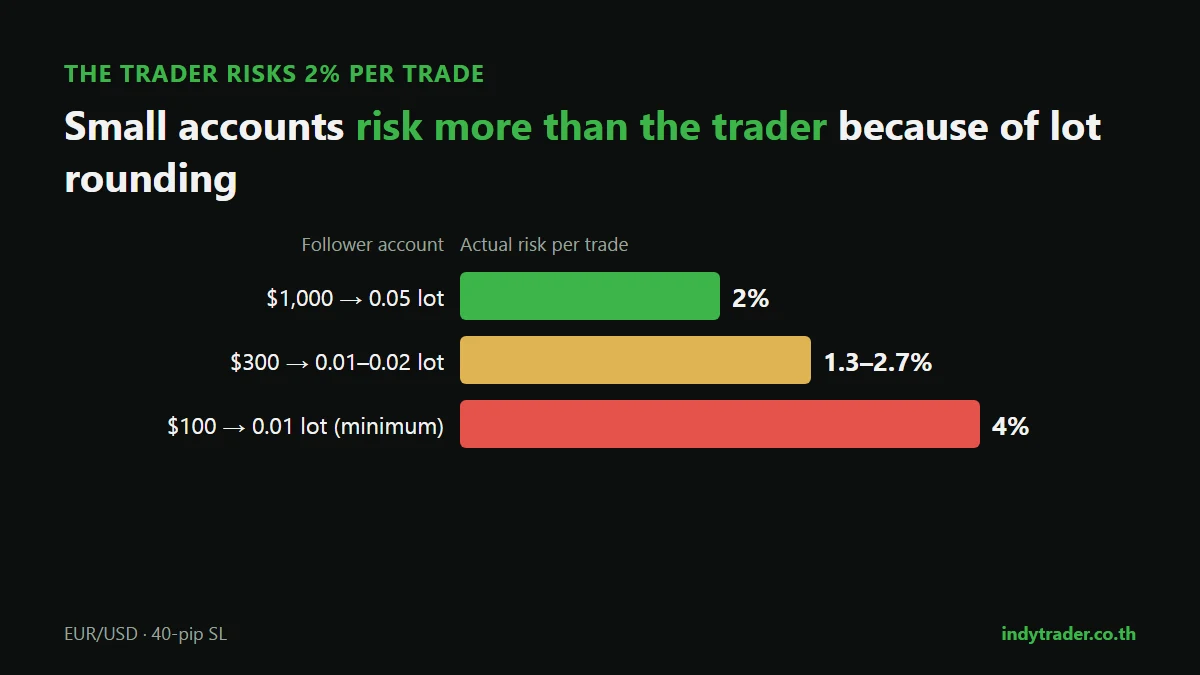
The smallest position is 0.01 lot. When a follower's account is very small, the system must round position sizes up or down, so risk per trade no longer matches the source.
Example: the source account has $10,000 and opens EUR/USD at 0.5 lot with a 40-pip stop-loss, risking $200, or 2% of the account.
Follower account | Proportional size | Size actually opened | Actual risk per trade |
|---|---|---|---|
$1,000 | 0.05 lot | 0.05 lot | $20 (2%), same as the source |
$300 | 0.015 lot | 0.01 or 0.02 lot | $4–8 (1.3–2.7%) |
$100 | 0.005 lot | 0.01 lot (minimum) | $4 (4%), double the source |
Small followers can end up taking more risk than the source without realising, and their drawdown will be deeper than the statistics suggest (see the minimum capital table in How much money do you need to start forex trading).
2. Fees eat into profit
Copy trading services usually charge at least one of: a monthly subscription, a performance fee, or a wider spread. Example: if the source makes +10% in a month on a $1,000 account and there's a 25% performance fee, the follower keeps $75, or 7.5%, before other costs.
Ask whether the performance fee uses a high-water mark, meaning it's charged only on profit that takes the account above its previous peak. If not, you may pay fees on gains that merely recover earlier losses.
3. Slippage and delay
The follower's order always goes in after the source's, even if only by a fraction of a second. During big news the price may already have moved. Losing an average of 2 pips per trade over 20 trades a month is 40 pips; at 0.05 lot that's $20, or 2% of a $1,000 account, every month. Systems that trade often with small targets suffer most.
4. Different providers and spreads
If your account is with a different provider from the source, prices, spreads and candle close times can differ, so the same trade gives a different result (see What is spread).
5. When you start and when you stop
This causes the biggest differences. Most people start copying after several strong months in a row, which is often just before the system's drawdown. Then they stop when the loss gets deep, which is often close to the recovery. The result: they get only the losing stretch, even though the system was positive for the year.
How to read a source's statistics without being fooled
Platforms such as MyFXBook show several figures. These are the ones to understand:
Figure | Means | Watch out for |
|---|---|---|
Gain | Return adjusted for deposits and withdrawals | A high number over a short period says nothing about sustainability |
Abs. gain | Profit relative to actual deposits | If very different from Gain, there were many deposits/withdrawals; read both |
Drawdown | The deepest fall from a peak | The most important number: could you accept it? |
Monthly / Daily | Average compounded return per month or day | A historical average, not what you'll get every month |
Track record / Trading privileges | The platform verifies a real linked account and unedited data | Be extra careful without verification |
Duration | How long the track record runs | Less than a year hasn't seen enough market conditions |
Beware survivorship bias on leaderboards
Copy trading leaderboards show traders who have survived and are doing well right now. Accounts that blew up disappear from the list, so what you see looks better than the reality of everyone who tried the same thing.
Beware profit curves that are too smooth
Martingale or grid systems that add size when losing often show a smooth, straight-line profit curve for months, because they never close at a loss, until the market runs far enough one way and the account takes a heavy hit in one go. If you see an unusually high win rate with many trades left open for a long time, check the strategy first (see Grid trading).
6 risk rules for followers
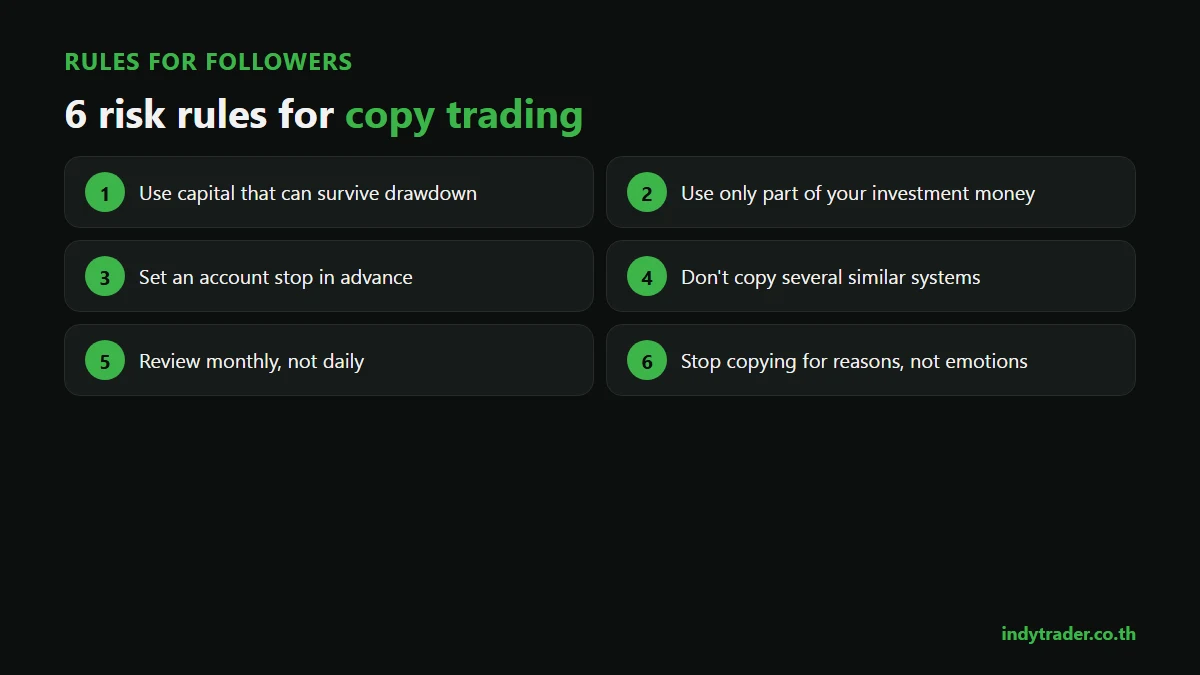
Use capital that can survive the drawdown. If the worst historical drawdown is 35%, assume the future may be deeper, and ask whether you could accept a 40–50% fall
Use only part of your investment money. Copy trading belongs in the high-risk part of your finances, not your savings
Set an account stop. Decide in advance at what level you'll pause and review. Set it deeper than the system's normal drawdown so you don't stop too early
Don't pick several similar sources. 3 gold trend-following systems aren't diversification: they'll lose together when gold has no trend
Review monthly, not daily. Check whether results stay within the historical range, rather than judging from one losing day
Stop copying for reasons, not emotions, such as a drawdown clearly beyond the historical record, or the strategy changing from what was described
Example: same system, two followers, different results
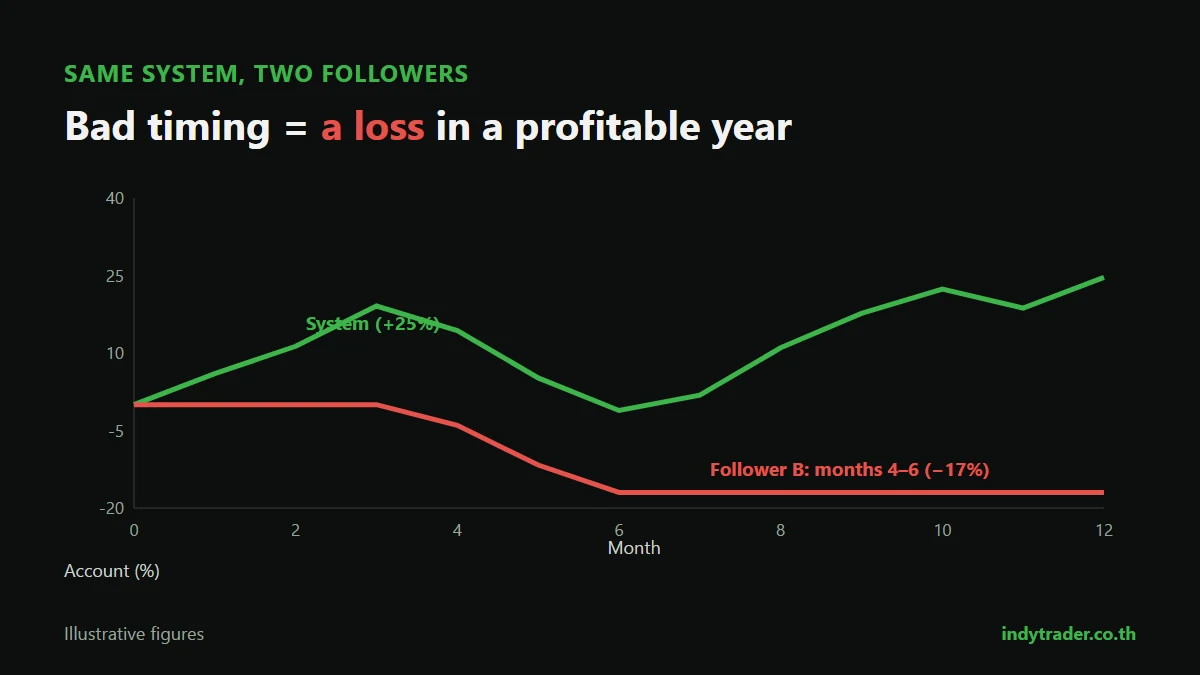
Say a source system's monthly results over a year are (illustrative): +6%, +5%, +7%, −4%, −8%, −6%, +3%, +9%, +6%, +4%, −3%, +5%, about +25% for the year.
Follower A starts in month 1, uses capital that can handle the drawdown, and copies all year. Their result is close to the source's after fees
Follower B sees 3 profitable months and starts in month 4, hits 3 losing months in a row (about −17%), can't take it and stops at the end of month 6. Result: a loss of about 17%, although the same system was positive for the year
The difference isn't the system; it's expectations and decisions. Before copying, check the longest losing streak the system has had, and ask whether you could sit through it. If not, copy with less money from the start.
Starting copy trading systematically: 5 steps
Decide how much to use: money you can lose entirely, within the share of your investments you've set
Shortlist sources from statistics: at least 1 year of verified results, a drawdown you can accept, and an explainable strategy
Write your rules in advance: how much capital, where your account stop is, and when you'll stop copying
Start small: try 1–3 months to compare your account with the source's and see how much lot rounding and slippage cost
Review monthly with numbers, comparing against the historical statistics, not your feelings on a losing day
Copy trading vs the alternatives
Copy trading | Signals | Trading yourself | |
|---|---|---|---|
Who places trades | Copied automatically | You, following the signal | You |
Time needed | Little | You must be free when signals arrive | A lot |
Difference from source | Lot rounding, fees, slippage | Bigger: late or missed entries | No source |
Learning | Little unless you study | You learn from each signal's reasoning | The most |
More on signals in What are forex signals and on automated systems in Can AI really trade forex.
Red flags in copy trading services
Asking you to transfer money to a personal account or the provider's account instead of a trading account in your name
Asking for your trading account's master password, which normal copy trading doesn't need
Guaranteed monthly returns
No third-party verification, or a hidden drawdown
The US regulator CFTC has cited Mirror Trading International, which claimed to use a forex trading bot and caused losses of about $1.7 billion. If you suspect a scam, call the Thai SEC hotline 1207, press 22.
AI Auto Trade: Indy Trader's gold copy trading
Indy Trader's AI Auto Trade copies trades from 2 gold strategies, Gold Apex (trend following) and Gold Ranger (trend + momentum), into the user's own trading account on MT4/MT5. Results, including drawdown, are published on MyFXBook, and the team helps users size their capital to the risk they can accept.
Summary
Copy trading can make money with a good source and proper capital management, but your results will always differ from the source's because of lot rounding, fees, slippage and when you start and stop. Look at drawdown before profit, use capital that can survive losing periods, and decide from statistics, not emotions.
Understand the system before you copy it
The Road to Trader course for beginners, taught by founder Coach Beer, covers forex basics, trading mindset, key terms such as pips, lots, leverage and margin, the MT4 platform and the Indy System Trade method, with access to the Indy Trader community.
Frequently asked questions
Does copy trading really make money?
It can, if the source has a real long-term edge and the follower's capital suits the drawdown. But followers usually earn less than the source because of fees, slippage and lot rounding, and can lose money.
Why don't my copy trading results match the source?
The main causes are lot rounding on small accounts, fees, slippage, a different provider, and when you started or stopped copying.
What's the minimum capital for copy trading?
Enough that your position sizes stay proportional to the source without rounding up, and that the worst historical drawdown wouldn't stop you out. Gold usually needs more capital than major currency pairs.
What's the difference between copy trading and signals?
Copy trading opens and closes trades in your account automatically. With signals, you place the trades yourself. Signals take more time, but you learn more from each trade's reasoning.
When should I stop copy trading?
When the drawdown clearly exceeds the historical record, the strategy changes from what was described, or you reach the account stop you set in advance. Don't stop just because of a short loss within the system's normal range.
Sources
ESMA: Supervisory Briefing on Copy Trading Services (30 Mar 2023)
CFTC: Customer Advisory: AI Won't Turn Trading Bots into Money Machines (25 Jan 2024)
ESMA: Product intervention measures on CFDs and binary options (27 Mar 2018)
By the Indy Trader team. Indy Trader is a forex and gold trading academy founded in 2012 by Coach Beer (Tithivat Huayhongtong).
Risk warning: Forex and gold trading carry a high level of risk and you may lose some or all of your capital. Figures in this article are illustrative only. Past performance is not a guide to future results.
