
Short answer: Technically, you can open a forex account with a few hundred to a few thousand baht and trade as little as 0.01 lot. But the capital you need to trade properly, risking no more than 1% per trade, starts at about 8,000–10,000 baht for EUR/USD and about 16,000–20,000 baht for gold (XAUUSD) with normal stop-loss distances. Less than that is fine for practice, but it forces you to risk too much on each trade.
Ask "what's the minimum to trade forex?" and the answer is usually a provider's minimum deposit, such as $10 or $100. That's true in the sense that you can open an account, but it doesn't answer the more important question: how much do you need to trade systematically without blowing up the account?
This article separates the 3 numbers people confuse, the minimum deposit, the minimum trade size and the capital you actually need, and works through the maths in baht to show why too little capital makes beginners lose money faster.
Three numbers to tell apart
Number | Means | Example | What to know |
|---|---|---|---|
Minimum deposit | The least a provider lets you open an account with | Usually $10–250, depending on the provider | Opening an account doesn't mean you can trade safely |
Minimum trade size | The smallest position you can open | Usually 0.01 lot (micro lot) | Sets the smallest possible risk per trade |
Capital you actually need | Money that lets you risk 1–2% per trade | Depends on the market and stop-loss distance | This is the real answer to the question |
If lots and pips are new to you, read Lot size and What is a pip first.
Why a small account is riskier than it looks
The risk rule traders use most is to risk no more than 1–2% of the account on a single trade, so you can survive a run of losses (more in Forex risk management).
The problem is that the smallest trade size is fixed. Assuming $1 = 33 baht:
EUR/USD at 0.01 lot: each 1-pip move is worth about $0.10
With a 25-pip stop-loss, normal for day trading, the smallest possible risk is 25 × 0.10 = $2.50 (about 83 baht) per trade
With a 3,000-baht account, 83 baht is 2.8% of the account per trade, already over the 1–2% rule on the first trade, even at the smallest size
So traders with very small accounts must choose between stops so tight they get hit constantly, or risk per trade so high that a few losses wipe them out. That's one reason ESMA's 2018 data found 74–89% of retail CFD accounts lost money.
Minimum account for the 1% rule, in baht
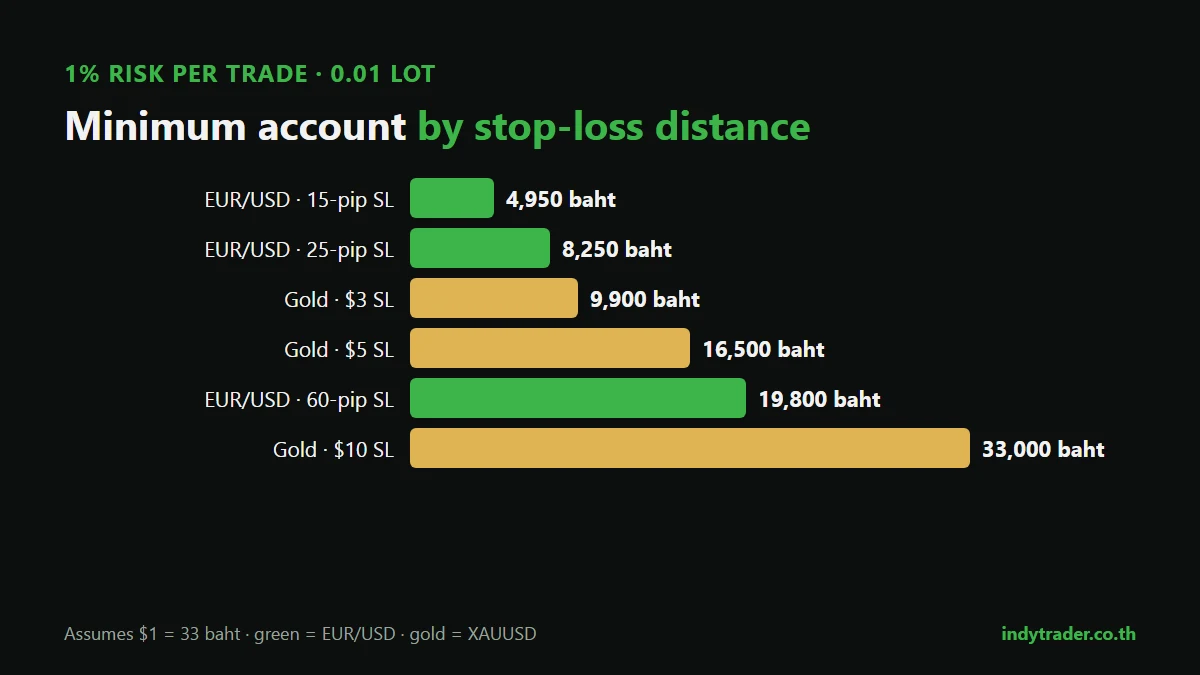
This table shows the smallest account that keeps risk at 1% when trading 0.01 lot (assuming $1 = 33 baht):
Market | Stop-loss | Risk per trade at 0.01 lot | Minimum account for 1% |
|---|---|---|---|
EUR/USD | 15 pips (short-term) | $1.50 (≈ 50 baht) | $150 (≈ 5,000 baht) |
EUR/USD | 25 pips (day trading) | $2.50 (≈ 83 baht) | $250 (≈ 8,300 baht) |
EUR/USD | 60 pips (swing) | $6 (≈ 198 baht) | $600 (≈ 19,800 baht) |
Gold XAUUSD | $3 of gold price | $3 (≈ 99 baht) | $300 (≈ 9,900 baht) |
Gold XAUUSD | $5 of gold price | $5 (≈ 165 baht) | $500 (≈ 16,500 baht) |
Gold XAUUSD | $10 of gold price | $10 (≈ 330 baht) | $1,000 (≈ 33,000 baht) |
How to read it: 0.01 lot of gold is 1 ounce, so a $1 move in the gold price changes the account by $1. Gold moves more than major currency pairs, so it usually needs wider stops and a bigger account. More on gold capital in How much capital to trade gold.
The point of the table: your trading style and market decide your minimum capital far more than the provider's minimum deposit. Someone who wants to swing trade gold with 3,000 baht can't follow the risk rule at all.
Margin and leverage: being able to open a trade doesn't mean you should
Leverage lets you use less money than the position is worth. For example, 0.01 lot of EUR/USD is worth about €1,000, or about $1,080 at 1.0800. At 1:100 leverage it needs only about $10.80 of margin.
That number makes many people think $100 can open 9 trades. But what decides whether an account survives isn't margin. It's how far the price can move against you. The bigger the position relative to the account, the shorter the distance before a margin call or stop-out. See What is margin and What is leverage.
Example: 10,000 baht and an oversized position
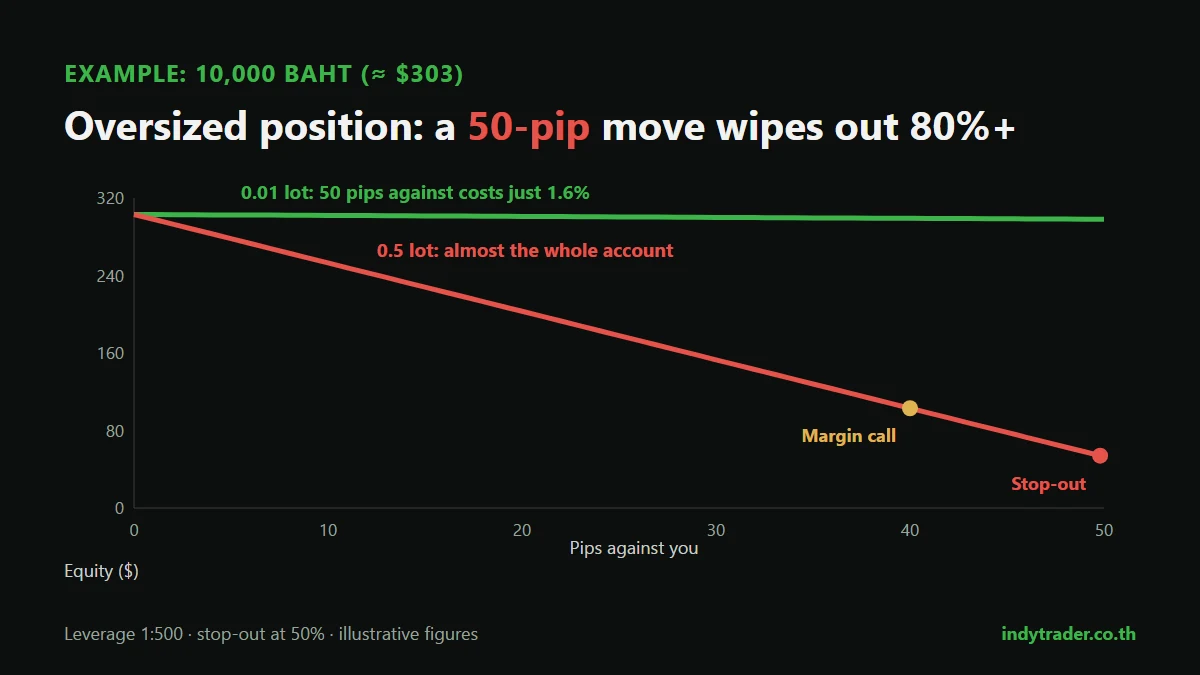
Say you have 10,000 baht (about $303), 1:500 leverage, and a stop-out level of 50% margin level (providers differ):
Open EUR/USD at 0.5 lot, using about $108 of margin. It looks like plenty is left
At 0.5 lot, each pip is worth $5
Price moves 20 pips against you: equity falls to $203 (margin level about 188%)
40 pips against: equity $103 (margin level about 95%); you get a margin call
About 50 pips against: equity around $54 hits the stop-out level and the platform closes the trade. More than 80% of the account is gone on one trade
A 50-pip daily move in EUR/USD is normal. At 0.01 lot, the same 50 pips costs just $5, or 1.6% of the account. The difference comes from position size, not from the starting capital.
What each level of capital is good for
Capital (approx.) | Good for | Limits |
|---|---|---|
0 baht | A demo account to learn the platform and your system | No real emotional pressure |
1,000–5,000 baht | A "tuition fee": feeling real money in amounts you can lose | Can't follow the 1% rule; treat it as training, not investing |
8,000–20,000 baht | Trading major pairs systematically, risking 1–2% per trade | Gold still needs tight stops; limited choice of style |
30,000 baht and up | Both currency pairs and gold, with more choice of style | Profits in baht are still modest; don't expect a main income |
Whatever the amount, it must be money you can lose entirely without affecting your life: not emergency savings, not a loan.
Setting realistic profit expectations for your capital
Capital decides how much profit means in baht. Illustrative maths only, not expected returns:
Capital | A +2% month | A +5% month | A −5% month |
|---|---|---|---|
10,000 baht | +200 baht | +500 baht | −500 baht |
30,000 baht | +600 baht | +1,500 baht | −1,500 baht |
100,000 baht | +2,000 baht | +5,000 baht | −5,000 baht |
This explains why people with small accounts often feel profits are "too small" and raise their lot size beyond the risk rule, which is how accounts get blown. Early on, the goal should be consistent statistics, not the amount of money.
Why risk per trade matters more than starting capital
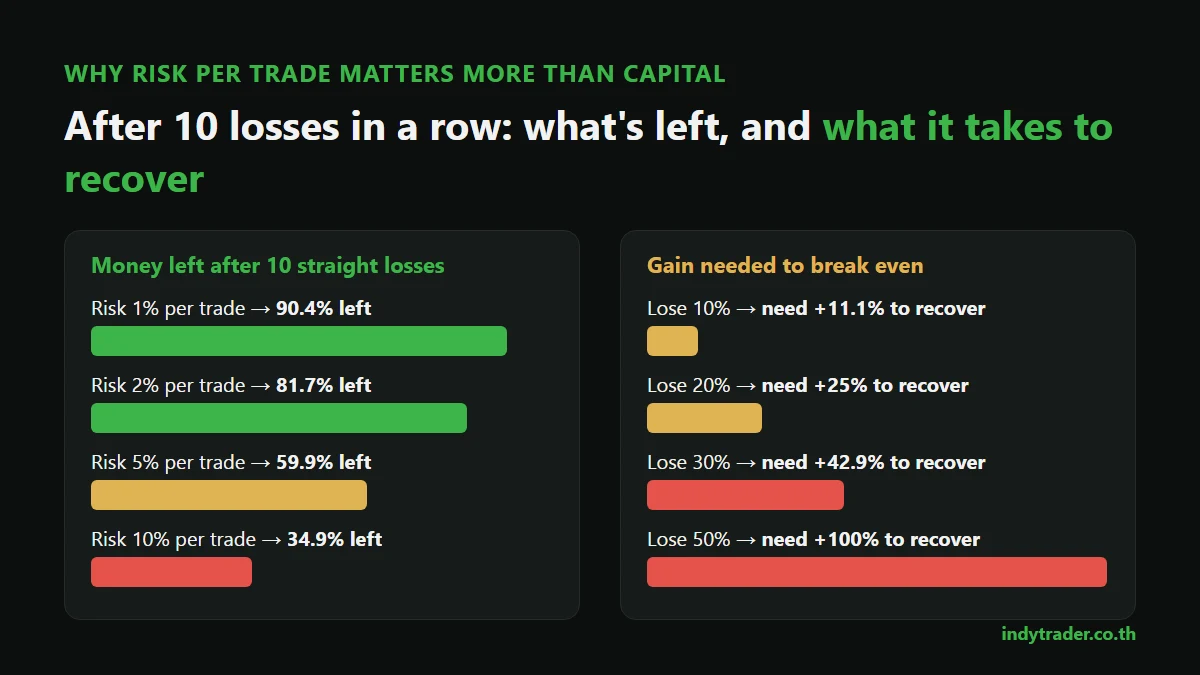
Every trading system has losing streaks. The question is how much is left when one comes. This table shows the account after 10 losses in a row at different risk levels:
Risk per trade | Left after 10 losses in a row | A 20,000-baht account becomes |
|---|---|---|
1% | 90.4% | about 18,080 baht |
2% | 81.7% | about 16,340 baht |
5% | 59.9% | about 11,980 baht |
10% | 34.9% | about 6,980 baht |
And once you've lost, getting back is harder than it looks, because you're growing a smaller base:
Loss | Gain needed to break even |
|---|---|
10% | 11.1% |
20% | 25% |
30% | 42.9% |
50% | 100% |
That's why professional traders protect capital before chasing profit. A 20,000-baht account risking 1% per trade will last longer than a 100,000-baht account risking 10%.
Costs to budget for on top of capital
Spread: the gap between buy and sell prices, paid on every trade (see What is spread)
Commission: some accounts charge per lot
Swap: a charge or credit for holding positions overnight
Currency conversion and transfer fees: depositing and withdrawing in baht may cost more than you expect
These costs weigh more heavily on small accounts, because they're a bigger share of the balance.
Forex vs other ways to invest
Option | Typical starting amount | Thai regulator | How it differs from forex |
|---|---|---|---|
Forex / gold CFDs | Thousands to tens of thousands of baht (see table above) | No Thai SEC licence for retail providers | Leverage means losses can exceed the margin used, fast |
SET stocks | Minimum 100 shares; low-priced shares from a few hundred baht | SEC and the Stock Exchange of Thailand | Bought with cash, no leverage, you own part of a company |
Mutual funds | Some from a few hundred baht or less | SEC | Professionally managed, diversified |
96.5% gold bars | Depends on the day's price; small bars from a few thousand baht | Gold Traders Association sets reference prices | You hold real gold, no leverage, never force-closed |
TFEX futures | Margin per contract | SEC and the Stock Exchange of Thailand | Has leverage too, but traded on a regulated Thai exchange |
Forex isn't "better" or "worse" than the others. It needs more skill and risk management, because leverage makes both gains and losses happen faster than buy-and-hold investing.
Law, tax and scams to know before you transfer money
Legal status: The Thai SEC says forex trading is not a securities business it licenses, and foreign exchange services fall under the Exchange Control Act. The Bank of Thailand has warned that using unlicensed money-transfer services to fund forex trading may be an offence, so check deposit and withdrawal channels carefully before transferring.
Tax: Under Revenue Department order Por. 161/2566, people resident 180 days or more in a tax year must include foreign income earned from 2024 onward when it is brought into the country. Keep records of deposits and withdrawals, and get tax advice if your profits are significant.
Scams: Common warning signs are guaranteed monthly returns, transfers to personal bank accounts, being asked to top up to "unlock" a withdrawal, and pressure to decide quickly. If you suspect a scam, call the SEC hotline 1207, press 22.
5 ways to start safely with a small account
Practise on demo first, with a virtual balance equal to your real capital
Choose a market that fits your capital: small accounts suit major pairs better than gold
Choose a style whose stop-loss fits your capital, using the table above
Use low leverage, even if the provider offers more
Add capital from income, not by taking more risk, and only once your statistics are good enough
For the bigger picture, read How to become a forex trader and How to trade forex for beginners.
Summary
You can open a forex account with a few hundred to a few thousand baht, but the capital that lets you trade with a system depends on the market and your stop-loss: around 8,000–10,000 baht for major currency pairs and around 16,000–20,000 baht or more for gold. Less than that is fine for practice, but treat it as a training cost, not money you expect a return on.
Start with understanding at Indy Trader
The Road to Trader course lays the foundations for beginners, including the terms behind capital and risk calculations, such as pips, lots, leverage and margin, plus the MT4 platform and basic trading principles, so you start with understanding from day one.
Frequently asked questions
What is the minimum to start forex trading?
Minimum deposits depend on the provider, usually $10–250. But the capital that lets you keep risk at 1% per trade starts at about 8,000–10,000 baht for EUR/USD and about 16,000–20,000 baht for gold.
Can I trade forex with 1,000 baht?
You can open trades, but you can't follow the 1–2% risk rule, because the smallest position is a large share of the account. Treat this amount as a training cost, or start with a demo account.
Why does gold need more capital than currency pairs?
Gold moves more than major pairs, so it needs wider stops. At 0.01 lot, a $1 move in gold is $1, so a $5 stop risks about 165 baht per trade.
Does high leverage help a small account?
Leverage reduces the margin needed, but it doesn't reduce risk per trade, which depends on position size and stop-loss distance. High leverage on a small account makes it easy to open positions that are too big.
When should I add more capital?
When you have several months of statistics showing you follow your system consistently, and the extra money is still money you can lose. Don't add capital to win back losses.
Do I pay tax on forex profits?
People resident 180 days or more in a tax year must include foreign income earned from 2024 onward when it is brought into the country, under Revenue Department order Por. 161/2566. Keep records of every deposit and withdrawal.
Should a small account trade gold or currency pairs first?
Below about 15,000 baht, major pairs such as EUR/USD make it easier to follow the risk rule, because they need tighter stops than gold. Move to gold as your capital and experience grow.
Sources
ESMA: Product intervention measures on CFDs and binary options (27 Mar 2018)
Bank of Thailand: Warning on unlicensed FOREX service providers (15 Oct 2021)
By the Indy Trader team. Indy Trader is a forex and gold trading academy founded in 2012 by Coach Beer (Tithivat Huayhongtong).
Risk warning: Forex and gold trading carry a high level of risk and you may lose some or all of your capital. Figures in this article are illustrative calculations using an assumed exchange rate, not investment advice or expected returns.
