
Short answer: You don't need a degree or a licence to trade forex on your own account, but you do need to work through 5 steps: (1) learn the basics, (2) practise on a demo account, (3) build and test a trading system, (4) learn to manage risk and your own emotions, and (5) start with a small amount of real money. Most people need 6–12 months to trade with a system and 1–2 years or more to build consistent results. Before you start, know that most retail traders lose money, and that choosing a lawful provider is something you have to check yourself.
On social media, "forex trader" usually means working from a beach and making thousands of baht a day. What rarely gets shown is the first year of practice with almost no income, the losing streaks that make many people quit, and the people who trust unlicensed providers and lose their money.
This guide comes from an academy that has taught traders since 2012. It covers the whole path: what being a trader actually means, the steps of training, how much capital you need in baht, a realistic schedule for people with day jobs, and the legal and tax points to know. If you mainly want the practical setup (law, tax, accounts and trading hours), read How to Start Forex Trading.
What is a forex trader, and what kinds are there?
Forex is the world's largest financial market. The Bank for International Settlements' 2025 Triennial Survey put average daily turnover at about $9.6 trillion, up 28% from 2022. Many kinds of participants trade it, and "trader" can mean different jobs. (For the basics, see What is forex.)
Type | Trades for | What it takes | Suits |
|---|---|---|---|
Retail trader | Their own account | Knowledge, a trading system, their own capital | Anyone, part-time or full-time |
Prop / funded trader | A firm that provides capital and shares profits | Passing the firm's evaluation, usually for a fee | People who have a system but little capital |
Institutional dealer | A bank or financial institution | A finance degree and a job offer | People who want a salaried finance career |
This guide focuses on the first path, which is the one most people mean. A retail trader's work is more than clicking buy or sell: it includes analysing the market, planning entries and exits, setting risk, and keeping records to improve.
Three facts to know before you decide
1. Most retail traders lose money. The European Securities and Markets Authority (ESMA) reviewed data from several national regulators in 2018 and found that 74–89% of retail CFD accounts lost money. The main causes were excessive leverage, no system and no risk control. It isn't impossible to succeed, but "let's just try it" usually ends with losses.
2. Income depends on capital, not just skill. Say you have 30,000 baht. Even a strong 3% month makes about 900 baht, far from a living. (This is an illustrative calculation, not an expected return.) That's why most traders start alongside a job.
3. Forex isn't gambling, but it becomes gambling without a system. The difference is having rules, testing them and controlling risk. More in Is forex gambling?
The 5-step path to becoming a forex trader
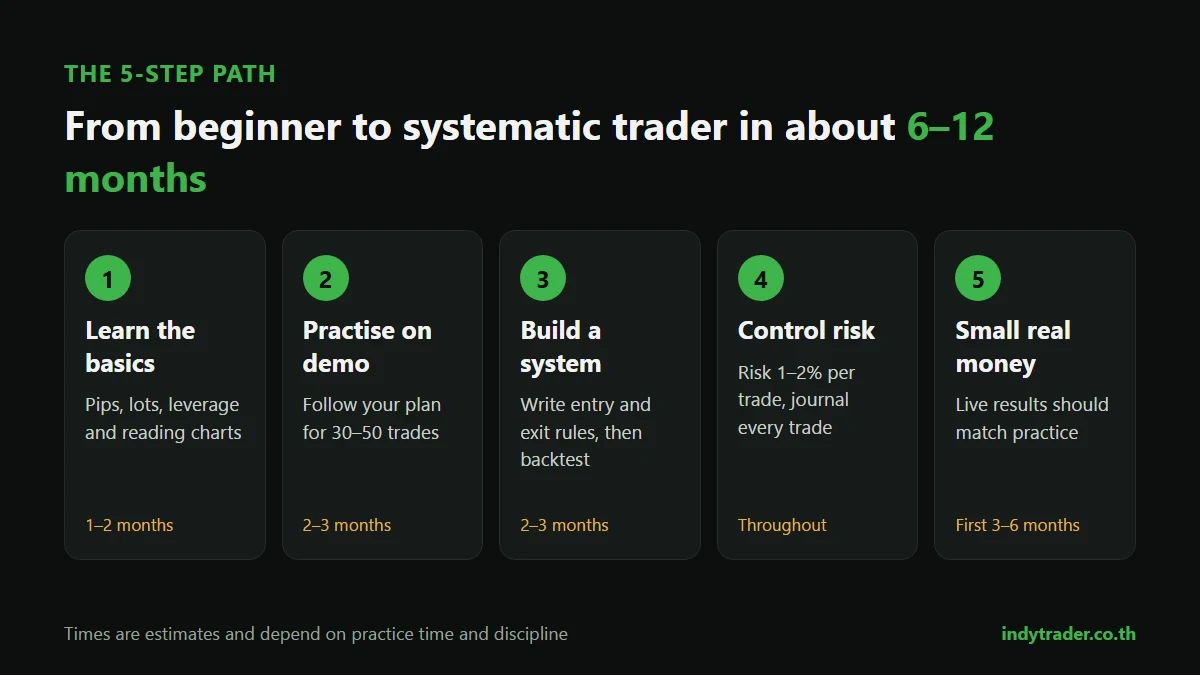
Step | What you do | Approx. time | You've passed when |
|---|---|---|---|
1. Learn the basics | Currency pairs, pips, lots, leverage, chart reading | 1–2 months | You can say how much each trade makes or loses |
2. Practise on demo | Learn MT4/MT5, open and close orders | 2–3 months | You've followed your plan for 30–50 trades without breaking a rule |
3. Build a system | Write entry and exit rules, then backtest | 2–3 months | Your rules are written down and tested on past data |
4. Risk and mindset | Set risk per trade, keep a journal | Throughout | You never risk more than planned, even after losing streaks |
5. Small real money | Use money you can lose, follow the system | First 3–6 months | Live results are close to your practice results |
Step 1: Learn the basics until you can do the maths
The goal of step 1 isn't to memorise jargon. It's to calculate how much each trade makes or loses, because that's the skill that separates systematic traders from guessers.
You need to understand currency pairs and bid/ask prices, pips, lot size, leverage and candlestick charts. Examples you should be able to work out:
EUR/USD at 1 lot: a 1-pip move is worth about $10
At 0.10 lot: a 1-pip move is worth about $1
Buy EUR/USD 0.10 lot at 1.0800. If it rises to 1.0850 (50 pips), you make about $50; if it falls to 1.0770 (30 pips), you lose about $30
A fuller beginner walkthrough is in How to trade forex: 5 steps for beginners.
Step 2: Practise on demo as if it were real
A demo account lets you trade real market prices with virtual money. The most common mistake is setting the demo balance far too high and opening big positions because "it's not real". That habit follows you to a live account.
What works: set the demo balance close to what you'll really use (for example $1,000, around 30,000–35,000 baht), size trades with the same risk rules you'll use live, and record every trade. A good bar is following your plan for 30–50 trades without breaking a rule before moving on.
Step 3: Build a trading system that fits you
A trading system is a set of written rules that answers 6 questions:
What do you trade (for example EUR/USD or gold, XAUUSD)?
Which timeframe?
What conditions trigger an entry?
Where do you take profit?
Where is your stop-loss?
How much do you risk per trade?
No system is best for everyone. People with day jobs often suit swing or position trading, which doesn't need constant screen time, while people free during the day may suit day trading (compare them in 4 types of forex trading strategy). Once you have rules, backtest them on past data before risking money. The full process is in Forex trading system.
Step 4: Manage risk with numbers, not feelings
The widely used rule is to risk no more than 1–2% of your account on any single trade, and always use a stop-loss. Two examples of sizing a position from your risk:
Example 1: EUR/USD
Account: $1,000 (about 33,000 baht at an assumed $1 = 33 baht)
Risk 1% = $10 (about 330 baht)
Stop-loss distance = 25 pips
Position size = 10 ÷ (25 × 10) = 0.04 lot
Example 2: Gold (XAUUSD)
Same account and $10 risk
1 lot of gold = 100 ounces, so a $1 price move = $100 per lot ($1 per 0.01 lot)
Stop-loss distance = $5 of gold price
Position size = 10 ÷ (5 × 100) = 0.02 lot
At 1% per trade, it takes dozens of losses in a row to badly damage the account, which gives you time to learn and adjust. Risking 20–30% per trade can wipe you out in a handful of losses. More in Forex risk management and How much capital to trade gold.
On the mindset side, practise following your system right after a loss, never trading to "win it back", and accepting that some losses are the normal cost of any system. A trading journal and a pre-trade checklist show you your own patterns of mistakes.
Step 5: Move to real money gradually
Once you meet the criteria for steps 1–4, start with money you can afford to lose. The aim of the first 3–6 months is to show that live results are close to practice results, not to maximise profit. Many people find their decisions change when the money is real, and starting small lets you adjust without big damage.
How long does it take to become a trader?
Stage | Timeframe | What happens |
|---|---|---|
Beginner | 0–6 months | Learn the basics, practise on demo, try different approaches |
Developing | 6–24 months | Trade small real money, build your own statistics, refine your system |
Established | 2+ years | A verifiable track record, risk managed across different market conditions |
It depends on how many hours a week you practise, how consistently you keep records, and whether someone points out your mistakes. People who learn in a structured order usually get through trial and error faster than those learning from many conflicting sources.
A day in the life of a part-time trader
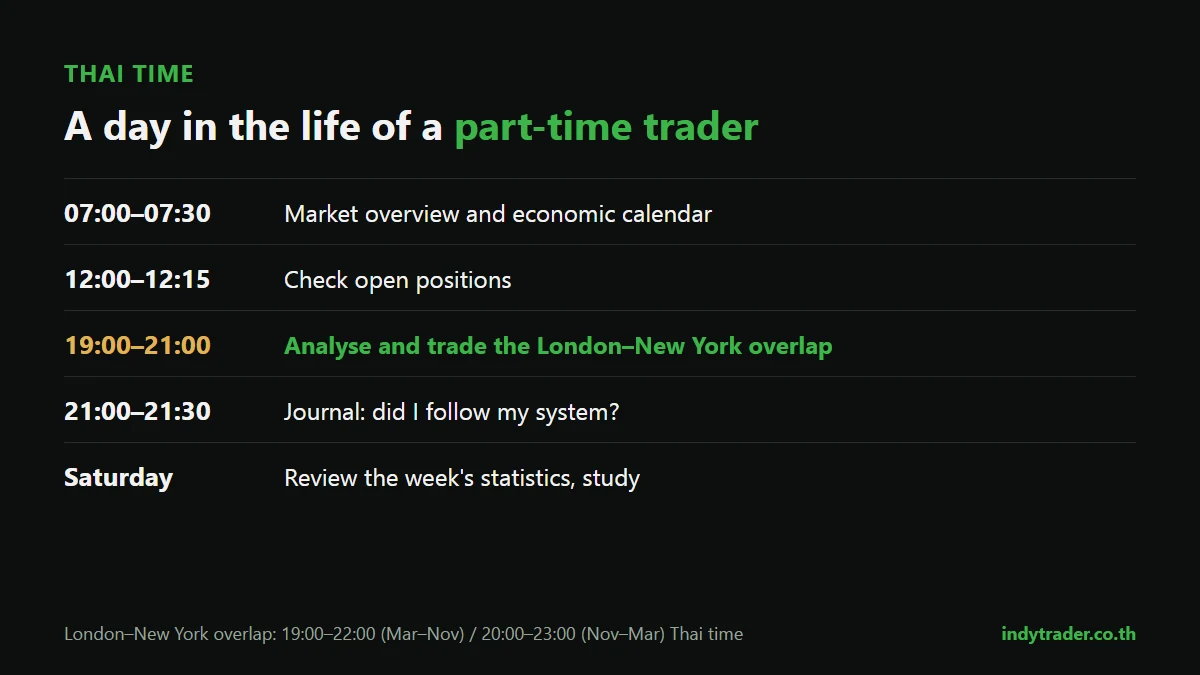
A big advantage of forex on Thai time is that the busiest part of the market falls after office hours. A sample schedule for someone with a day job who swing or day trades:
Time (Thai time) | Activity |
|---|---|
07:00–07:30 | Check the market overview and the day's economic calendar |
12:00–12:15 | Check open positions (no trading at work) |
19:00–21:00 | Analyse and trade during the London–New York overlap, the most active period |
21:00–21:30 | Update your journal, check whether you followed your system |
Saturday | Review the week's statistics, study |
The London–New York overlap runs about 19:00–22:00 Thai time during US daylight saving time (March–November) and 20:00–23:00 in winter (November–March). See the full timetable in Forex market hours.
The skills that separate those who last from those who quit
Discipline: following your rules when nobody is making you
Probabilistic thinking: judging a system by dozens of trades, not one
Emotional control: not getting greedy after wins or panicking after losses
Self-knowledge: choosing a style that fits your time and temperament. This is the core of the Identity Trading approach Indy Trader has always taught
Continuous learning: markets change, so systems need regular review
7 mistakes that stop beginners reaching their goal
Skipping straight to real money before having a tested system
Using too much leverage, so a few losses do serious damage
Trading without a stop-loss and hoping the price comes back
Changing systems after every loss, so you never learn what works
Revenge trading after a loss with a bigger position
Believing high-return adverts instead of checking verifiable statistics
Not keeping a journal, so the same mistakes repeat unnoticed
Law, tax and scams: what you need to know
This is the part most guides skip, and one of the most important.
Who regulates forex? The Thai SEC has said that foreign exchange trading is not a securities business; providers need a licence from the Ministry of Finance under the Exchange Control Act. The Bank of Thailand has warned that offering unlicensed money-transfer services so people can trade forex online is an offence. Always check a provider's status before using it.
Signs of a scam include guaranteed fixed monthly returns, being asked to transfer money for someone else to trade for you, rewards for recruiting others, and apps or websites that won't let you withdraw. To report a suspected scam, call the SEC hotline 1207, press 22.
Tax. Under Revenue Department order Por. 161/2566, anyone resident 180 days or more in a tax year must include foreign income earned from 2024 onward in the year it is brought into the country. If trading becomes a significant income, talk to a tax adviser.
Capital. Use only money you can afford to lose: never emergency savings, loans or money your family needs.
Learning on your own vs with an academy
Self-study | Academy or coach | |
|---|---|---|
Cost | Low; lots of free material | Course fees |
Order of learning | You filter and sequence it yourself | A step-by-step curriculum |
Spotting mistakes | From your own records | A coach reviews with you |
Community | Find it in online groups | Classmates to learn with |
Suits | People with lots of time who like research | People who want less trial and error |
Both paths can work. What both need is real practice, not just watching videos or reading theory.
Ready for real money? Check yourself
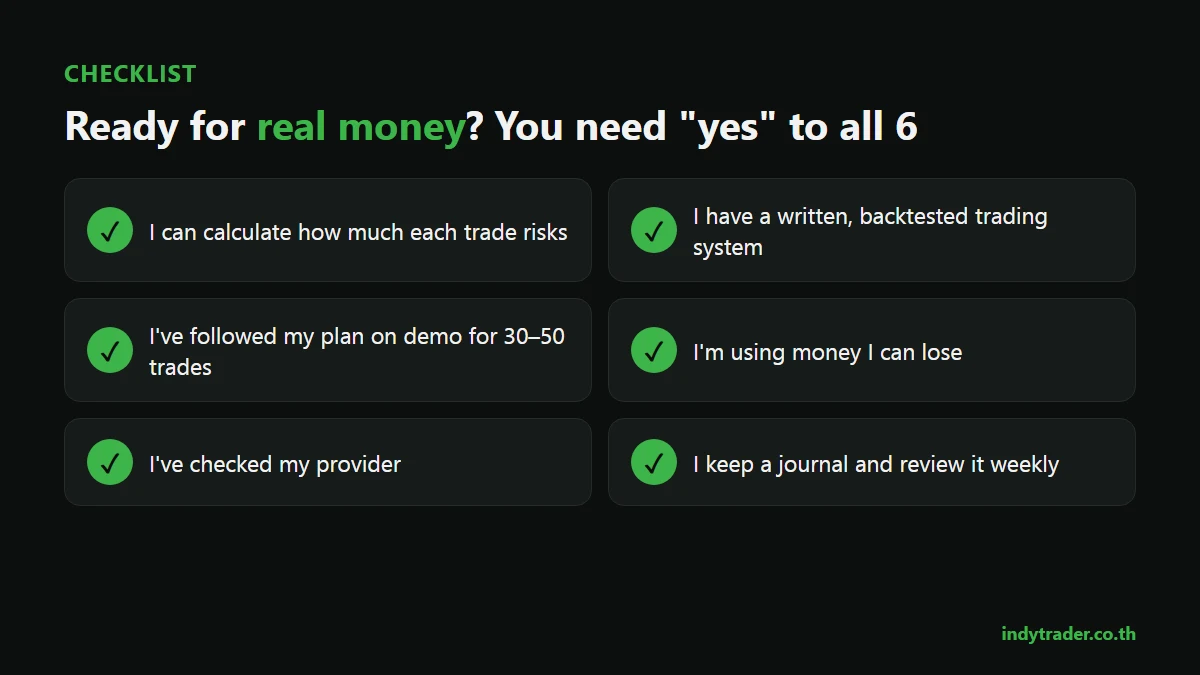
Can you answer "yes" to all of these?
I can calculate how much each trade risks
I have a written trading system that has been backtested
I've followed my plan on demo for at least 30–50 trades
I'm using money I can lose without affecting my life
I've checked the provider I'll use
I keep a trading journal and review it every week
If not all of them yet, that doesn't mean you aren't suited to trading. It means there's a step left to practise.
Summary
Anyone can start the path to becoming a forex trader, but it isn't a shortcut. The people who make it aren't the ones who profit fastest. They're the ones who learn in order, measure risk in numbers, choose providers carefully, and stay in the market long enough to keep improving.
Start your trading path with Indy Trader
If you want to start from zero in a structured way, Indy Trader's Road to Trader course is designed for beginners and taught by founder Coach Beer. It covers forex basics, trading mindset, key terms such as pips, lots, leverage and margin, the MT4 platform and the Indy System Trade method, with access to the Indy Trader community.
Frequently asked questions
Do I need a degree or licence to be a forex trader?
Not to trade your own account. To work as a dealer at a bank or financial institution, you usually need a finance degree and to be hired through their selection process.
How long does it take to learn forex trading?
You can understand the basics within weeks, but trading with a system usually takes 6–12 months, and consistent results usually take 1–2 years or more, depending on practice time and discipline.
How much money do I need to start forex trading?
You can start practising for free on a demo account. When you're ready for real money, use money you can afford to lose, and enough that you can risk 1–2% per trade at the smallest position size your provider allows.
Can I trade forex alongside a full-time job?
Yes, and most traders do. The market is busiest in the evening Thai time, and swing or position trading needs little screen time, so it suits people with jobs.
Is forex trading legal?
The key issue is the provider. The Thai SEC says forex providers need a Ministry of Finance licence, and the Bank of Thailand warns that unlicensed money-transfer services for forex trading are an offence. Check a provider's status before using it.
Do most forex traders really lose money?
ESMA data from 2018 found that 74–89% of retail CFD accounts lost money, mainly because of high leverage, no system and poor risk management, all of which can be learned.
Sources
Bank for International Settlements: Triennial Survey 2025 (30 Sep 2025)
ESMA: Product intervention measures on CFDs and binary options (27 Mar 2018)
Bank of Thailand: Warning on unlicensed FOREX service providers (15 Oct 2021)
By the Indy Trader team. Indy Trader is a forex and gold trading academy founded in 2012 by Coach Beer (Tithivat Huayhongtong).
Risk warning: Forex and gold trading carry a high level of risk and you may lose some or all of your capital. Figures in this article illustrate calculations only; they are not investment advice or expected returns. Past performance is not a guide to future results.
