
Short answer: Forex isn't a buy-and-hold investment like stocks or funds. There are no dividends and no company growth behind it. Returns come from forecasting price direction correctly more often than not, after costs. ESMA data found that 74–89% of retail CFD trading accounts lose money. Forex suits people willing to learn, who have a trading system and the discipline to control risk, and who use only money they can afford to lose entirely. It isn't a place for savings or retirement money.
"Investing in forex" is a common phrase, but in practice forex is trading, not investing in the same sense as buying shares or funds. The difference isn't just wording. It changes how you should think about returns, risk and how much money to use.
This article explains where forex returns come from, the kinds of risk involved, what the data shows, and how to decide whether forex suits you.
How forex differs from ordinary investing
Forex is the world's largest market. The Bank for International Settlements' 2025 Triennial Survey put average turnover at $9.6 trillion a day, up 28% from 2022. But the size of the market says nothing about whether small traders make money. (For the basics, see What is forex.)
Stocks / mutual funds | Forex | |
|---|---|---|
Returns come from | Company growth, dividends, interest | Correctly forecast currency moves, plus swap |
Grows on its own over time? | Tends to follow economic growth over the long run | No; currencies only rise or fall against each other |
Leverage | Usually none (except margin accounts) | Standard; losses can come fast |
Profit from falling prices? | Hard (needs short-selling tools) | Yes; selling is as easy as buying |
Trading hours | Exchange hours | 24 hours, Monday to Saturday morning (Thai time) |
Thai regulation | SEC and the Stock Exchange of Thailand | No Thai SEC licence for retail providers |
The second row matters most. Buy an index fund and hold it for 10 years, and a growing economy can lift its value. Hold EUR/USD for 10 years and nothing like that helps you. Every baht you make in forex has to come from making better decisions than other market participants, after costs.
Where forex returns come from
Price differences: buy a currency you expect to strengthen, or sell one you expect to weaken. Profit or loss equals the distance the price moves times your position size
Swap (interest differential): holding a position overnight may earn or cost you the interest-rate difference between the two currencies. For retail traders it's usually a cost rather than income once fees are included
What reduces returns on every trade are the spread, commission and negative swap. These costs are why random guessing loses money in the long run, even if you're right half the time.
The maths of profit: win rate isn't everything
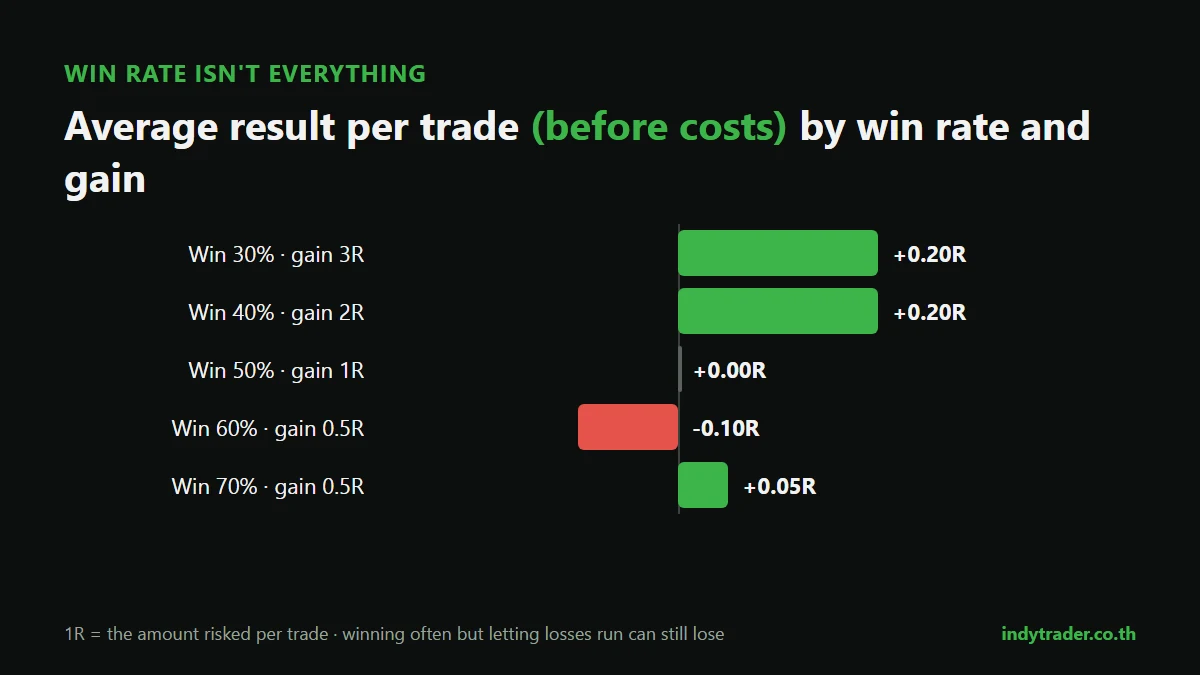
A common belief is that you need to win more than 50% of the time. In reality, results depend on win rate and reward-to-risk ratio together. This table shows the average result per trade in R (1R = the amount risked per trade), before costs:
Win rate | Gain when winning | Average per trade | What it means |
|---|---|---|---|
30% | 3R | +0.2R | Wins rarely but big; the system still has an edge |
40% | 2R | +0.2R | Loses more often than it wins, but profits over time |
50% | 1R | 0R | Breaks even before costs; after spread, it loses |
60% | 0.5R | −0.1R | Wins often but loses money, because losses are bigger than wins |
70% | 0.5R | +0.05R | Needs a very high win rate; a thin edge |
Example: risking 200 baht per trade, a system that wins 40% of the time with average wins of 2R makes about 40 × 400 − 60 × 200 = +4,000 baht over 100 trades, before costs. If the same system cuts winners early at 1R, it makes 40 × 200 − 60 × 200 = −4,000 baht.
That's why "investing in forex" without a tested system is no different from gambling. More in Is forex gambling?
The 6 risks of investing in forex
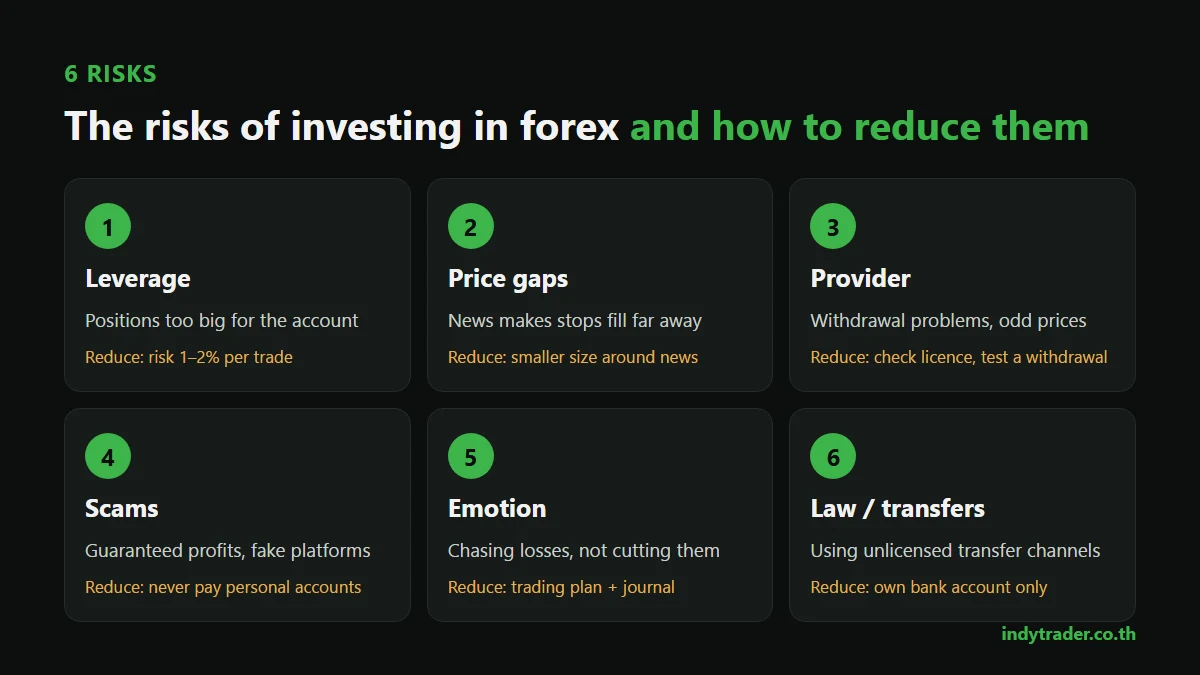
Risk | Caused by | Example | How to reduce it |
|---|---|---|---|
1. Leverage | Positions too large for the account | A 50-pip move wipes out most of the account | Low leverage, 1–2% risk per trade |
2. Price gaps | News or unexpected events | Stop-loss fills at a much worse price | Smaller positions around big news, no large positions over the weekend |
3. Provider (counterparty) | An unstable or dishonest provider | Can't withdraw, abnormal prices | Choose a provider regulated by a major authority, test withdrawals early |
4. Scams | Promises of guaranteed returns | Ponzi schemes, fake platforms | Never transfer to personal accounts, never trust guaranteed returns |
5. Emotion | Fear and greed | Raising lot size to win back losses, not cutting losses | A written trading plan and a journal of every trade |
6. Law and transfers | Using unlicensed money-transfer channels | Frozen accounts, legal liability | Deposit and withdraw only through your own bank account |
A real example of gap risk
On 15 January 2015, the Swiss National Bank scrapped its cap of 1.20 francs per euro without warning. The franc jumped almost 30% within minutes. Many traders' stop-losses were filled far from where they were set, some accounts went negative, and some providers went bust. That's why you should choose a provider with negative balance protection and never open positions too big for your account.
Common forex scams
Forex-related scams take many forms: Ponzi schemes that claim to trade your money, fake platforms that show profits but block withdrawals, and courses or systems sold with guaranteed returns.
Stop immediately if you see:
Guaranteed monthly percentage returns
Requests to transfer to a personal account, or to "let us trade for you"
Fees or "tax" you must pay before you can withdraw
Income that mainly comes from recruiting others
Contact through LINE or social media with no company you can verify
If you suspect a scam, call the Thai SEC hotline 1207, press 22.
The data: most retail traders lose money
In 2018, the European Securities and Markets Authority (ESMA) examined retail CFD accounts, including forex, and found that 74–89% lost money, with average losses per client of €1,600 to €29,000. ESMA then capped retail leverage at 30:1 for major currency pairs and 20:1 for gold.
What the data shows isn't that forex can't be profitable. It shows that the default outcome for people who come in unprepared is a loss. The causes found again and again are excessive leverage, no system, not cutting losses, and increasing position size to win money back (see What is leverage and Forex risk management).
Common ways to invest in forex, and what to watch
Approach | How it works | Advantage | Watch out for |
|---|---|---|---|
Trading yourself | You analyse and decide | Full control, builds long-term skill | Takes time to learn and practise |
Trading signals | You follow someone else's entry and exit points | Saves analysis time | You still need to understand the reasoning and control risk; see What are forex signals |
Copy trading | Your account copies another trader's orders automatically | No need to watch the screen | Past results don't guarantee the future; check drawdown first; see What is copy trading |
EA / trading robots | Software opens and closes trades by rules | No emotion, runs all the time | Poorly tested systems break when the market changes; see What is a forex robot |
Letting someone else manage your money | Transfer funds or give your login to someone | — | The highest risk; unlicensed money management is a common scam |
Whichever you choose, the person carrying the risk is the owner of the money, so understanding basic risk management matters even if you don't trade yourself.
How much of your finances should forex be?
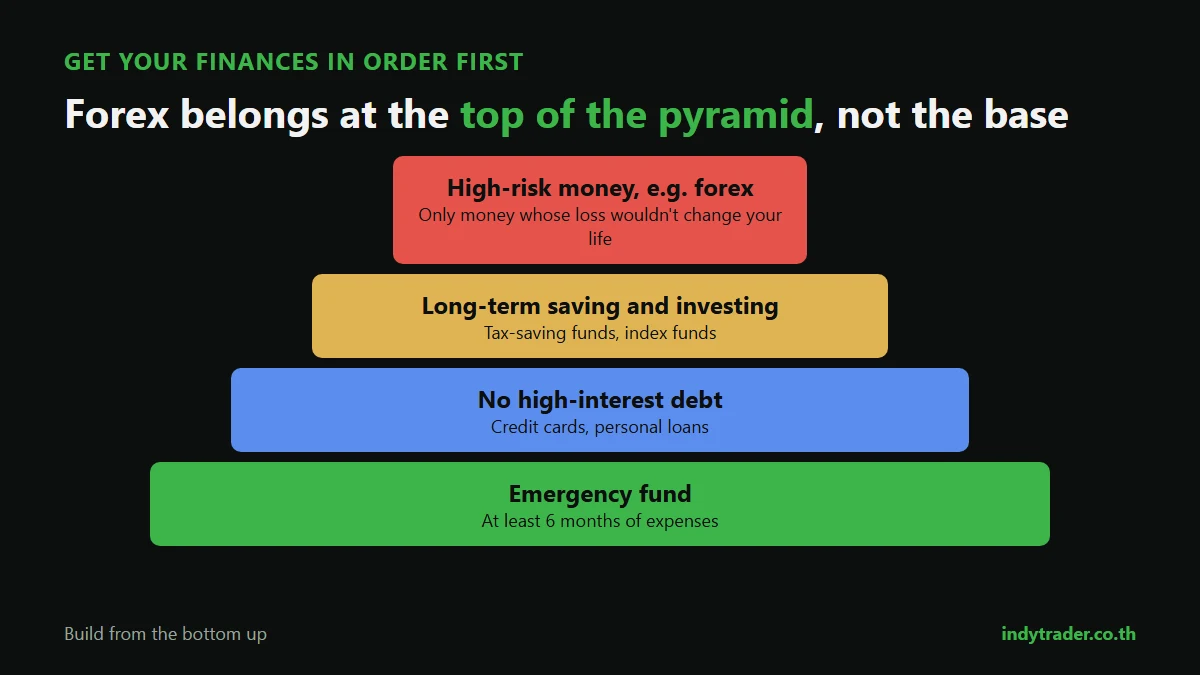
Forex belongs in the "high-risk money" part of your finances, after the basics are covered. The usual order:
Emergency fund: at least 6 months of expenses, in an account you can access immediately
No high-interest debt: such as credit cards or personal loans
Long-term saving and investing: such as tax-saving funds and index funds
High-risk money such as forex: only money whose loss wouldn't change your life
There's no right percentage for everyone, but if forex losses cost you sleep or affect your monthly bills, you're using too much. For the capital needed to trade systematically, see How much money do you need to start forex trading.
Law and tax
Licensing: The Thai SEC says forex trading is not a securities business it licenses, so retail forex providers are overseas companies
Transfers: The Bank of Thailand warns that using unlicensed money-transfer services to trade forex may be an offence
Tax: Under Revenue Department order Por. 161/2566, people resident 180 days or more in a tax year must include foreign income earned from 2024 onward when it is brought into the country
Who forex suits
Suits | Doesn't suit |
|---|---|
People ready to learn for months before expecting results | People who need a fixed monthly income |
People with money they can lose entirely | People using savings, retirement money or loans |
People who follow rules even while losing | People who decide on emotion or chase losses |
People who see trading as a skill to build | People looking to get rich quick |
If you're mostly in the left column, the next step is building skill step by step: read How to become a forex trader and How to make sustainable profits from forex.
Checklist before investing in forex
I have an emergency fund, and the money I'll use is money I can lose
I understand pips, lots, leverage, margin and spread
I have a written trading system that I've tested on demo
I've set a risk rule of no more than 1–2% per trade
I've checked the provider and tested a withdrawal
I deposit and withdraw only through my own bank account
I keep records of deposits and withdrawals for tax
Summary
Forex returns come from forecasting prices better than others after costs, not from holding and waiting for value to grow. The data shows most retail traders lose money, mainly because of high leverage and no system. Those who last treat trading as a skill, use a system with a mathematical edge, control risk on every trade, and use only money they can afford to lose.
Learn to trade forex systematically with Indy Trader
Indy Trader has taught forex and gold trading since 2012. The Road to Trader course for beginners, taught by founder Coach Beer, covers what forex is, trading mindset, key terms such as pips, lots, leverage and margin, and basic trading principles, so you decide with understanding, not hope.
Frequently asked questions
Is forex a good investment?
Forex lets you profit from both rising and falling prices and trade almost 24 hours a day, but leverage makes it high risk. ESMA found 74–89% of retail accounts lose money, so it only suits people ready to learn and using money they can lose.
What monthly return can forex give?
There's no fixed figure. Returns depend on the system, discipline and risk taken, and can be positive or negative in any month. Anyone guaranteeing a monthly percentage return is a scam warning sign.
Is forex trading legal?
Trading isn't banned for individuals, but the Thai SEC doesn't license retail forex providers, and the Bank of Thailand warns that transferring money through unlicensed channels to trade forex may be an offence.
How is forex different from investing in stocks?
Stocks get value from company growth and dividends and can be held long term. Forex is trading currency price differences, with no value growth over time, and usually uses leverage, so losses can come faster.
Can I invest in forex without trading myself?
Yes, through copy trading, signals or an EA, but the risk is still yours. Check track records and drawdown, and never transfer money for someone else to manage.
Sources
Bank for International Settlements: Triennial Survey 2025 (30 Sep 2025)
ESMA: Product intervention measures on CFDs and binary options (27 Mar 2018)
Bank of Thailand: Warning on unlicensed FOREX service providers (15 Oct 2021)
By the Indy Trader team. Indy Trader is a forex and gold trading academy founded in 2012 by Coach Beer (Tithivat Huayhongtong).
Risk warning: Forex and gold trading carry a high level of risk and you may lose some or all of your capital. Figures in this article are illustrative calculations only, not investment advice or expected returns. This article is general information, not tax or legal advice.
