
Short answer: A monthly forex signal service is only worth it if your net profit from the signals is bigger than the subscription, and that depends more on your capital than on signal quality. Pay 1,500 baht a month with a 30,000-baht account and you need 5% every month just to break even, which is unrealistic for risk-controlled trading. Good signals have a verifiable track record, a stop-loss every time, arrive when you can act on them, and explain the reasoning behind each trade instead of just telling you to click.
There are hundreds of forex and gold signal groups on LINE and Telegram, from free to several thousand baht a month. Many post "+500 pips" profit screenshots every week, yet plenty of subscribers lose money. So the question isn't only whether the signals are accurate, but whether they're worth your money and time.
If you're not sure what a complete signal contains, read What are forex signals first. This article focuses on the money decision.
Working out the break-even of a monthly signal service
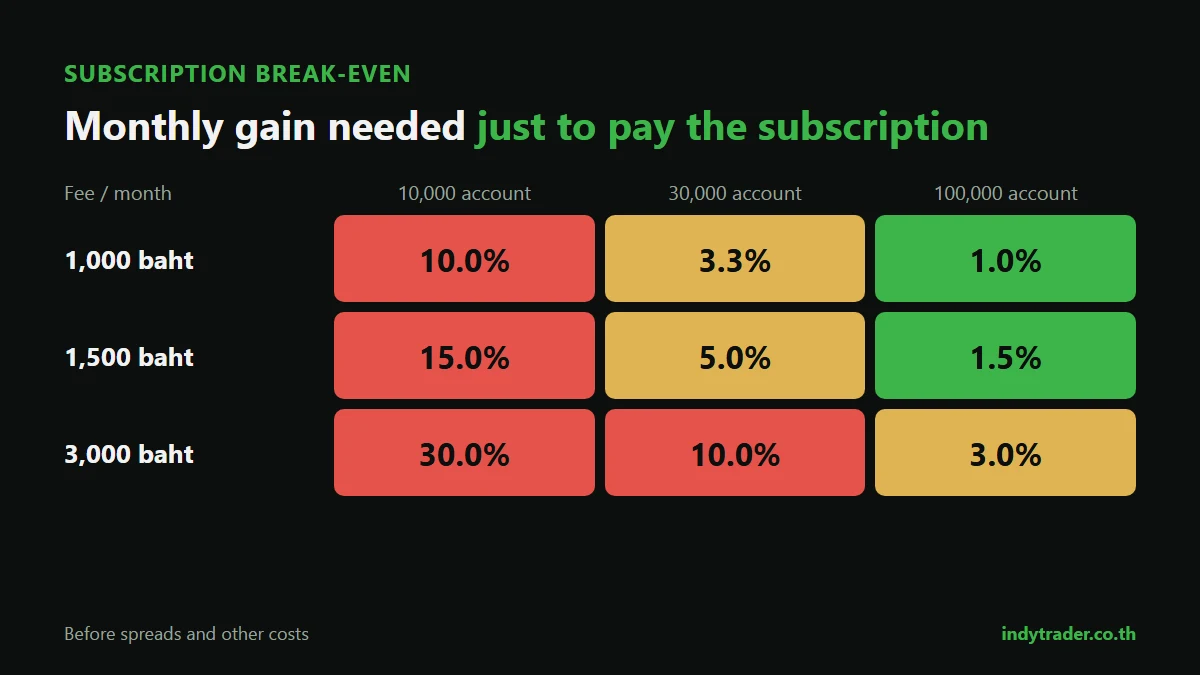
The subscription is a fixed cost whether the month is profitable or not. This table shows how much your account must grow each month just to pay for it (before spreads and other fees):
Subscription / month | 10,000-baht account | 30,000-baht account | 100,000-baht account |
|---|---|---|---|
1,000 baht | 10% | 3.3% | 1% |
1,500 baht | 15% | 5% | 1.5% |
3,000 baht | 30% | 10% | 3% |
If you risk no more than 1% per trade, making 5% a month consistently is very hard. Making 15% a month means taking so much risk that the account can easily blow up. Conclusion: for small accounts, expensive paid signals almost never add up mathematically, and they push subscribers to raise their lot size "to earn the fee back", which is where big losses start (see suitable capital in How much money do you need to start forex trading).
For small accounts, the better spend is usually on learning the reasoning behind signals, which builds a skill you keep using.
Why "+500 pips" statistics mislead
Pips don't show risk
500 pips of profit sounds a lot. But if the same month lost 450 pips on wide stop-losses, or some trades had no stop-loss at all, the number tells you nothing. What matters is profit relative to the risk taken.
Gold pips aren't counted the same way
Some providers count a $0.10 move in gold as 1 pip, so a $50 move becomes "500 pips". At 0.01 lot, a $50 gold move is a $50 profit or loss, so a big-looking number may be little real money (see What is a pip).
Screenshots are selective
Groups that post only winners, leave out losers or edit messages afterwards make their statistics look better than reality. Verifiable signals have timestamps that can't be edited and a record of every trade, including losers.
Read signal results in R, not pips
R is the amount risked per trade (the distance from entry to stop-loss). It lets you compare signals across markets and styles.
Signal | Entry | Stop-loss | Closed at | Result (R) |
|---|---|---|---|---|
EUR/USD buy | 1.0820 | 1.0795 (25 pips) | 1.0870 | +2R |
XAUUSD sell | 4,050 | 4,056 ($6) | 4,056 | −1R |
GBP/USD sell | 1.2700 | 1.2730 (30 pips) | 1.2655 | +1.5R |
XAUUSD buy | 4,030 | 4,024 ($6) | 4,024 | −1R |
The 4 trades total +1.5R. If you risk 300 baht per trade, that's 450 baht before costs. This turns a provider's statistics into real money in your own account, and shows immediately whether the subscription is worth it.
Before subscribing, ask the provider for: signals per month, win rate, average result per trade in R, the longest losing streak, and how long the track record runs.
Example: provider statistics vs your real account
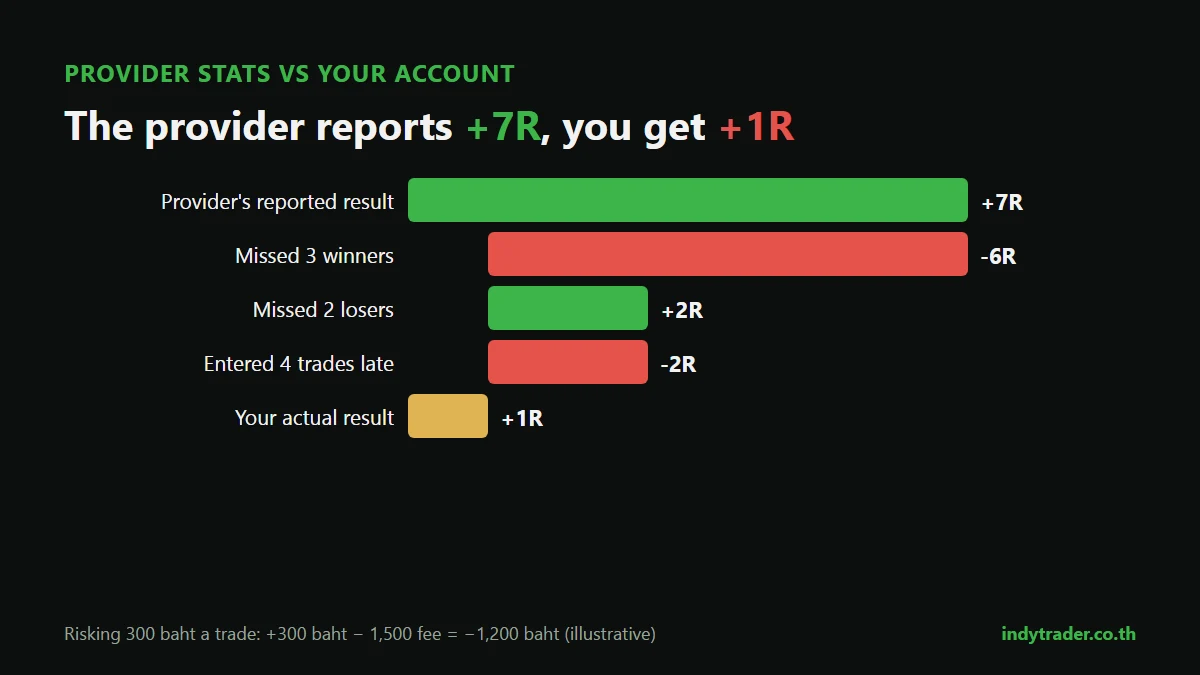
Say a provider reports 20 signals this month: 9 winners and 11 losers, with winners averaging +2R, for a total of +7R (illustrative figures).
But you have a day job, and this is what actually happened:
You missed 5 signals sent during meetings or while you slept, including 3 winners (+6R) and 2 losers (−2R)
You entered 4 trades late, after price had moved, losing about 0.5R on each, −2R in total
Your real result: +7R − 6R + 2R − 2R = +1R
Risking 300 baht per trade, you made about 300 baht. With a 1,500-baht subscription, you lost 1,200 baht net in a month the provider reported as good.
This doesn't mean signals are bad. It means your result depends on how many trades you can follow and how promptly. Before subscribing, check when signals usually arrive against your daily schedule, and always record your own results separately from the provider's.
8 ways to choose forex signals you can verify
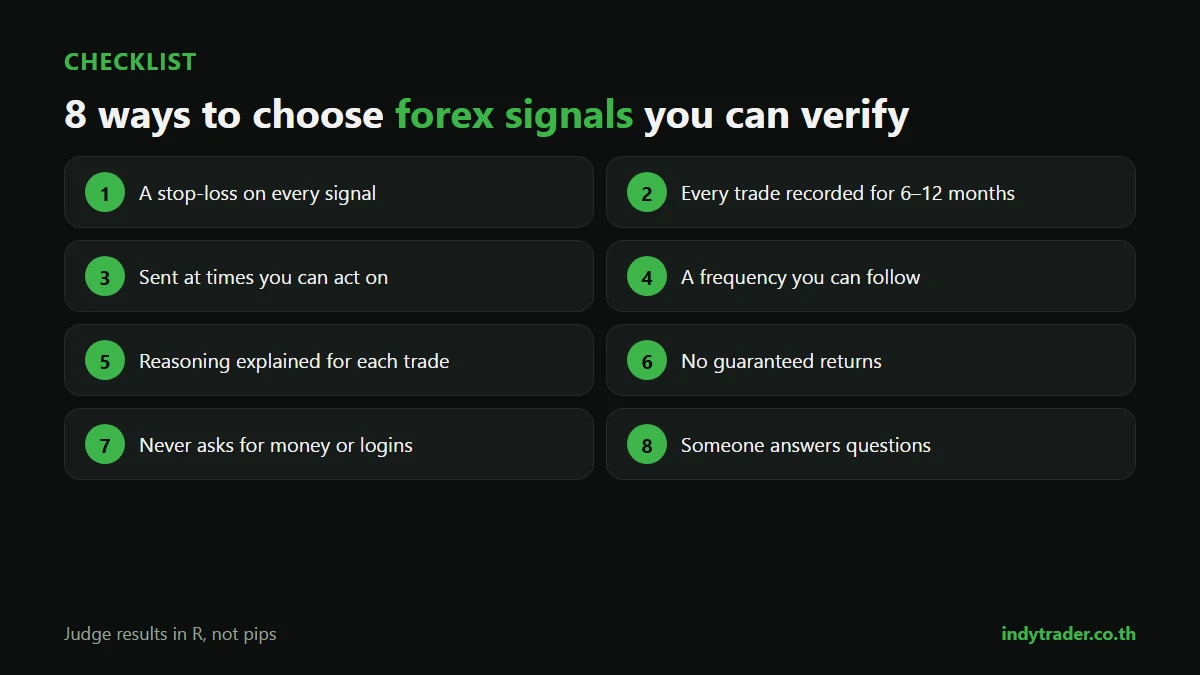
A stop-loss on every signal: a signal without one hands all the risk to you
Every trade recorded for at least 6–12 months, including losers, with verifiable timestamps
Sent at times you can act on: if most signals arrive at 20:00–23:00 but you're only free in the morning, you'll miss them or enter late (see Forex market hours)
A sensible frequency: dozens of signals a day can't be followed, and spreads eat the profit
The reasoning is explained, such as the trend, support and resistance or pattern used, so you learn and can judge when a signal conflicts with the market
No guaranteed returns: guaranteed monthly profit is a red flag
Never asks for money or your login: a signal service doesn't need to hold your funds or access your trading account
Someone answers questions, for example explaining why a signal was closed early or what to do around big news
Free vs paid signals
Free signals | Paid monthly signals | |
|---|---|---|
Cost | No subscription | A fixed fee every month |
Why it's offered | To attract people to other services, courses or brokers | Subscriptions are the main income |
What to check | How the provider earns money, and whether there's pressure to deposit or trade bigger | Break-even against your capital, and a verifiable track record |
Suits | Beginners who want to learn from the reasoning behind signals | Accounts large enough that the fee is a small share |
Free or paid, the key question is the same: how does the provider make money? If income depends on how much you trade, there may be an incentive to send more signals than necessary.
Using signals safely
Calculate your own lot size every time, from the signal's stop-loss distance and a risk of no more than 1–2% of your account, not the size the group suggests (see Lot size)
If you're late, skip the trade: if price has moved far from the entry, the reward-to-risk gets worse
Record your own results and compare them with the provider's
Set a trial period, for example 2–3 months on demo or at the smallest size, and decide from the numbers
Don't take more risk to earn back the fee: if you'd have to break your risk rule to make the subscription pay, the service doesn't suit your capital yet
If you don't want to place trades yourself at all, copy trading is another option with different pros and cons, covered in Can copy trading really make money.
Warning about scam signal groups
The US regulator CFTC warned in 2024 that scammers use trade-signal services and trading bots, promising unrealistic returns. A common pattern is a free signal group that gradually pushes members to deposit with a recommended platform that won't let them withdraw, or to keep "upgrading" to more expensive packages. If you suspect a scam, call the Thai SEC hotline 1207, press 22.
Indy Trader's VIP Signal
Indy Trader's VIP Signal provides forex, gold and other signals from the coaching team, analysed with the Indy System Trade method. Each signal includes entry, exit and a risk plan, and coaches and a community of more than 2,500 traders explain the reasoning behind each trade, so members gain both signals and skills they can use on their own.
Summary
Monthly forex signals are worth it when your net profit exceeds the subscription, which is very hard with a small account. Work out the break-even before subscribing, read results in R instead of pips, and choose providers who give a stop-loss on every trade, record every trade, and send signals when you can act on them. Then control risk by sizing your own lots every time.
Learn to read signals yourself
The Road to Trader course for beginners, taught by founder Coach Beer, covers forex basics, trading mindset, key terms such as pips, lots, leverage and margin, the MT4 platform and the Indy System Trade method, with access to the Indy Trader community.
Frequently asked questions
Are monthly forex signals worth it?
Only if your net profit from the signals beats the subscription. With a small account, the fee is a large share: 1,500 baht on a 30,000-baht account means 5% a month just to break even. Do the maths before subscribing.
How do I choose accurate forex signals?
Look for every trade recorded with verifiable timestamps over at least 6–12 months, a stop-loss on every signal, results in R rather than just pips, and signals sent when you can follow them.
Can I trust free signals?
Some providers offer free signals to teach or to introduce other services, which is fine, but check how they make money and beware of groups that push you to deposit on unverifiable platforms.
What lot size should I use with signals?
Work it out yourself from the signal's stop-loss distance so you risk no more than 1–2% of your account per trade. Don't use the size the group suggests, because everyone's capital is different.
How are gold signals different from currency signals?
The principles are the same, but gold moves further, so stop-losses are wider and you need more capital to control risk per trade. Also check how the provider counts gold pips, as conventions differ.
Sources
CFTC: Customer Advisory: AI Won't Turn Trading Bots into Money Machines (25 Jan 2024)
ESMA: Product intervention measures on CFDs and binary options (27 Mar 2018)
By the Indy Trader team. Indy Trader is a forex and gold trading academy founded in 2012 by Coach Beer (Tithivat Huayhongtong).
Risk warning: Forex and gold trading carry a high level of risk and you may lose some or all of your capital. Subscription prices and figures in this article are illustrative only. Past performance is not a guide to future results.
