
Short answer: No format is best for everyone. Group classes and online courses are best for building the foundations, because they're good value and well structured. 1-on-1 coaching pays off most once you have your own trading journal, because a coach can pinpoint your personal mistakes. What makes any format worth it is how much real practice and feedback you get, not the format itself. And if a teacher guarantees profit or income, walk away.
People deciding to learn forex trading usually face the same question: pay extra for private sessions with a coach, join a group class, or watch an online course at home? The answer depends on where you are in your learning, how much time you have, and how you learn best.
This article compares the 3 formats, explains which stage each suits, and gives you questions to ask before paying any academy.
How the 3 ways of learning differ
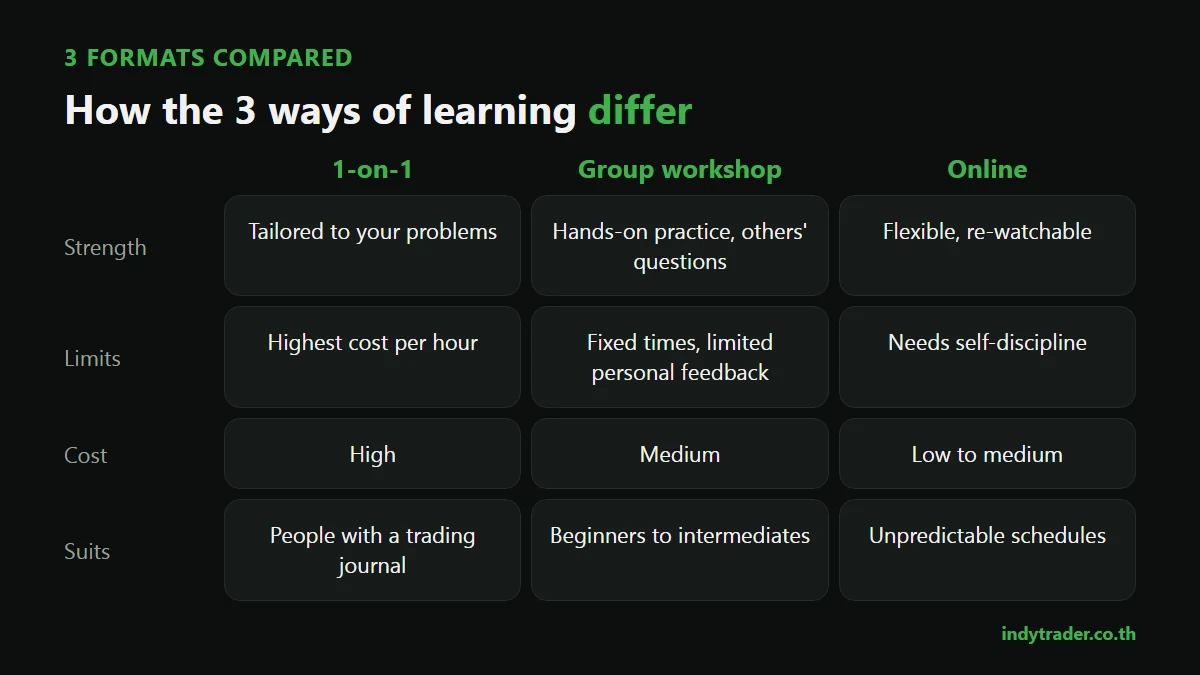
1-on-1 coaching | Workshop / group class | Online course | |
|---|---|---|---|
Format | One coach, one learner | Live with other learners, in a room or online | Recorded videos or live online classes |
Strength | Content tailored directly to your problems | Hands-on practice with a coach; you see others' questions and mistakes | Flexible, re-watchable, at your own pace |
Limits | Highest cost per hour | Fixed times; limited personal feedback | Needs self-discipline; without a way to ask, you get stuck alone |
Relative cost | High | Medium | Low to medium |
Suits | People with a trading journal who know their problems | Beginners to intermediates who want to practise with a coach | People with unpredictable schedules, or who want to review |
1-on-1 coaching: when it's worth it, and when it isn't
Worth it when
You already have dozens of trades in your journal. The coach can see your patterns of mistakes from real data, such as closing winners too early or losing at the same time of day
You're stuck on a personal problem, for example you follow your plan on demo but not with real money
You need a personal plan, such as a style that fits your working hours or capital
Not worth it when
You don't know the basics yet. Paying by the hour to learn about pips and lots is expensive when group or online courses teach it for less
You haven't practised yet. The coach has no trading data to analyse, so most of the time goes on theory
A simple rule: use 1-on-1 coaching to "solve your problems", not to "learn what everyone needs to know".
Workshops and group classes: real practice at an accessible price
An often-overlooked benefit of group learning is learning from other people's mistakes. Classmates' questions are often ones you didn't know you needed to ask, and analysing live charts with a coach helps you understand faster than reading alone.
What to look for in a workshop:
Hands-on practice, not just lectures
Not too many learners per coach, with time for Q&A
A way to review or ask questions after the class ends
Online courses: flexible, but you need discipline
Online courses suit people with unpredictable schedules or who want to re-watch material. The common problems are not finishing and watching without doing. If you choose online learning, pick a course with a way to ask the coach, regular live sessions, or a learner community, so you're not stuck on your own.
What works well is a mix: live classes to practise with a coach, then recordings to review afterwards.
Which format at each stage
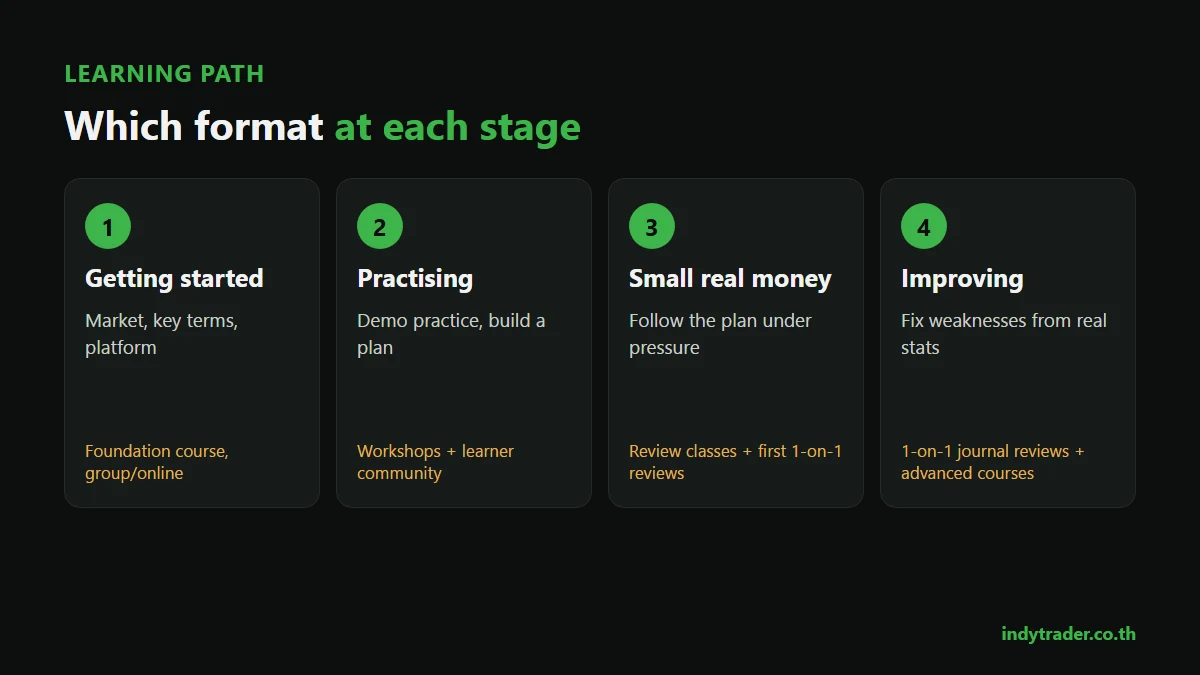
Stage | Goal | Suitable format |
|---|---|---|
1. Getting started | Understand the market, key terms and the platform | A foundation course, group or online |
2. Practising | Practise on demo, build a trading plan | Workshops with hands-on practice, plus a learner community |
3. Small real money | Follow your plan under real pressure | Review classes, and start using 1-on-1 reviews |
4. Improving | Fix personal weaknesses from real statistics | 1-on-1 journal reviews and advanced courses |
For an overview of each stage, read How to become a forex trader, and for demo practice see Forex demo accounts.
Getting the most out of a 1-on-1 session
Bring your trading journal: at least 20–30 trades with your reasons for entry and the results
Write down your 3 most important questions, such as "why do I lose so often around news?", rather than broad ones
Open the charts of your mistakes: a coach spots problems faster from the chart than from a description
Ask for a measurable action plan, such as "take 20 more trades using a pre-trade checklist, then review the results" (use a pre-trade checklist)
Book a follow-up: one review helps, but follow-up shows whether the fix actually worked
8 questions to ask before paying for a course
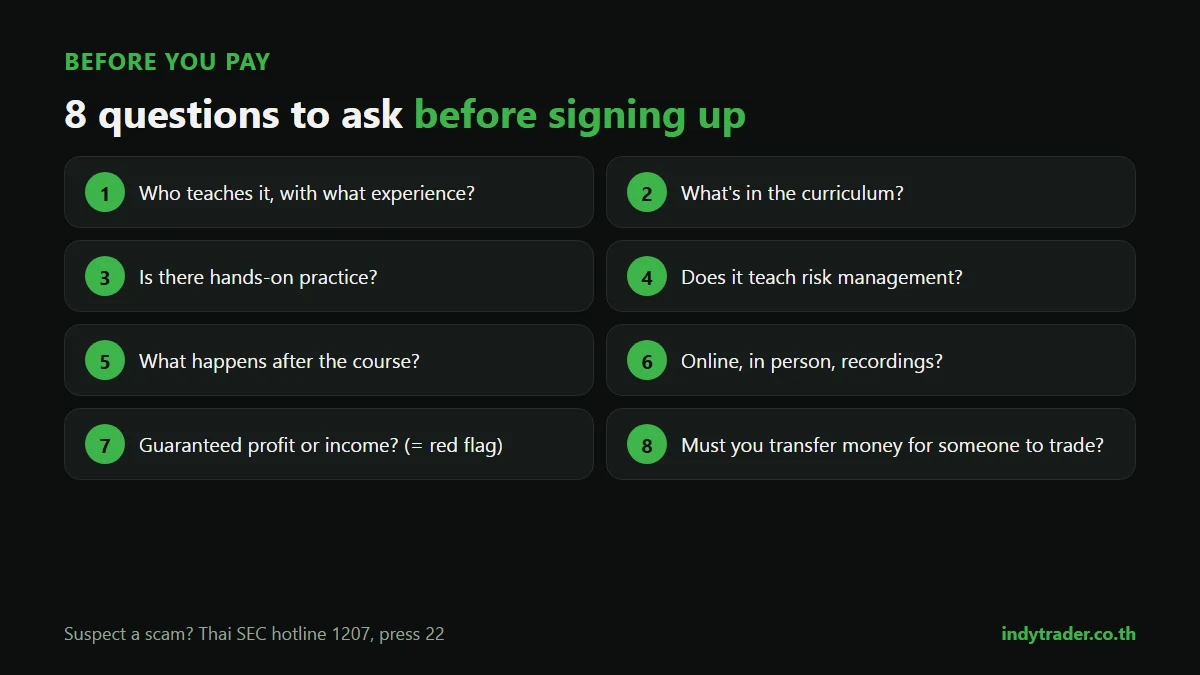
Who teaches it, and how much market and teaching experience do they have?
What's in the curriculum? Ask to see the details before signing up
Is there hands-on practice, or only lectures?
Does it teach risk management? A course that doesn't mention risk is a warning sign
What happens after the course? Such as reviews, repeat classes or a learner community
Online, in person, or both? And can you watch recordings?
Does it guarantee profit or income? If so, treat it as a red flag
Does it require you to open an account or transfer money for someone to trade for you? Course fees should be course fees, not tied to depositing investment money
Red flags in trading courses
Guaranteed monthly income after you finish
Only profit screenshots, no content about risk
Pressure to decide immediately ("this price today only")
Income mainly from recruiting others
Asking you to transfer money to a personal account to "invest while you learn"
If you suspect a scam, call the Thai SEC hotline 1207, press 22.
How you can learn at Indy Trader
Indy Trader offers several formats for different stages. See them all on the courses page.
Foundation: Road to Trader, taught by Coach Beer, covers forex basics, key terms, the MT4 platform and the Indy System Trade method, with access to the trader community
3-hour workshops: such as the Short-Term Trading Workshop, available online and onsite, with a team of coaches guiding the session
2-day courses: Setup Sniper and Advance Sniper, online or onsite in Bangkok, with practical exercises and Q&A with the coach; both include a free 1-hour private coaching session with Coach Beer
Courses with live sessions and replays: such as Turn Pro, with live coaching and unlimited online replay
Students can also join the VIP Signal group and the trader community to keep practising after class.
Summary
Learn the foundations in a group or online course for good value, practise with a coach in workshops, and save 1-on-1 coaching for when you have a trading journal and know your own problems. Whatever you choose, look for real practice, risk management and support after the course, and avoid courses that guarantee profit (see the principles of controlling risk in Forex risk management).
Frequently asked questions
Is 1-on-1 forex coaching worth it?
It's worth it once you have the basics and your own trading journal, because a coach can fix your specific problems directly. If you don't know the basics yet, a group or online course is better value.
Which format should a beginner start with?
Start with a structured foundation course, group or online, then practise on a demo account, then join a workshop with hands-on practice alongside a coach.
Is online learning as effective as in-person?
It can be, if there are live sessions, a way to ask the coach, and you actually practise. In-person lets you practise alongside the coach and classmates; online is more flexible and re-watchable.
How should I prepare for a 1-on-1 session?
Bring a trading journal of at least 20–30 trades, the charts of your mistakes, and your 3 most important questions, so the time goes on solving your problems.
How do I choose a trading course without getting scammed?
Check the teacher's background, the curriculum, the practical component and the risk management content. Avoid courses that guarantee profit or income, or ask you to transfer money for someone else to trade.
By the Indy Trader team. Indy Trader is a forex and gold trading academy founded in 2012 by Coach Beer (Tithivat Huayhongtong).
Risk warning: Forex and gold trading carry a high level of risk and you may lose some or all of your capital. Education does not guarantee profit. This article is not investment advice.
