
Short answer: A demo account is a trading account that uses simulated money with real market prices. It's free, and you can open one with a provider that supports MT4/MT5 or use paper trading on TradingView. To make practice count, set the demo balance to the capital you actually plan to use, trade by a written plan, and log every trade, for at least 30–50 trades before deciding to use real money.
A demo account is the best and cheapest place for beginners to practise, but most people use it wrongly. They open it with a million in play money, trade big lots because nothing is at stake, decide they "know how to trade", then move to a live account and lose faster than expected.
This article covers how to open a demo account, how to set it up realistically, a 30-day practice plan, and the criteria for deciding whether you're ready for real money.
What a demo account is, and how it differs from a live account
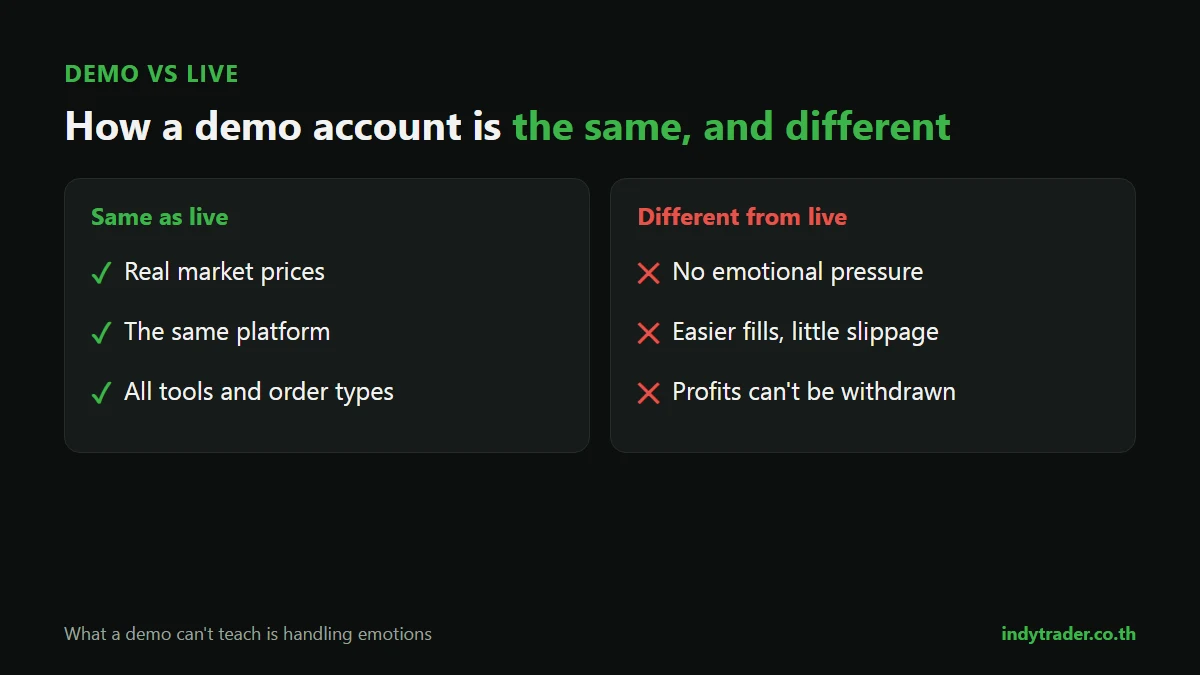
A demo account uses real market prices, the same platform and the same tools as a live account. The only difference is the money: profits can't be withdrawn, and losses cost you nothing.
Demo account | Live account | |
|---|---|---|
Money | Simulated, any balance you choose | Your own |
Prices and charts | Real market prices | Real market prices |
Fills | Usually at the price you see | Possible slippage, especially around news |
Spreads around news | May be narrower than reality, depending on the provider | Widen with market conditions |
Emotions | Almost no pressure | Fear, greed and hesitation are normal |
Account life | Some providers close inactive demo accounts | Open as long as you use it |
The most important difference is emotion. A demo teaches technical skills very well, but it can't teach you to handle fear when real money disappears. That's why a "small real money" stage should come after demo.
Where to open a demo account
Option | How to open | Best for |
|---|---|---|
A provider that supports MT4 / MT5 | Register for a demo on the provider's official website, or in MT4/MT5 via File → Open an Account | Practising in the same environment you'll trade live |
TradingView (paper trading) | Open a chart and choose Paper Trading in the trading panel | Practising analysis and placing orders on charts, no install needed |
MT4 / MT5 mobile apps | Choose to open a demo account in the app | Practising managing trades during the day |
A caution: download software only from official websites or the App Store / Google Play, and beware of anyone who offers to "open a demo for you" and then asks for personal details or money. A genuine demo account is free and never needs card details. (For how to use MT4, read What is MT4; to choose a platform, see MT4 vs MT5 or Forex trading apps.)
Setting up a demo account realistically
Set the demo balance to your real capital. If you'll start with 20,000 baht, set the demo to about $600, not $100,000, because lot sizes and how a loss feels are completely different (see suitable capital in How much money do you need to start forex trading)
Use the leverage you'll use live, not the maximum on offer
Use the same account type you'll open live, because spreads and commissions differ by account type
Trade at the times you'll trade live. If you work and will trade in the evening, practise in the evening
A 30-day demo practice plan
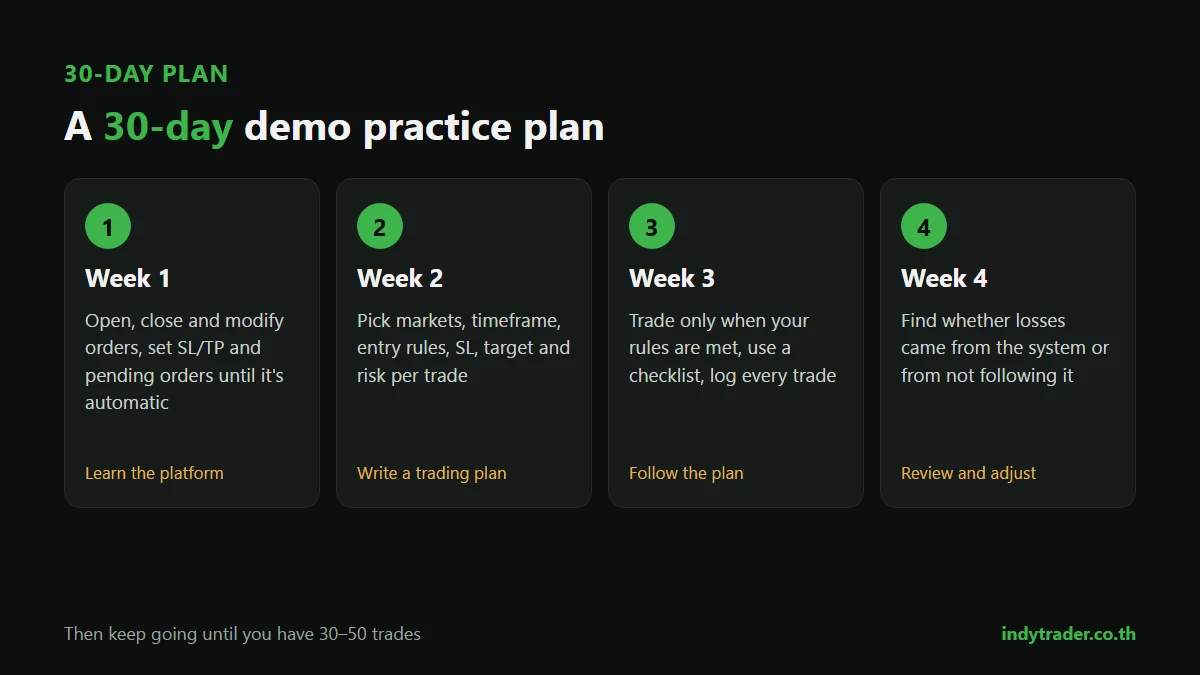
Week | Goal | What to do |
|---|---|---|
1 | Learn the platform | Open, close and modify orders, set stop-loss / take-profit and all 4 pending order types until it's automatic |
2 | Write a trading plan | Choose 1–2 markets, a timeframe, entry conditions, stop-loss, target and risk per trade (see Forex trading system) |
3 | Follow the plan | Trade only when your conditions are met, use a pre-trade checklist on every trade, and log every result |
4 | Review and adjust | Analyse your journal, find whether losses came from the system or from not following it, and change one thing at a time |
After 30 days, keep trading the demo until you have at least 30–50 trades before deciding on the next step. If your system trades rarely, add a backtest to get a larger sample.
What to log for every trade
Date, time, market and direction (buy/sell)
Why you entered, and which rule in your plan it matched
Entry, stop-loss, target, lot size and risk as a percentage
The result in R (profit or loss relative to the risk)
Whether you followed the plan fully, and if not, why
Criteria for knowing you're ready for real money
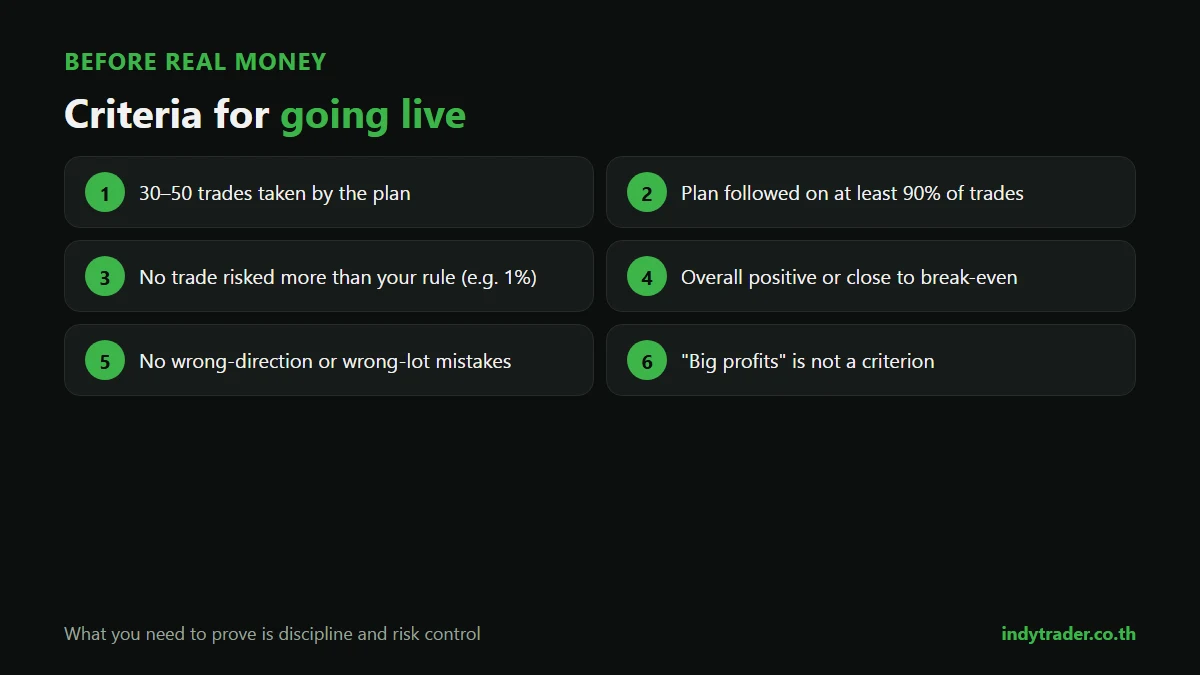
Criterion | Passed when |
|---|---|
Number of trades | At least 30–50 trades taken by the plan |
Discipline | The plan was followed on at least 90% of trades |
Risk | No trade risked more than your rule (e.g. 1% per trade) |
Results | Overall positive or close to break-even, and the largest drawdown is something you could accept with real money |
Fluency | No recent execution mistakes, such as the wrong direction or a mistyped lot size |
Notice that "made a lot of profit" isn't a criterion, because big demo profits are easy with big risk. What you need to prove is that you can follow your plan consistently while controlling risk.
From demo to live, in stages
Start with a small amount of real money and the smallest lot size. The aim is to follow the same plan under real pressure
Compare results with your demo. If they're much worse, the cause is usually emotional, such as closing winners early or moving stop-losses
Increase size only once you have statistics. After dozens of trades followed by the plan on a live account, increase gradually
Go back to demo whenever you change your system. Always test a new strategy there first
For the whole path from beginner to trader, read How to become a forex trader.
6 mistakes people make with demo accounts
Setting an unrealistic balance, which gets you used to big lots and numb to losses
Overtrading because nothing is at stake, a habit that follows you to live trading
Resetting the account after losses, so you never learn to handle a drawdown
Not logging results, so you never know whether the system works or you were lucky
Staying on demo too long. Some people practise for a year and never start; once you pass the criteria, start live with a small size
Expecting live results to match demo. Slippage, spreads and emotions usually make live results worse, so allow for the gap
Summary
A forex demo account is free and the best training ground for beginners. Set the balance and leverage to what you'll use live, follow the 30-day plan, log every trade, and move to real money when you pass the criteria on discipline and risk, not when profits look big. Then start small and control risk using risk management and lot sizing.
Practise with a coach instead of trial and error
The Road to Trader course for beginners, taught by founder Coach Beer, covers forex basics, trading mindset, key terms such as pips, lots, leverage and margin, the MT4 platform and the Indy System Trade method, with access to the Indy Trader community.
Frequently asked questions
Where can I practise forex trading for free?
Open a free demo account with a provider that supports MT4 or MT5, or use paper trading on TradingView. All use real market prices and simulated money, with no payment or card details needed.
How long should I practise on a demo account?
At least until you have 30–50 trades taken by your plan, which usually takes 1–3 months depending on how often your system trades. Passing the discipline and risk criteria matters more than the time.
How much should I put in a demo account?
The same as the real capital you plan to use. For example, if you'll start with 20,000 baht, set about $600, so lot sizes and how losses feel are close to reality.
Why do I make money on demo but lose on a live account?
Mainly emotions, such as closing winners early, moving stop-losses or increasing size to win back losses, plus slippage and wider spreads around news. That's why you should start live with a small size.
Do demo accounts expire?
Some providers close demo accounts that haven't been used for a while; the period varies. If yours expires, you can open a new one for free.
By the Indy Trader team. Indy Trader is a forex and gold trading academy founded in 2012 by Coach Beer (Tithivat Huayhongtong).
Risk warning: Forex and gold trading carry a high level of risk and you may lose some or all of your capital. Demo results don't guarantee live results. This article is not investment advice.
