
Short answer: A trustworthy forex broker holds a licence from a strict regulator that you can verify on the regulator's own website, and you also need to check which company in the broker's group actually holds your account, because many clients are onboarded through a subsidiary regulated differently from the parent. Check segregated client funds, negative balance protection and total costs; deposit and withdraw only through a bank account in your own name; test a small withdrawal in your first week; and avoid anyone who guarantees returns.
Choosing a broker means deciding who holds your money. The best trading system is useless if you can't withdraw. This matters even more because the Thai SEC doesn't license forex providers for retail investors, so people who trade forex use overseas brokers and have to do all the checking themselves.
This article doesn't recommend any broker. It gives you a 10-point checklist you can apply yourself.
Before you start: the legal position
The Thai SEC says forex trading isn't a securities business it licenses; no retail forex broker holds an SEC licence
The Bank of Thailand has warned that using unlicensed money-transfer services to fund forex trading may be an offence
If you want leveraged products under local regulation, the option is futures on TFEX through a licensed securities company
In practice, if you have a dispute with an overseas broker, it's handled under the rules of the country regulating your account, which can be difficult and slow. Choosing well from the start is what matters most (see the risks overview in Investing in forex: returns and risks).
10-point checklist for choosing a forex broker
1. A licence from a strict regulator
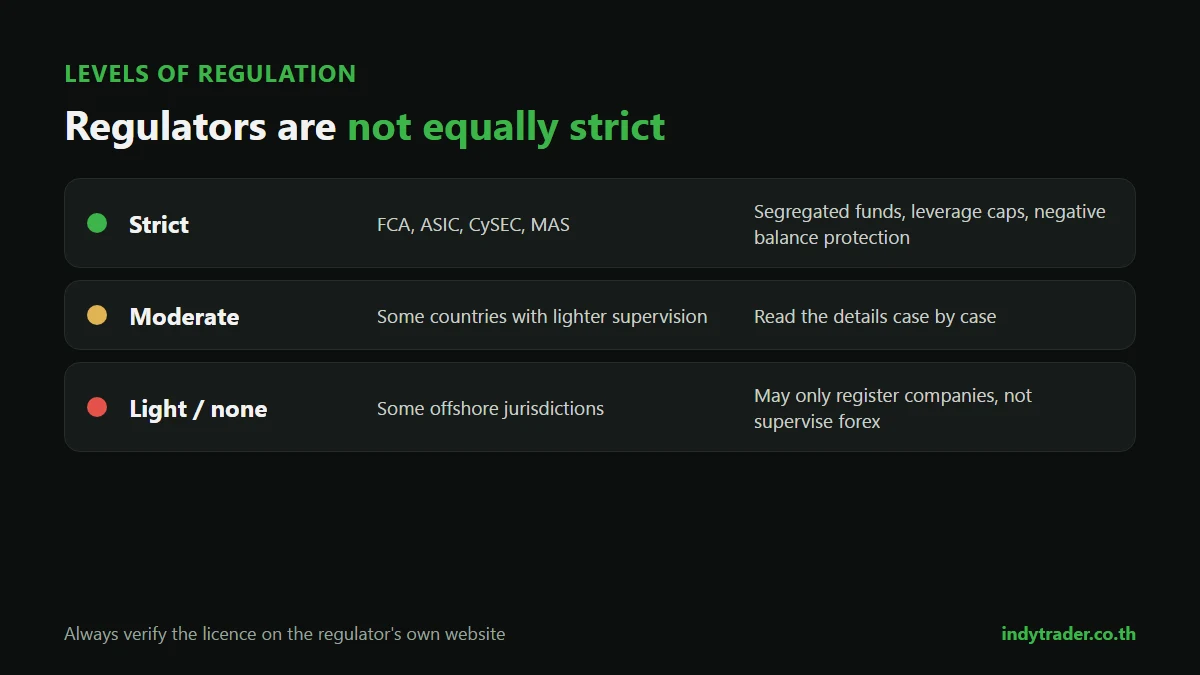
Regulatory standards vary enormously by country.
Level | Example regulators | What they usually require |
|---|---|---|
Strict | FCA (UK), ASIC (Australia), CySEC (Cyprus / EU standards), MAS (Singapore) | Segregated client money, leverage limits, negative balance protection, regular audits |
Moderate | Regulators in some countries with rules but lighter supervision | Varies; read the details |
Light or none for forex | Some offshore jurisdictions | May only register companies without supervising forex services |
An example worth knowing: the Financial Services Authority of St Vincent and the Grenadines (SVG FSA) states in its public notices that it doesn't license or supervise forex businesses. A broker "registered in SVG" therefore doesn't have a regulator supervising its forex services.
2. Verify the licence on the regulator's own website
Don't trust logos or licence numbers on the broker's site. Instead:
Note the full company name and licence number from the bottom of the broker's website
Go to the regulator's official website by typing the address yourself, not via a link from the broker
Search its register of authorised firms (such as the FCA Register or ASIC Professional Register)
Check that the company name, website and status match, and beware "clone" firms using names similar to real companies but different websites
3. Which company holds your account?
Many large brokers have subsidiaries in several countries. The strictly licensed company may only accept clients from its own country, while clients from elsewhere are often onboarded through another subsidiary registered abroad, with different regulatory standards.
How to check: read the client agreement or account confirmation to see which company is your counterparty, then check that company's licence, not the parent's.
4. Segregated client funds
Client money should be held in accounts separate from the company's own money (segregated accounts), so the company can't use it for operations and the risk is lower if the company gets into financial trouble. This should be stated in the broker's official documents.
5. Negative balance protection
Negative balance protection guarantees you can't lose more than the money in your account, even if prices gap so fast that positions can't be closed in time. Events like the Swiss central bank scrapping its currency cap in 2015 left many accounts negative. ESMA made this protection mandatory for retail clients in Europe from 2018.
6. Total cost, not just the spread
Cost | What it is |
|---|---|
Spread | The gap between buy and sell prices (see What is spread) |
Commission | Some accounts charge per lot in exchange for tighter spreads |
Swap | A charge for holding positions overnight |
Deposit, withdrawal and conversion fees | Exchange-rate margins when depositing and withdrawing in baht |
Inactivity fee | Some brokers charge if you don't trade for a while |
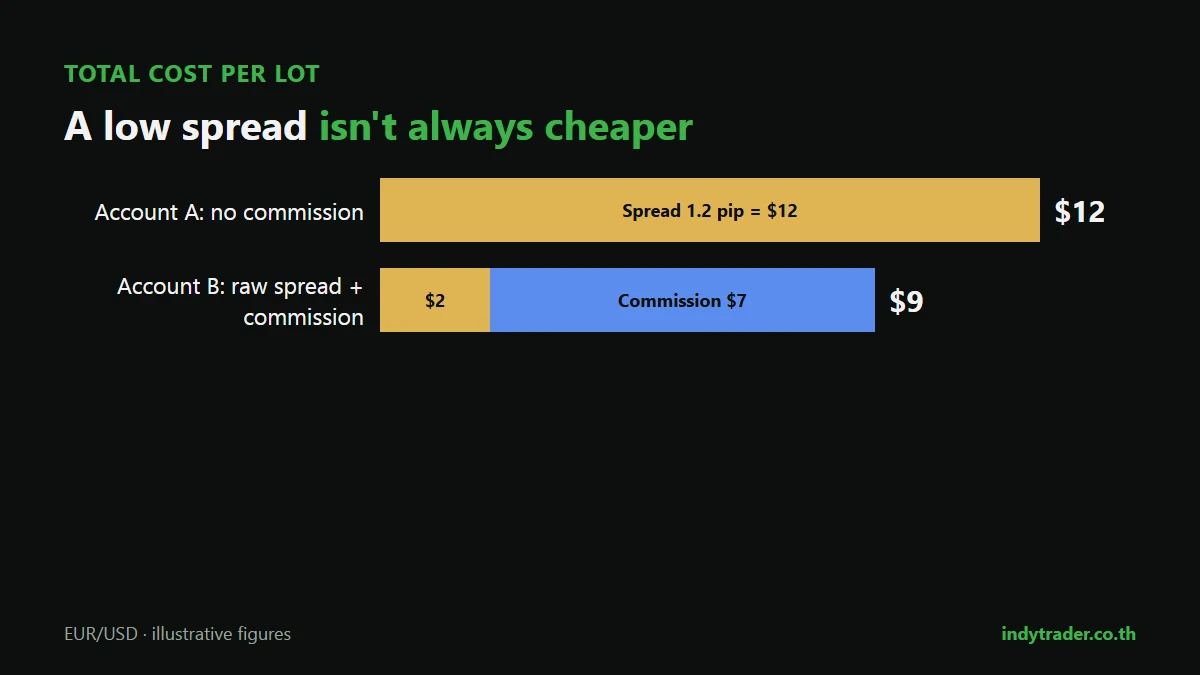
Comparison example: account A has no commission and an average EUR/USD spread of 1.2 pips; account B has a 0.2-pip spread plus $7 commission per lot round trip. Cost per lot: account A = $12, account B = $2 + $7 = $9. So the spread alone doesn't tell you which is cheaper (illustrative figures).
7. Sensible leverage
Brokers offering very high leverage, such as 1:1000 or more, aren't necessarily wrong, but it often signals lighter regulation. Strict European regulators cap retail leverage at 30:1 for major pairs and 20:1 for gold. Whatever a broker offers, use a level that fits your risk control (see Leverage and Margin).
8. Deposit and withdraw safely
Deposit and withdraw only through a bank account in your own name
Never transfer to a personal account or an "agent" offering to deposit for you, which may count as using an unlicensed money-transfer service
Check withdrawal times and fees before depositing
Keep records of every deposit and withdrawal, for disputes and for tax on foreign income
9. The platform and tools you need
Check it supports the platform you'll use, such as MT4 or MT5, any EA or copy trading service you're interested in, and a demo account for practice (see MT4 vs MT5, Forex trading apps and Forex demo accounts).
10. History, transparency and a test withdrawal
How long has it operated? Are company details, address and management verifiable?
Search news and warnings about the company name, in English and other languages
Make a small test withdrawal in your first week. A broker that makes even small withdrawals difficult or keeps delaying them is the clearest sign to stop
Red flags: walk away immediately
Guaranteed returns, or "you'll never lose"
Very large deposit bonuses with conditions to trade hundreds of lots before withdrawing
Being asked to transfer to a personal account, or an account not in the company's name
Having to pay "tax" or an "unlock fee" before withdrawing
Staff calling to push you to deposit more or use higher leverage
Requests for your trading account password or OTP codes
A licence you can't verify on the regulator's website
If you suspect a scam, call the Thai SEC hotline 1207, press 22.
Checklist summary
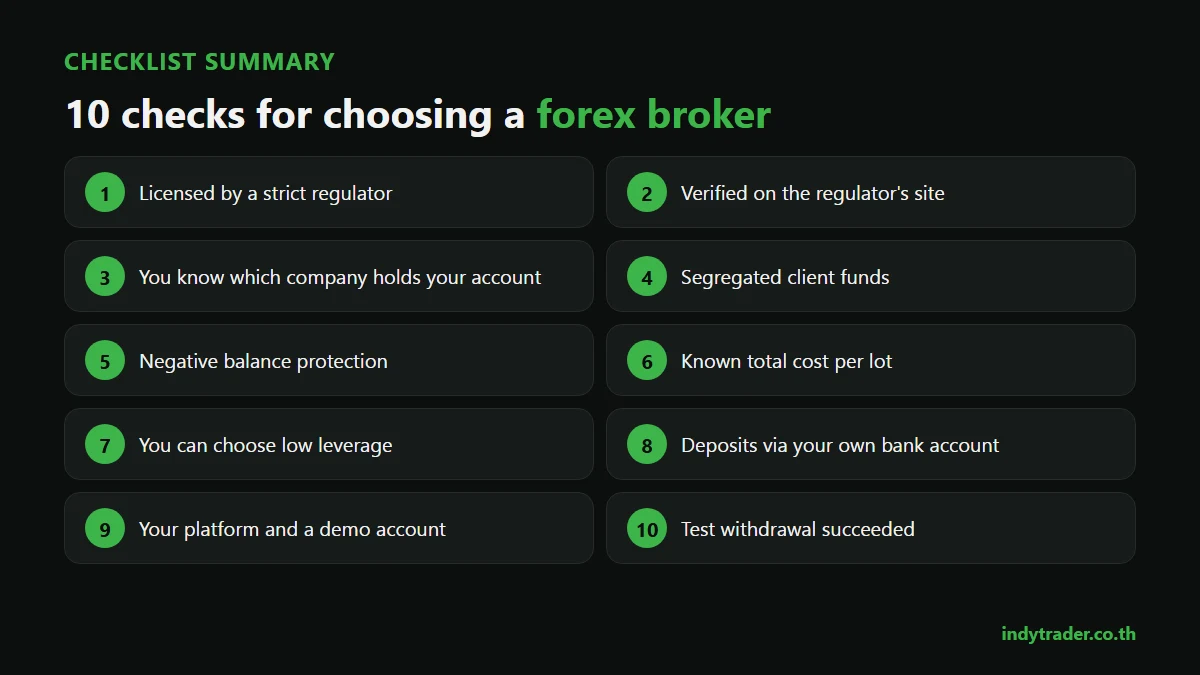
# | Question | Passes when |
|---|---|---|
1 | Licensed by a strict regulator? | Yes |
2 | Verified on the regulator's own website? | Name, website and status match |
3 | Which company holds your account? | You know it and its regulation |
4 | Segregated client funds? | Stated in official documents |
5 | Negative balance protection? | Yes |
6 | Total cost per lot? | Known and comparable |
7 | Sensible leverage? | You can choose a low level |
8 | Deposits/withdrawals via your own bank account? | Yes, no third parties |
9 | Your platform and a demo account? | Yes |
10 | Test withdrawal successful? | Received within the stated time |
Summary
No retail forex broker holds a Thai SEC licence, so choosing one is the trader's own responsibility. Verify the licence on the regulator's website, check which company holds your account, look for segregated funds and negative balance protection, compare total costs, deposit and withdraw through your own bank account, and test a withdrawal in your first week. Then start with suitable capital (see How much money do you need to start forex trading) and control risk on every trade with forex risk management.
Learn before you deposit
The Road to Trader course for beginners, taught by founder Coach Beer, covers forex basics, trading mindset, key terms such as pips, lots, leverage and margin, the MT4 platform and the Indy System Trade method, with access to the Indy Trader community.
Frequently asked questions
Are forex brokers legal?
The Thai SEC doesn't license forex brokers for retail clients, so traders use overseas brokers. Choose one licensed by a strict regulator, and deposit and withdraw only through a bank account in your own name.
How do I check a broker's licence?
Note the company name and licence number from the broker's website, then search the official register on the regulator's own website, typing the address yourself. Check that the company name, website and status match.
Can I trust offshore brokers?
They aren't necessarily scams, but regulation is usually much lighter, and some jurisdictions only register companies without supervising forex business. Check which company holds your account, and whether client funds are segregated and protected against negative balances.
Is the broker with the lowest spread the best?
Not necessarily. Look at the total cost, including spread, commission, swap and deposit/withdrawal fees, as well as trustworthiness. The cheapest broker isn't worth it if withdrawals are difficult.
Should I choose a broker that offers a bonus?
Be careful. Deposit bonuses often come with conditions to trade large volumes before withdrawing, and can encourage overtrading. Choose on trustworthiness and cost, not bonuses.
Sources
Bank of Thailand: Warning on unlicensed FOREX service providers (15 Oct 2021)
ESMA: Product intervention measures on CFDs and binary options (27 Mar 2018)
By the Indy Trader team. Indy Trader is a forex and gold trading academy founded in 2012 by Coach Beer (Tithivat Huayhongtong).
Risk warning: Forex and gold trading carry a high level of risk and you may lose some or all of your capital. This article is general information, not a recommendation or endorsement of any broker, and not legal or investment advice.
